Leaving a little something to the imagination
WE’RE looking at the full wide view of this new, stone house on Kenmare Bay and its architect, Danile Dusoswa is waxing lyrical about proportion.
“Windows are like the eyes of a beautiful woman — a house wouldn’t be half as nice with flat plastic panels — it would have no definition, no character.”
He is, he claims, an architect who designs contem-porary properties, but with classic proportions — beauty is symmetry and all that.
And the modern stuff isn’t secluded enough, he feels, and doesn’t fit into the landscape of his south-west Kerry hinterland half as much as his rooted stone buildings.
“A hundred years from now that’s what will last and that’s why we’re not trying to change it,” he asserts.
His signature stone design emphasises the point for him — a cut-stone, Gothicky lodge in a secluded location on the edge of Kenmare bay.
It’s one of those gorgeous holiday homes that’s occupied for part of the year, but whose existence creates that rich environment that has made Kenmare one of the more sophisticated towns in Ireland.
This property is complete and growing into its landscape, but Dusoswa is also in the middle of a very hush-hush, €11 million project, a surprise considering market conditions. But then, there are lots of discreet villas littered around the south-west of the country — Kenmare being a hot spot.
Despite the Dutch inflection and the name, Dan is very much a Kerry man, a designer who’s proud of his place and his style and who has designed big and small, commercial and domestic from his long-running practice, DOD Architects, in the town.
His father was an early immigrant to Ireland, coming over in the ‘60s, when land was cheap and buying enough of the asset to support a very long retirement — he died at 94, says Dan, and never drew a penny from the state.
The son trained in Holland and spent time practicing on the continent before settling permanently in Kenmare over 30 years ago. He’s mined a niche market since then: “When I started in the ‘80s it was bad — I’m 30 years in business this year and I got work long before the recession lifted — it took 15 years before we really started getting out of it. I noticed when prices started to rise, to go from £25 to £40 per square metre, but over 15 years,” he says.
And then it took off like a rocket — which is why were are where we are now.
Declan O’Sullivan, a quantity surveyor who has worked with Dusoswa for years and who handles the budget and specifications on their joint projects, warms to this theme:.
“We’re in such a recession at the moment that there are no values.
“When you can buy something for less than the cost to build then that’s a temporary market and it has to change.
“What happened in the ‘80s and again now is that you will have the continentals coming to Ireland, coming into the country to buy again and while that may boost the market somewhat, internally it will take years to fix.”
O’Sullivan forecasts a steep climb in prices eventually — but for exclusive properties, such as this one.
“As far as I’m concerned current restrictions are going to make properties like this extremely valuable and highly sought after in the long-term.”
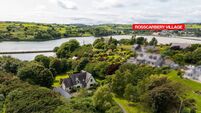
The house we stand outside is a prime example of the type: tucked off a very quiet country lane and private, with only the telltale blue glow of an intercom on a wooden gate. Drive past an avenue of limes and you land in front of a modest stone dwelling, shel-tering under wild woodland.
There’s very little indication of what lies beyond, and that’s part of Dusoswa’s style, he likes to hide his properties, he says, so the postman or casual caller would never guess at the space beyond the hall door.
The house circles this north-facing courtyard with a number of projections south-ward, all modelled before building and with sun surveys completed — this is not a house of shadows. Dusoswa likes a public and a private part to a building and can’t understand why people put all the detail of their houses to the front, to the public face, leaving little for their own enjoyment.
He designs to reveal a building on all four sides, he says, and believes a house should be easy to read, natural and not too complicated or fussy.
“I don’t like adding detail... or unnecessary embellishments. It’s very important that every design has four or more sides so the design should work to the side and rear elevation just as much as any other part of the design.”
He likes to use stone and rarely resorts to render. It requires craft, he says, because the stone mason dresses the stone and builds for each house, it’s individual. Render, on the other hand, is messy by comparison and needs continual upkeep.
It doesn’t last as long as stone either, he argues, so is less sustainable.
In terms of design, Dusoswa says his ideal room is one where you can create a circle in front of the fireplace — too mean and it won’t work, too long and it’s not good. The circle has to have outside space for furniture and access.
And he doesn’t believe in separate, good rooms — they’re just not used, he says.
An open plan layout with a visual link between spaces and an emphasis on the vertical is his preference and that’s what’s created here with an extended kitchen, dining and living space running over two wings and with changes in levels, but connections from room to room.
There’s a modest, 2,600 square feet here, spread over two floors, with four en-suite bedrooms and a scale that’s low key, but with quality fittings. The front elevation wraps around the main courtyard, with a high wall on one side and an attached double garage on the other, closing around the space.
Designer Cara O’Driscoll has created a series of gardens that are just on the right side of natural, but still showy enough for display. She walks a fine line, and even in the woodland groves, her nimble hands have been at work spreading wildflower seeds and artful sedum on the sea shore.
The house is a secret quietly unfolding. An unremarkable rain porch leads through to stunning views directly through the house to Kenmare bay, framed by full height windows at the rear.
And that’s not all, move rooms and there’s another image — a view over a tidal creek on the eastern side, with high grassy tussocks as islands.
It’s almost as if the house is secondary to the location, which is quite a feat: this limestone built, slated and gabled property is no small dwelling, yet it bows to the immensity of sea, mountain and woodland. Designed to a tee, it has two wings and gables fan out from the courtyard to capture a different perspective from every window and level.
Yet, it’s not pretentious. There’s no ‘good room’, no expensive flourishes, few dust collectors and only a little art.
It’s a simple house for simple, holiday living —at a certain level, you don’t have to show off.
Construction, by O’Sullivan Rath, was in Quinn Lite block, with limestone finish, natural slate roof and a bespoke, carved stone chimney, for which detailed drawings were made by Dusoswa.
Rooms are single depth and the staircase acts as a bridge between the house’s two wings, while many gables are used in the Victorian manner. Dusoswa admires the Victorians for the way in which they break up space and his houses are neo-Gothic in style: some, more that others.
Windows are a mix of box bay, with a triple row of glass matching the almost 10’ high ceilings with dormer windows at the upper level. Coated in moss green externally, the Marvin units have a blond wood finish internally, which complements the American oak flooring.
The main staircase is an elaborate, steel and chestnut construction which looks complicated and expensive, but isn’t, the architect says. It’s a kit find and was installed by the builder to his specifications. The taut steel cabling brings a nautical touch to the seaside residence.
But there are few standout additions, just good quality design which extends to the simple, double-side fireplace designed and executed by the team, simple but clever touches like cutting slate for the external vents, (see Get The Look), limestone slabs for light fittings and upright posts in limestone to hold open doors in place. Then there’s the rusted steel lights scattered around the garden.
Every single element of easy living is addressed — it’s the kind of house where all the boxes, big and small are ticked — the result of years of practice.

CONNECT WITH US TODAY



Be the first to know the latest news and updates