I found Fergus Finlay’s column in Tuesday’s Irish Examiner to be an intriguing read (‘On both sides of the Irish Sea, political leaders are in trouble’).
As a clinician, it’s my contention that the psychology of political leaders’ personalities, cognitions, and emotions influence their decisions and interactions with others.
It focuses on how traits like charisma and emotional intelligence enable leaders to inspire, while cognitive biases and personal experience shape their strategic choices and governance styles.
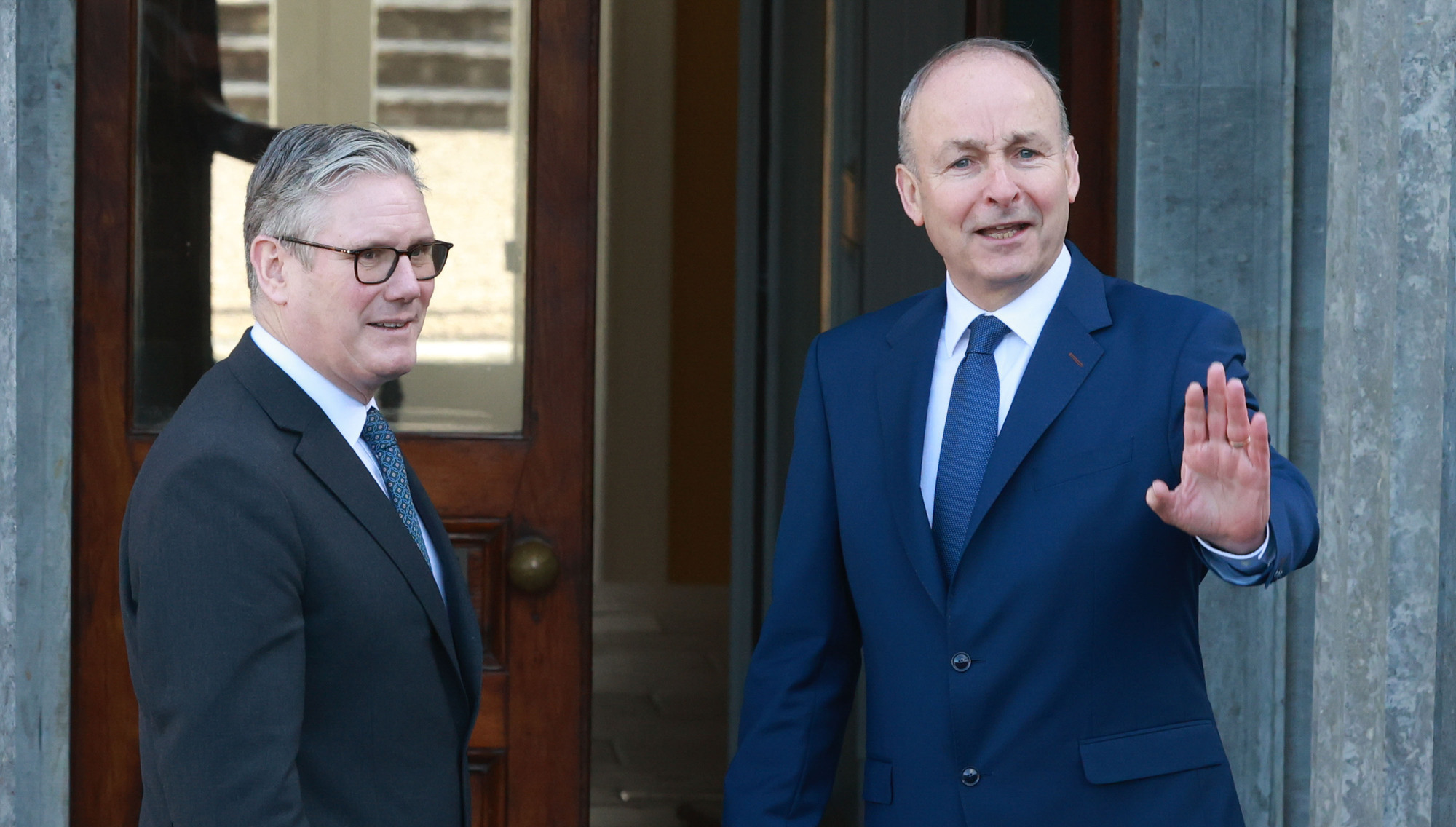
It would seem to me that both British prime minister Keir Starmer and Taoiseach Micheál Martin have lost their way. There is no doubt that Starmer and Martin are both trying to navigate through messes that they find themselves presently in.
I believe that this is not the right time to change the prime minister. Starmer was right on the call not to join the US offensive against Iran and it would be a risk to oust him as the country faces a potentially massive economic shock, particularly without any oven-ready challengers to command a majority of the UK parliamentary Labour Party.
I am acutely aware that the fundamentals have not changed. Starmer is a deeply unpopular prime minister with a lacklustre vision of how to govern, and the party is flirting with fourth in the polls. This is not a sustainable position, and eventually something will have to change.
The Peter Mandelson fiasco has to be the straw that breaks the camel’s back for Starmer.
Finlay is on the money when he astutely observes that Starmer allowed himself to be handcuffed to an economic and fiscal policy that has come back to bite him.
Apropos to Martin, I am bewildered by some of his recent faux pas and blunders. His decision to promote Jim Gavin as Fianna Fáil’s presidential candidate displayed very poor judgement.
He has been accused by members of his own party of being hugely out of touch with the citizens of Ireland vis-a-vis the recent fuel protests.
Martin is an experienced politician and he knows how to fight against such challenges against his leadership.
The Taoiseach does not have to deal with something akin to the magnitude of the Mandelson debacle, which gives him a great chance of surviving the political challenges to his leadership.
However, I do think the big problem for Starmer is Mandelson, which could very well signal the death knell to his leadership.
As earlier mentioned, who is readymade to step into Starmer, and indeed Martin’s, shoes?
Martin has a much better chance of survival when juxtaposed with Starmer.
I believe that political leaders fail for lots of reasons.
It often depends on how smart (or stupid) they are, or how nice (or nasty) they are, and how much (or little) they know about their domain.
I believe that there’s a cultural aspect to leadership as well: Does a leader’s style align with the prevailing cultural winds?
I will conclude by saying that both Starmer and Martin are aware that their tenure is near ending, and one would hope that they would leave office on their terms as opposed to being pushed.
John O’Brien
Clinical Psychotherapist
Clonmel, Co Tipperary
Contradictory view on the Irish tricolour
Ciarán Cannon asserts that the Irish tricolour has been used recently in the wrong context, for dubious reasons, and to “sow division”. (‘The tricolour is a powerful symbol of inclusion so let’s reclaim it from those who use it to sow division’. Irish Examiner, April 18).
By ‘those”, Cannon includes the
protesters who recently blocked roads and fuel infrastructure in anger at the sudden spike in the cost of fuel, and one can infer further, those myriad protests regarding the immigration crisis with which the country continues to wrestle, and where the national flag was
ubiquitous.
However, while saying, on the one hand, that “No group, however vocal, owns our Irish flag”, and, on the other, that the flag’s “meaning is rooted in the founding ideals of the State and in the broader aspirations of the people it represents”, Cannon offers a slightly contradictory view, if the “vocal” or loudest voices believe that the flag does indeed, “represent” them, their aspirations, their ideals, where are they “wrong”?
Is the “will” of some people, and not others, allowed to be “expressed”?
Who decides?
And as regards to the cosy language around the tricolour and the foundation of the State, and “inclusivity”, what accounts for the exit of more than 100,000 members of the protestant faiths in the immediate aftermath of the foundation of our Republic? Perhaps the “will” of some of the people?
Peter Declan O’Halloran
Belturbet, Co Cavan


Cancel anytime
Time up for FF and FG
Fianna Fáil and Fine Gael collaborated with each other to stay in power but it looks very much like the union is well beyond its sell-by date.
Even within the parties themselves there is concern, given the very high cost of living and all the other problems with the country regarding public services. Our bulletproof Taoiseach, Micheál
Martin, has been seriously damaged by the fuel crisis, and a growing number of people say he should go.
Simon Harris is also way down on the popularity scale, and unquestionably one of the worst leaders of Fine Gael in the history of the party.
This country is now a very hard place to live and stay for too many people and it is time for radical change and to bring the seemingly indefinite rule of Fianna Fáil and Fine Gael to an end.
Their time is well up, and the country has lost all political direction while people get crushed by money worries, and their relationships are under heavy strain.
It is most certainly time for this country to look beyond Fianna Fáil and Fine Gael in future elections.
Maurice Fitzgerald
Shanbally, Co Cork
Electricity fiasco
The minister for energy’s warning that electricity prices will be significantly increased by “suppliers” is testimony to this Government’s hands-off attitude when it comes to overseeing citizens’ access to vital social goods.
It is noted that some members of this Government were also part of the one that privatised the supply of electricity and then quickly walked away.
A regulating quango was hastily put in place to give cover to politicians in the washing-of-hands process.
We have now arrived at the situation where 320,000 households are in arrears with bills; a staggering 191,000 of these are more that 90 days behind on payments. And this information is not the end of the story, for it does not include the thousands of households stuck with a prepay meter who must endure frequent remote disconnections from supply as they struggle to keep these meters in credit.
It is truly astonishing to discover that the energy regulator has not instructed companies installing these meters to maintain and publish a full record of disconnections suffered by these households, complete with details of frequency and whether any such households comprise children, elderly, or persons with chronic illness.
There can be little doubt that the vast majority of these meters are placed in homes of the vulnerable and those struggling on low incomes, despite the fact that it is not only the most insecure way to access electricity, it is also by far the most expensive.
This latter point is extraordinary, given that a prepay meter provides the supplier with a risk-free business model and
accordingly one would expect that it would be the cheapest option. Where is the oversight?
Given the impending energy crisis, it is clear that this Government’s laissez-faire approach is no longer acceptable, and the State must now take full charge and oversight of the generation and supply of this vital utility.
In a nutshell, the country needs a
Government that will take responsibility and govern in the common good.
Jim O’Sullivan
Rathedmond, Sligo
Prudent expenditure would serve Ireland’s interest
The positive figures contained in the Spring Economic Forecast, particularly in respect of a general Government surplus of €9.2bn, are most welcome!
There will be competing and understandable demands on Government to allocate available monies immediately, to assist in cases of domestic hardship to which we are all subject.
Broadly viewed, it is also a propitious time for a meaningful commitment to
Ireland’s security and neutrality in the
future.
The imminence of Ireland’s presidency of the EU in July, events in Eastern Europe and the Persian Gulf, with longer-term horizons, bring security and defence into sharp focus.
We are part of a Europe that is not
insulated from the ripples of seismic diplomatic and military developments elsewhere.
Several important position papers on defence have been produced at the behest of Government since 2020. All of these emphasise the need for an increase in State investment in defence, consistent with, and in parallel to, our position of neutrality.
Defence minister Helen McEntee has acknowledged and accepted the compelling need for the acquisition of equipment for seabed and airspace monitoring, as well as improving land-based capabilities.
For all these defensive measures, UAV (drone) detection and deterrence is
central. This can be acquired and
subsequently developed at a reasonable cost and, learning and profiting from
experience in Ukraine, deployed
effectively.
This would be a practical and
long-sighted use for at least some of the predicted surplus.
Such prudent expenditure would serve Ireland’s interest nationally, and as a
contributor to the EU.
Tim O’Connell
Capt (ret’d) Irish Defence Forces
Ballinteer, D16 E