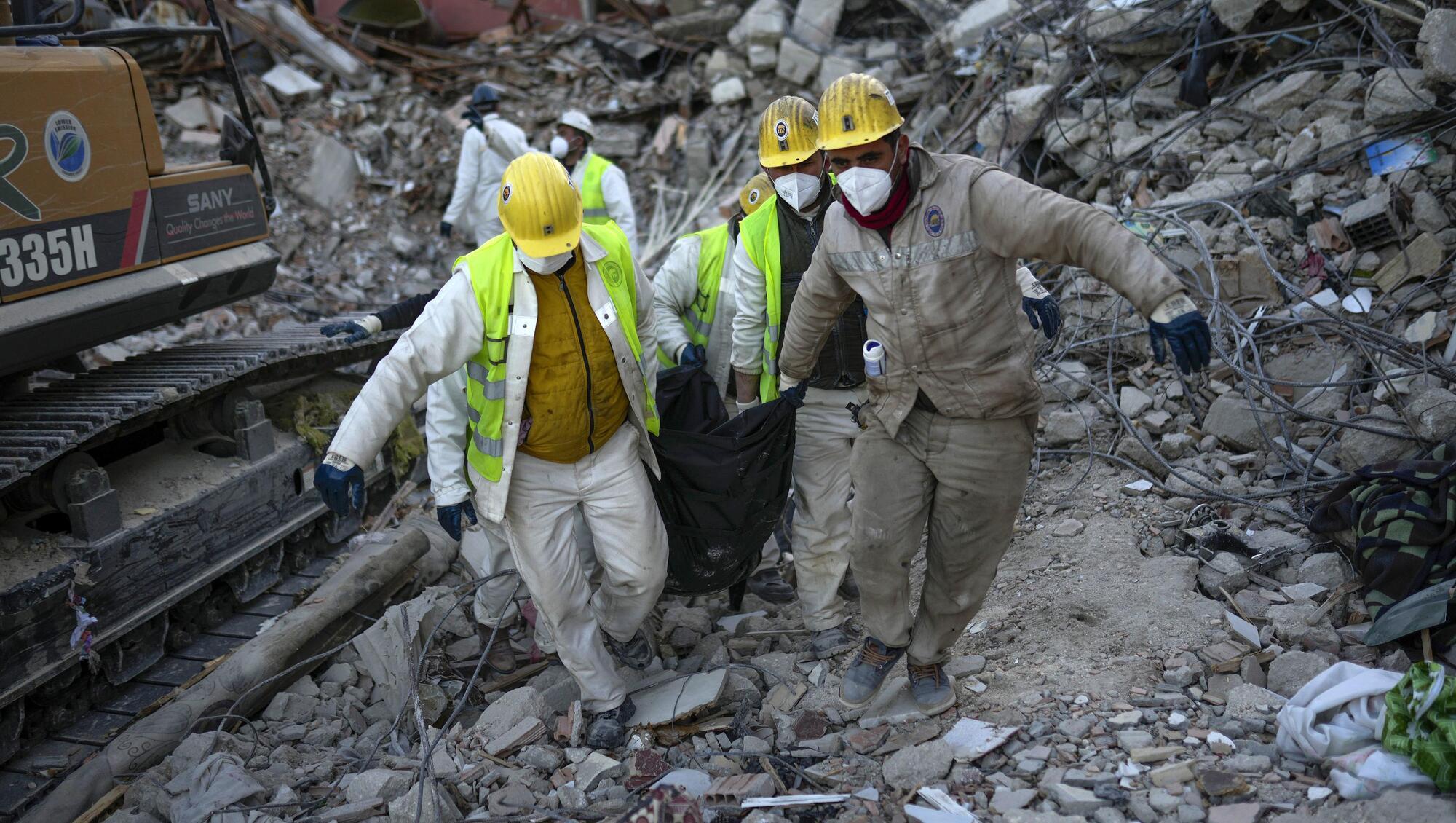
In the hours and days after a major humanitarian emergency, speed is critical. We undoubtedly witnessed this in the intense efforts to save the thousands of lives of those buried under rubble following the catastrophic earthquake that struck southern Turkey and northwest Syria on Monday, February 6.
The ability to quickly support those who survive but are so desperately impacted, having lost loved ones, homes, and livelihoods is also crucial.
Within hours of the disaster, we were so heartened by the enormous outpouring of generosity from the Irish public to support Goal’s emergency response and, in tandem, heartened by the Irish Government’s announcement of funding support as the scale of the devastation became clear.
This was quickly followed by a further funding announcement and the delivery of more than €800,000 worth of humanitarian aid supplies by air, to Adana airport in southern Turkey last Thursday evening, February 16.
Goal and Concern Logistics Teams were ready to receive these 100 tonnes of life-saving aid which comprised cargo of tents, thermal blankets, solar lamps, hygiene kits, kitchen sets, and water cans. This was all enabled by the relentless pragmatism and “red tape shedding” Department of Foreign Affairs in the Irish Government.
For this extraordinarily rapid and characteristically generous response from the Government, we are deeply grateful. This is the
largest-ever deployment of emergency stocks under Ireland’s Rapid Response Initiative, as part of Ireland’s €10m allocation for the earthquake response.
As I write, Goal, our humanitarian colleagues at Concern, and our partners are working quickly to distribute these emergency items to victims of the harrowing earthquake in the disaster-hit regions.
Our CEO, Siobhan Walsh, and our teams across the world, have also been deeply moved by the warmth and messages of sympathy received, following the loss of 31 dear colleagues. This is a powerful statement: That Ireland’s humanitarian instincts, honed over many decades and, unfortunately, by so many crises, are stronger than ever.
It is on occasions like this that Goal is more than proud of its Irish roots and stands with Irish Aid (the Government’s programme for overseas development), the Irish public and in unison with other partners, to deliver effective and appropriate support quickly to those most severely impacted. Thank you.
Barry O’Connell
Chairman
Goal Global
Overuse of the term ‘my dear’
The official meaning of the term, “my dear”, is to describe someone that you feel affection for.
Is it OK to call a work colleague, client or customer my dear? Surely, this term should be reserved for loved ones.
It has become so commonplace now, that it’s totally abused.
It’s used to address customers, clients, and staff, in restaurants, hairdressers, clinics etc. It is inappropriate and overfamiliar.
It makes the recipient, feel subservient and belittled in some way. It can also be ageist. It may be well-intentioned, but totally patronising. This overfamiliar use of the term should be banned for use in public places.
Other terms of endearment, like “love” and “pet” are also misused.
I once heard an older lady being addressed as “my dear”, in a care home setting. She quickly retorted, “don’t call me dear, call me expensive”.
That sums it up for me. It may be well meaning, but infuriates most people, including me.
Eileen Lucey
Crookstown
Co Cork
Violence perpetrated by ‘men’
In my day, we learned “the facts of life” at school, in addition to private chats with one’s mother. We were able to exercise a good instinct, common sense, and knowing right from wrong after leaving home.
Many initiates also gained some knowledge about sex from films like Porky’s and Blue Lagoon. Oscar Wilde prophetically summed up modern life when saying that “everything is about sex except sex”. He also ominously described sex as being about power. Rape is too prevalent. Men increasingly pay for sexual services. The murder of women in Ireland is now a blood sport.
Don’t tell me that this violence isn’t perpetrated by “men” who abuse sex and pornography!
Dr Florence Craven
Bracknagh
Co Offaly
Bertie Ahern’s move was well timed
I would like to make a few comments regarding Bertie Ahern rejoining Fianna Fáil. He obviously chose his moment well, in the midst of the anniversary of the Good Friday Agreement. Of course, he would have us believe that not only was he the architect of the agreement, but that he negotiated it all by himself. I’m not surprised that Fianna Fáil welcomed him with open arms as a leopard never changes its spots.
Rather than running for the Áras, Bertie should stick to what he knows best, and that is backing horses. By his own admission he has vast experience of this.
The phrase “rubber neck” suddenly springs to mind, I wonder why?
Niall O’Sullivan
Ballincollig
Cork
Big Tobacco agenda
Anyone who thinks Big Tobacco introduced vaping and e-cigarettes to help smokers quit tobacco is bonkers.
Big Tobacco needs to suck in our kids with highly addictive nicotine products to replace the thousands of smokers they kill every year.
Margaret Hogge
Haymarket
NSW Australia
A positive response from the Irish people
It was great to see such a large turnout at the Ireland For All march in Dublin on Saturday last.
It struck me that if even a small percentage of those who participated could offer a room to a refugee, the refugee accommodation crisis would be resolved overnight.
Patrick J Mathews
Drogheda
Co Louth
The conversation of religious faith
Why is it that the palliative effect of religious faith is so often undermined and dismissed in current documentaries. With regard to the interesting RTÉ documentary on ageing hosted by Mary Kennedy recently (Monday, February 20) the role of faith and its contribution to personal fulfilment was completely overlooked. Prayer offers a powerful antidote to suffering to many of us. It gives meaning to suffering and can enhance our sense of compassion and empathy. Meaning and purpose are crucial to personal happiness and by extension, to positive ageing.
Is it not cool to discuss religious faith anymore?
Sarah Butler
Inch
Thurles
Animal welfare laws not fit for purpose
Many people, while uncomfortable with the idea of killing animals for food, accept the commonplace assumption that animal welfare legislation looks after the animals’ wellbeing and that the animals lead lives largely free of stress, suffering and pain. But that assumption is weakening in the face of growing evidence that animal welfare legislation is not fit for purpose, that it protects the interests of the stakeholders more than the animals themselves, and that the existing laws and regulations are routinely breached, or worse, ignored.
On factory farms across the globe, pigs and chickens, hens and rabbits, geese and other animals, live out their brief lives in windowless sheds in a crowded and stressful environment, growing at a phenomenal rate that is unnatural and unhealthy. The animals are fed a concoction of drugs, including antibiotics, to prevent the spread of disease, yet still suffer from a wide range of illnesses. Then, after a short, stressful life, they are roughly handled and cargoed to a factory that will slaughter them mercilessly and, not infrequently, inefficiently.
How does any of this fit in with good animal welfare practice?
Each animal on a factory farm is an individual, with its own unique DNA and its own individual personality. Yet, animals on a factory farm are treated as mere commodities, inanimate objects in a conveyor belt system of production that has no room for mercy and whose main purpose is to produce as many animals as possible as cheaply as possible in the shortest time possible.
Factory farming by its very nature is the antithesis of good animal welfare practice, and any legislative framework that gives the green light to the intensive rearing of farmed animals is clearly not fit for purpose.
Gerry Boland
Keadue
Roscommon

Subscribe to access all of the Irish Examiner.
Try unlimited access from only €1.50 a week
Already a subscriber? Sign in