Letters to the Editor: Ireland must recognise Armenian genocide
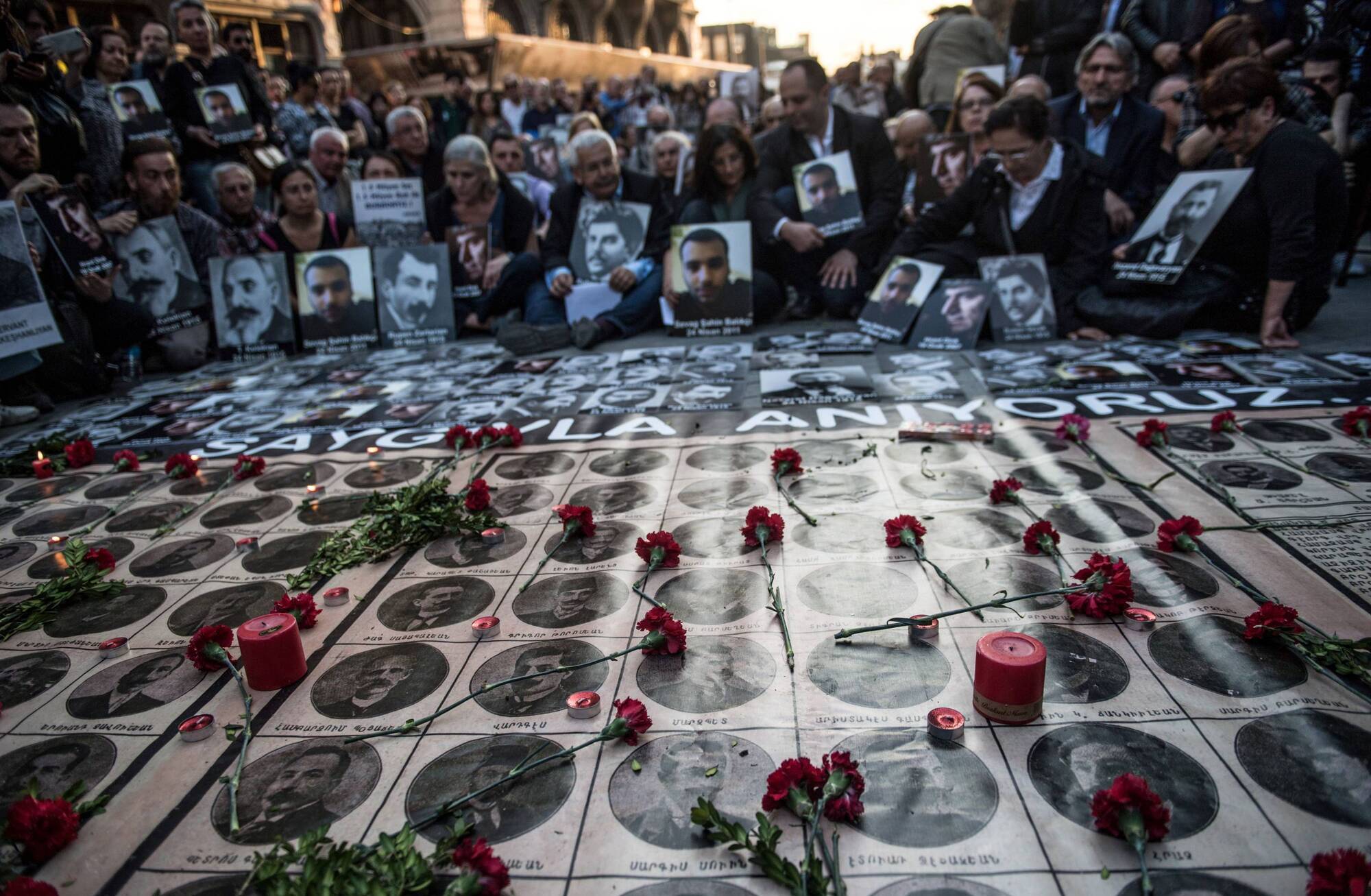
People hold portraits of Armenian intellectuals — who were detained and deported in 1915 — during a rally in Istanbul in 2018, held to commemorate the 103nd anniversary of the 1915 mass killing of Armenians in the Ottoman Empire. Picture: Bulent Kilic/AFP via Getty Images
Genocide is the most serious crime against humanity. The Holocaust caused the deaths of 6m people.
The UN was founded to prevent such crimes against humanity and the Genocide Convention was passed in 1948 to ensure the words ‘never again’ actually meant what they said.
Genocides occurred prior to the Holocaust, committed against indigenous people in the Americas; by Germany in south-west Africa, and by the Ottoman Turkish government during the First World War.
Genocides have continued to occur in breach of the Genocide Convention, especially in Cambodia, East Timor, Bosnia, and Rwanda.
The Armenian genocide began in 1915 during the First World War causing the deaths of more than 1.5m Armenian, Greek, and Assyrian people.
Subsequent governments of Turkey have denied that what occurred was genocide, thereby avoiding accountability or reparations. Recent conflicts across the Middle East from Libya to Myanmar have the potential to lead to acts of genocide.
Now is the time to act to prevent further acts of genocide.
The Armenian genocide has been recognised by the parliaments of 30 countries including 16 EU countries, the US Congress, and the EU Parliament.
Ireland has so far failed to do so.
We the undersigned call on members of the Oireachtas, including the Dáil and Seanad to pass a motion formally recognising the Armenian genocide as an initial step towards helping to prevent further acts of genocide.
The ever-changing proposals of Minister for Health,Stephen Donnelly
regarding the schedule for administration of the Covid-19 vaccine are well outlined by Terry Prone — Advice for Donnelly: Don’t explain or illustrate, just answer the question (Irish Examiner, April 19).
She highlights aptly the unreasonableness of prioritising selfish young socialisers over those within the 60-69 age bracket.
Such a proposal smacks of ageism, seeking, as it does, to discriminate against an age group that is considered to be compliant, despite the fact that many people in this category have made valuable contributions to society in the course of their lives.
Perhaps it might be more beneficial if our Minister for Health liaised with his colleagues in the Department of Justice to ensure that youngsters who continue to socialise in large numbers should be severely penalised for their disloyal behaviour and that older people should, in turn, be treated more respectfully.
His thoughtlessness has undoubtedly served to unsettle older community members, already frightened and feeling quite threatened by continuous media coverage of deaths in nursing homes and hospitals.
We urgently need a cohesive, equitable approach to the handling of the vaccine programme instead of continuous vacillation and disagreement.
In his letter, Government destroy the country (Irish Examiner, April 20), Vincent McMahon declares Ireland as having been ‘destroyed’ by the the Government’s management of Covid.
Keeping people alive would seem to be a fundamental measure of success in a pandemic.
In that regard many fellow European countries, including the UK, actually have Covid death rates that are much higher than the Irish death rate.
In addition, Irish death rates are lower than in most EU member states with which we share vaccines.
What is going to happen in relation to the pandemic in the future is anybody’s guess but at the moment declaring it as destroying the country is a bit over the top.
I wish to ask us all to reflect on the changes we need to make regarding a sustainable future for ourselves and the generations coming after us.
We are all aware of climate change issues and the actions of various environmental activists, such as Greta Thunberg.
However, we cannot wait for someone else to be the driver for change, We need to do this ourselves.
Every morning when we wake up, we need to consider what can I do differently today?
- Can I cycle, walk, car pool, take public transport to where I need to go?
- Can I consider the items I need to purchase throughout the day?
- Where will the plastic go? How can I recycle properly?
- How can I be a good example to others and to our children?
- Can I lobby politicians, councillors to drive for a greener future?
- Can I volunteer in local community to keep my area litter free?
- Can I reduce the energy I consume at home?
- How many of us know what the Sustainability Development Goals are?
During the pandemic, we have all become more aware of the wonderful countryside we have here in Ireland. Let’s give it the respect it deserves.
The more we do nothing, the greater the problem becomes, putting our heads in the sand will not be a solution.
Education is a vital cog in us solving some problems, we need to take the time to bring ourselves up this learning curve.
It would be well for everyone to take note of what was attempted with proposals to establish a European Super League; what was planned is a microcosm of what is happening in global economics.
Rich and powerful forces are out to gain ownership and control of practically every aspect of economic and financial activity with as little responsibility or obligation to those who suffer commercial failure and job loss, as can be enforced on weak, naive and impotent governments.
It took ordinary fans to thwart the ambitions of the most powerful clubs and derail takeover for profit of a game which millions of ordinary people nourished and supported for the benefit of all.
How much greater in global importance is the future of economics than the future of soccer?
Yet governments who parade principles “of the people, by the people, for the people” allow economic dominance be assumed by the few.
Wouldn’t it be a wonderful world if all that societal anger directed against a European Super League was now re-directed at eliminating real injustices in our societies.
However, we have to hold our breath.
Looking at the worldwide media coverage of the collapse of the proposed European Super League, it would appear to be the case that the instinctively greedy behaviour of billionaires matters more than the deaths of countless ordinary people.
This world has gone completely daft.
People blame God for everything — wars, violence, murders, starvation — but why?
God gave us all free will to do whatever we want and everything that’s happening in this world is literally caused by man.
We live in a world where racism, discrimination, and stigmatisation are happening as we speak — just because of someone’s race, colour, or creed.
The problem with this world is there’s no empathy, no compassion, and a lack of communication.
People are so caught up with technology today that it’s controlling their lives and no one knows how to talk to each other.
So for the sake of the next generation we must do something. I’m a strong believer in teaching our children to live in harmony with each other.
I’m also a strong believer in teaching our children that hostility is not the
solution but is the problem.