Irish Examiner view: Government has been thrown off by blockades
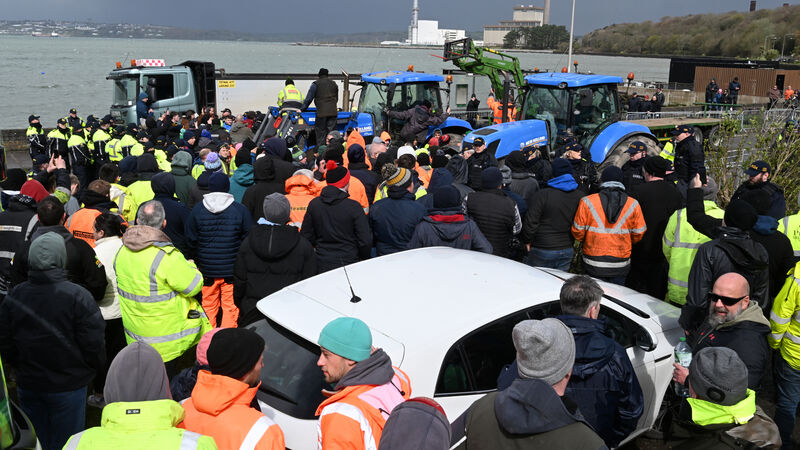
Fuel crisis protesters being pushed back by the Garda public order unit at Whitegate near Ireland's only oil refinery on Saturday. Picture: Larry Cummins
As the dust settles on a rancorous week across the country, when the Government appeared caught very much on the back foot by the crisis facing it, a raft of questions remains for Micheál Martin’s administration.
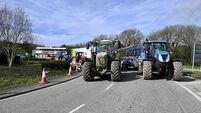
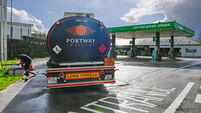
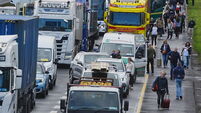
Although hamstrung by events out of its control — America and Israel’s war in Iran and Lebanon — the Government was completely thrown by the unexpected and swift blockades mounted against our only oil refinery, our cities, our road infrastructure, and our ports.
It should not have been this way.
While there was a genuine feeling among many that the protesters had a point, and that more needed to be done to assist those most affected by skyrocketing fuel prices, some of that sympathy evaporated in the face of fuel supply issues, along with the fact that medical care and emergency services operations were being jeopardised.
A political crisis duly ensued as some in power favoured an immediate and tough response to “economic sabotage” perpetrated by the protesters, while others favoured a more accommodating approach.
What has emerged, however, is a nagging fear across the political spectrum that this scenario could easily happen again.
Despite the protesters having no clear leadership and little organisational structure, they mobilised swiftly and were able to identify and hinder critical targets with clinical ease.
Was there an absence of forward information on the protesters’ plans, or was the implementation simply so easy there was little or no time to react?
These are questions that will, in the fullness of time, have to be answered.
Solutions will have to be found to ensure the country’s emergency services and critical infrastructure is protected while maintaining the right to peaceful protest.
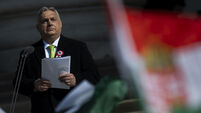
The world waited and watched as Hungary’s electorate went to the polls yesterday, anticipating the end of the 16-year reign of the country’s populist prime minister, Viktor Orbán.
While the pre-election polls clearly predicted that Orbán would be defeated, it was far from a certainty.
The extreme complexity of the Hungarian electoral system, manipulated by years of gerrymandering by Orbán and his Fidesz party, meant that the result might not have been what outside observers expected.
There was a school of thought that, even if the polls were correct, Orbán and his associates could still claim a majority in parliament or enough to form a coalition government with smaller parties.
As he was cheered on by US vice president JD Vance — who said it was inevitable that the incumbent would win — during the week, Orbán himself admitted that was “the plan”.
That “plan” had been years in the making.
Fidesz had tweaked the electoral system repeatedly since Orbán was returned to power in 2010.
It reduced the number of seats in parliament from 386 to 199 — a seismic shift which necessitated a complete redrawing of electoral districts, something which was again amended in 2024.
According to Orbán’s biggest critics, including main challenger Peter Magyar of Tisza, this involved packing opposition-leaning areas into bigger constituencies and splitting pro-government areas into smaller ones, giving their vote more clout.
The net effect meant fewer votes were required to win a seat in rural areas — where Fidesz was historically stronger — than in urban areas that favour the opposition. Thus, even before yesterday’s voting started, the scales were tipped in favour of the ruling party.
In the end, polls were correct.
Shortly after 8pm, Orbán conceded the election to Magyar.
He said the election result was “clear” as he conceded defeat, saying he congratulated the winning party, Tisza, and admitted the result is painful for Fidesz.
Many eyes across the EU, and also in America and Russia, were anxiously watching the result, while hoping for differing outcomes. Now that we have it, we wait to see what the defeat of Orbán means for Hungary, for the EU, and for febrile international politics.
Ireland has had a fraught relationship with EU emissions regulations — regularly failing to meet them and facing massive fines as a result.
It was somewhat dispiriting, therefore, to learn in recent days that agriculture and aviation — our two biggest contributors to greenhouse gas emissions — increased their carbon footprint rather than lessening it.
Figures revealed by the EU’s emission trading system, a scheme set up two decades ago to incentivise businesses and utilities with high energy use and emissions to switch to greener ways of operating, show an overall reduction in emissions of 5.5% in 2025.
However, emissions from airlines increase by just under 2%.
Meanwhile, emissions from dairy processors were up 3.6%.
Emissions within Europe by Irish airlines grew to more than 13.4m tonnes last year, more than all other forms of transport in this country. Emissions from dairy processing also grew.
The combination of these two industries has put the Environmental Protection Agency (EPA) here in something of a pickle. The airline industry is emitting more now than it was prior to the pandemic, reflecting the level of growth in the sector while, according to the EPA, more work needs to be done to decouple growth in the dairy industry from carbon emissions.
One of the startling things about this is that, since 2005, overall emission figures have been cut by 52%, and huge progress has been made here towards cleaner energy use and sustainable manufacturing.
That progress has to be accelerated if we are not to become environmental pariahs in Europe.
CONNECT WITH US TODAY



Be the first to know the latest news and updates