Irish Examiner view: No clear plan for what happens next in Iran
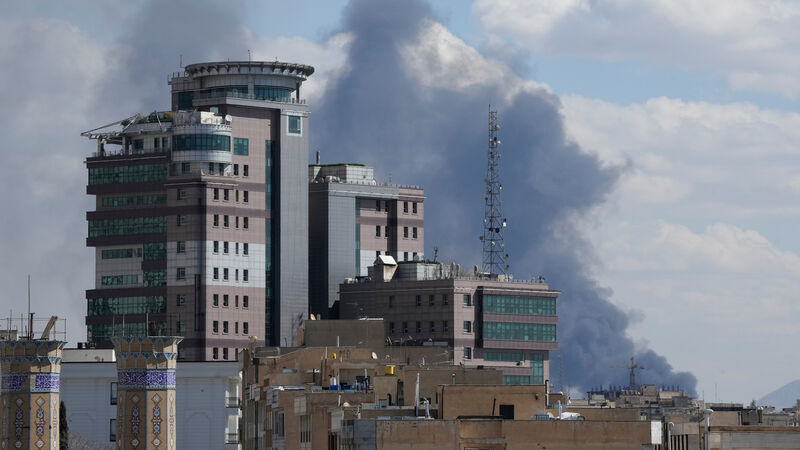
Smoke rising after a strike on Tehran, Iran, amid missile and drone strikes. Picture: Vahid Salemi/AP
The impacts of the US attack on Iran did not take long to be felt beyond Iranian borders. Within hours of Iran’s leader, Ayatollah Ali Khamenei, being killed in US and Israeli strikes on Saturday, Iran had launched missile and drone attacks on at least eight neighbouring countries, including Israel, Jordan, the United Arab Emirates, Bahrain, and Saudi Arabia.
On Sunday night, a UK air base in Cyprus came under attack and, by yesterday, Israel was responding to attacks on Israel by Hezbollah, the Iranian-backed militia group which had launched rockets from Lebanon.
The exact number of lives lost in the opening days of this war in the Middle East is unknown, but Iran’s Red Crescent said 555 people, including 148 killed in a strike on an elementary school, had been killed in Iran.
At least 30 people were killed in an Israeli attack on the Lebanese capital, Beirut, four American troops were confirmed dead, at least 10 were killed in Israel, and five in Gulf states.
The economic global fallout was also immediate.
Oil and gas prices rose, markets dipped, international shipping was curtailed and hundreds of flights to and from Gulf states have been cancelled.
The Strait of Hormuz, which carries about one fifth of global oil supplies, has come under attack; a number of oil refineries in Saudi Arabia have shut down; Qatar halted production of liquefied natural gas yesterday; and, with other major energy producers, Kuwait and United Arab Emirates, also under attack, the flow and transport of oil is likely to slow further.
The longer-term repercussions of this disruption will depend on how long the US-led military action continues, and on what happens after so-called ‘Operation Epic Fury’ concludes. That is precisely the problem: There is little clarity on either matter.
Donald Trump told at the weekend that combat operations would continue for “four to five weeks” if necessary, until US objectives were achieved. However, he did not elaborate on what those objectives were.
US defence secretary Pete Hegseth said yesterday that America’s goal in Iran was to destroy the missile threats, destroy the navy, “no nukes”. This was not a “so-called regime-change war”, there would be “no nation-building quagmire, no democracy-building exercise, no politically correct wars”.
It would appear, then, that there is no US plan for what happens next to Iran and its people. Once the US is satisfied that the country’s nuclear capability and current leadership are destroyed, it seems that a divided country of almost 93m people is to be left, unaided, to pick up the pieces.
That does not bode well for the prospect of peace in the Middle East, and it certainly does not bode well for the economic wellbeing of the rest of the world.
Two chilling reports in this title in recent days serve as timely reminders of why we still have, and need, International Women’s Day, which will be marked next Sunday.
The first told of the increasing use of tracking devices by abusers to control, follow, locate, and/or spy upon their current or ex-partners. One support service for survivors of domestic abuse alone had 15 cases in the last year of clients having been tracked through devices attached to their cars, children’s toys, and other belongings. With advances in technology and the availability of tracking devices, it is no longer ‘uncommon’ for abusers to stalk their victims in this way, according to West Cork Beacon CEO MaryClare Clark.
The second report was about how inconsistencies in the application of the in-camera rule in family law cases, may effectively be silencing some victims of domestic abuse.
The in-camera rule means legal proceedings in family law cases are conducted in private. However, different judges use it in different ways, with the result that some women may be unable to share important information about their child or family with, for example, the child’s school. The same report, on a campaign to fight for changes in the family law system, also refers to the continued use in our courts of unregulated assessors, who may be untrained in issues around domestic violence, but who are considered fit to make recommendations to courts about child custody and access.
Next weekend will bring a plethora of events to mark International Women’s Day on March 8. The events will be hosted by businesses, political parties, civic organisations, and community groups. Many will be celebratory in tone, applauding the achievements and gains of women in every walk of life in recent decades. It is right that the wins be celebrated, but we should not forget that the fight for true equality and freedom from oppression, which motivated the movement more than a century ago, isn’t quite over.
The news last week that 320,000 domestic customers were unable to pay their electricity bills in full in December quickly turned into a heated political row about the Government’s decision to drop energy credits from Budget 2026.
The Commission for the Regulation of Utilities’ announcement of the figure on Friday, along with the observation that it was up by nearly 20% on the previous year, was greeted with criticism of the Government and calls for the immediate introduction of a cost-of-living package. The Government rejected the criticism, and pointed to the additional 50,000 families who would benefit from a newly expanded fuel allowance scheme.
The predictable back-and-forth about the right and wrong way to help people pay their electricity bills continued until the issue was overtaken by other concerns. What was less discussed was the importance of that figure as an indicator of the alarming number of families whose financial wellbeing is balanced on a knife-edge.
The US Federal Reserve has long posed a particularly interesting question in its annual report. The question asks how households would deal with an unexpected expense of $400. In the latest survey, 13% said they would not be able to pay the bill right now. The responses are a good indicator of how many people can be tipped into financial difficulty by a relatively modest, unexpected expense.
Electricity bills are not unexpected expenses. The fact that more than 13% of domestic customers — individuals and families — were not able to pay their bills last December deserves some serious attention.


CONNECT WITH US TODAY



Be the first to know the latest news and updates