Irish Examiner view: Iran strikes could spark unintended consequences
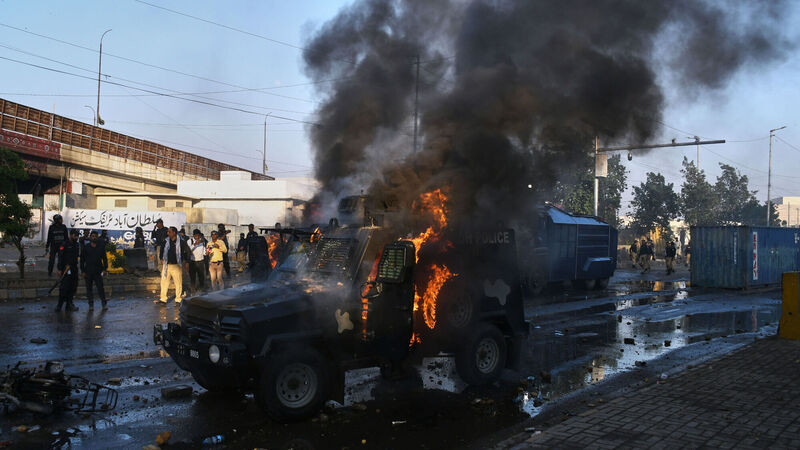
Police officers walk past a burning police's armoured vehicle, which was set on fire by Shiite Muslims during a protest to condemn the killing of Iranian supreme leader Ayatollah Ali Khamenei, in Karachi, Pakistan, on Sunday. Picture: Ali Raza/AP
Recklessness would appear to be a part of the DNA of US president Donald Trump. It was a large feature of his business life and his many bankruptcies; it played a huge, if successful, part of his unorthodox campaign strategies; it is playing out in his tariff policies; and now it is evident in his military attack on Iran.
While there may have been reasons — even if they were somewhat obtuse — in most things he has done during the course of his business and political life, there appears to be little, if any, clarity about his military objectives in attacking Iran and even less about the potential consequences.
Certainly, the joint military action by the US and Israel has achieved one thing in ending the life and reign of Iran’s supreme leader, Ayatollah Ali Khamenei, but nothing has yet emerged of their intentions about regime change within the country.
In a conflict of this nature, history has shown us there is no quick path to de-escalation. There is the distinct possibility that a more radical, aggressive faction within Iran’s armed forces could seize power and accelerate broader warfare.
Already, Iran has retaliated with missile strikes in Kuwait, Saudi, Bahrain, Qatar, and the UAE, while also targeting the cities of Haifa and Beit Shemesh in Israel, among others.
The leaders of Turkey, Saudi Arabia, Qatar, and Egypt have urged America and Israel to seek a diplomatic solution in order to contain Iranian ambitions rather than destabilise the whole country.
Fears of a scenario whereby there is chaos and uncertainty across the whole region are now rampant, along with a clear awareness that conflict with Iran will have severely negative global economic consequences in both the short and long term.
There is also undoubtedly a huge anxiety across the region — as well as the wider world — that a chaotic end to the regime in Tehran will spark many unintended consequences.
There are also credible concerns that Trump’s motives for attacking Iran have more to do with a dive in his popularity at home ahead of the mid-term elections in November, and also that the cloud of suspicion over his relationship with sex offender Jeffrey Epstein has not been dispelled.
This all points to the sheer recklessness of the actions of America and Israel. Right now, there appear to be few positive outcomes to the attack on Iran. That this drastic military action appears to have little legal foundation, goes against all principles of the United Nations, and has little broad support, further indicates the irresponsibility at hand.
The attack on Iran is a clear violation of the UN Charter, especially so in the absence of any clear, credible, or imminent threat from Iran to America or Israel. This, almost certainly, is not going to end well.
There is a clear and worrying opacity to the seemingly endless increases in the cost of health insurance in this country.
The price of health cover has surged in the past year, heaping further hardship on consumers who are already battling cost-of-living increases on all fronts. The announcement late last week that two more health insurers are increasing premiums is most unwelcome.
For insurers to maintain that the increases reflect rising healthcare costs is a simple way out for them, but it leaves their customers floundering. It forces many to simply do without any health insurance cover.
Their assertion that increases in the cost of delivering healthcare is outpacing general inflation might well be true, but where is the hard evidence of this? The seemingly arbitrary hiking of premium prices could not come at a worse time for customers.
The projected 15% increase in premiums in 2026 poses risks to market stability, and it will undoubtedly deter younger people from accessing healthcare cover.
Experts suggest that, while rate changes by Irish Life Health and Level Health were expected, the scale of them was not, and the unfortunate consequence is that many people are set to be priced out of the market.
The beating heart of Cork City has taken another blow with the news that St Augustine’s Church, located at the corner of Washington St and Grand Parade, is to close permanently later this year.
The Augustinian Order, which owns and runs the church and which has had a presence in the city for 755 years, described the decision to close the church as “akin to a death”.
The faithful who have used St Augustine’s since the current church was built in 1942, developed on the site of an earlier chapel, will be disconsolate at the loss of what many would describe as an old friend.
Announcing the closure, Fr Paddy O’Reilly, the vicar provincial of the Augustinian Order in Ireland, said at a vigil Mass on Saturday that the decision had been made with “great pain and sadness”.
However, the naked facts of an accelerating decline in vocations to the order made the decision inevitable.
While it may be that Cork’s city centre is well served by Franciscan, Dominican, and Capuchin churches, as well as an abundance of diocesan churches, the closure of St Augustine’s will leave a hole in the city’s religious landscape.
Like many other orders, the Augustinian friars are getting older and less able.
The order has only 10 friars under the age of 70 and more than half its priests are aged 80 or older.
For many adherents, St Augustine’s has a very real place in their hearts. Its permanent closure after 11.30am Mass on July 12 next will be keenly felt.
Read More

CONNECT WITH US TODAY



Be the first to know the latest news and updates