Irish Examiner view: Joined-up thinking is a necessity
Our world — and the needs of the people who live in it — has evolved drastically in recent years
Irish Examiner view: Joined-up thinking is a necessity

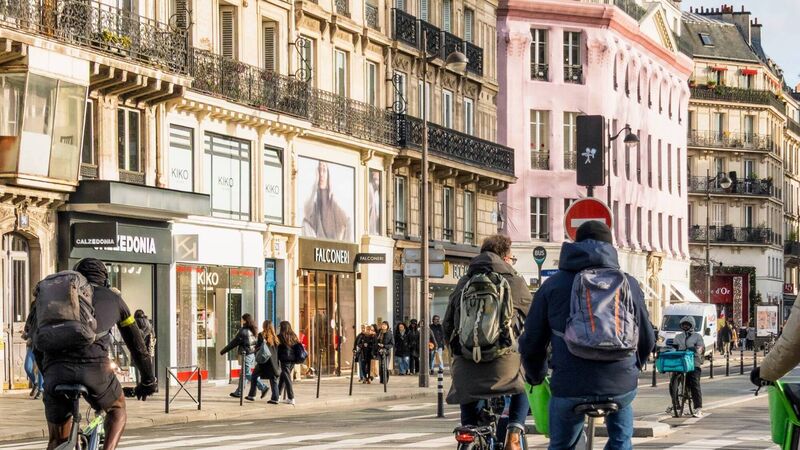
Cyclists in Paris. The concept of the 15-minute city is an old one and based on the premise of the common good, but it has, in recent years, been diluted by the absolute need to turn a profit.

It is salutary to know that local communities and the villages, towns, and cities in which they live — as well as the authorities which oversee their developmental wellbeing — are

becoming the focus of planners and those entrusted with our future health and welfare.

The concept of the 15-minute city is an old one and based on the premise of the common good, but it has, in recent years, been diluted by the absolute need to turn a profit.

That something so visionary can be spoiled by people driven by the bottom line, is not where this or any other country needs to be.

Our world — and the needs of the people who live in it — has evolved drastically in recent years, but what has emerged is a need not for compartmentalisation, as was so envisioned by such as the Swiss- French architectural pioneer Le Corbusier, whose ideas led to ugly, unconnected, urban sprawl.

Indeed, the man who gestated the idea of the 15-minute city, Carlos Moreno, interviewed in Monday's Irish Examiner, expounds on this thought by stressing the need for local
government to provide new ideas for urban and local development. But they cannot do this alone.

Certainly, as Prof Moreno points out, there is a need for co-operation between local authorities and the private real estate and development sector.

His concepts see the need to reshape our cities to generate more multipurpose activities and see an end to compartmentalised districts which actually forced people to travel long distances from home to work and led to the absolute necessity for us to have cars.

The idea is that in future, people will be able to live, work, do business, go to school or university and enjoy cultural and sporting activities — all in one place.

It might sound idealistic, but it’s not far-fetched.

Gaa finances — profitable and parochial

In a world where sporting success is measured on a global scale, the rude health of finances within the GAA, as revealed last week by the organisation’s annual accounts, is a welcome and timely reminder that sport can be parochial and still profitable.

While the GAA does have a global reach thanks to the voluntary efforts of the Irish diaspora, its sports have nothing near the financial clout of international sporting behemoths such as soccer, rugby, athletics, motor racing, tennis or golf.

And yet, in 2025, the organisations’ gate receipts alone increased to €45.7m, up €6.6m (or 17%) on the 2024 figure.

The buoyant figures not alone demonstrate the GAA’s unique place in Irish society, but its ability to keep its games attractive and vibrant. Indeed, the almost complete revitalisation of Gaelic football thanks to visionary new rules, was a clear indication of its ability to adapt, develop, and evolve.

Throw in Cork’s ‘crusade’ to win the holy grail of hurling, the Liam McCarthy Cup, after an agonising 20-year wait, and you have compelling storylines mixed with intoxicating action and — hey presto — record gate receipts.

The GAA has long been admired by fellow sporting organisations for its ability to channel the parish pump into a national narrative by feeding grassroots activities and evolving that into something which propels national debate and excitement.

In an ever-changing and financially demanding world, its ability to keep the game relevant, as well as being able to make them accessible for a huge number of fans, is unique in the global sporting context and its capacity to thrive is as necessary as it is welcome.

Democracy can prevail 

As much of the world today seems to slide inexorably towards authoritarianism, totalitarianism, repression, and despotism, over the past week we have seen a glimmer of hope.

What has happed in Bangladesh is a reaffirmation that the values we treasure can overcome the darkness which seems ready to overwhelm global politics.

Curiously, it has been Bangladesh, never a nation oozing political or economic stability, which has given us optimism that democracy can prevail even in the face of fearsome oppression.

In the first free and fair election in the South Asia state for two decades, the eighth most populous country in the world democratically elected a government in a victory which ended a lengthy period of political upheaval there.

A Gen-Z uprising last year toppled the oppressive, autocratic regime of Sheikh Hasina and led to last week’s historic vote. It was won in a sweeping victory by the Bangladesh Nationalist party, led by the formerly exiled Tarique Rahman, who declared it joyous, but, most importantly, a victory for democracy.

He said that those among the 174m Bangladeshi’s entitled to vote not only stood in lengthy queues to elect a government, but to reclaim their voice.

“This result is a mandate to end fear, curb corruption, and move beyond the climate of intimidation people have lived with for years,” he said.

While Rahman and his party now face a massive challenge not only to rebuild democracy across the vast country, but to restore trust with neighbours and rebuild relations with the wider world, theirs is now an opportunity to restore faith in the political system at home as well.

The Bangladeshi people have spoken vociferously in favour of a new era where institutions will have to be rebuilt, opportunities are created for its youth and proving, on a daily basis, that the government is accountable to its citizens.

In a volatile world where dissent is repressed, political opponents arrested or killed, the outcome of this election will be a sturdy test of Bangladesh’s ability to restore trust in democracy and transition from public protest to tangible reform and stability.

It is to be hoped the country will thrive and prosper in this new era and become a beacon for hope in an increasingly despairing world.

More in this section

Revoiced

Newsletter

Sign up to the best reads of the week from irishexaminer.com selected just for you.

Cookie Policy Privacy Policy Brand Safety FAQ Help Contact Us Terms and Conditions

© Examiner Echo Group Limited