Irish Examiner view: The State is trapped in an absurd legal loop of its own making
The case of Enoch Burke has passed from farce into something more troubling
Irish Examiner view: The State is trapped in an absurd legal loop of its own making

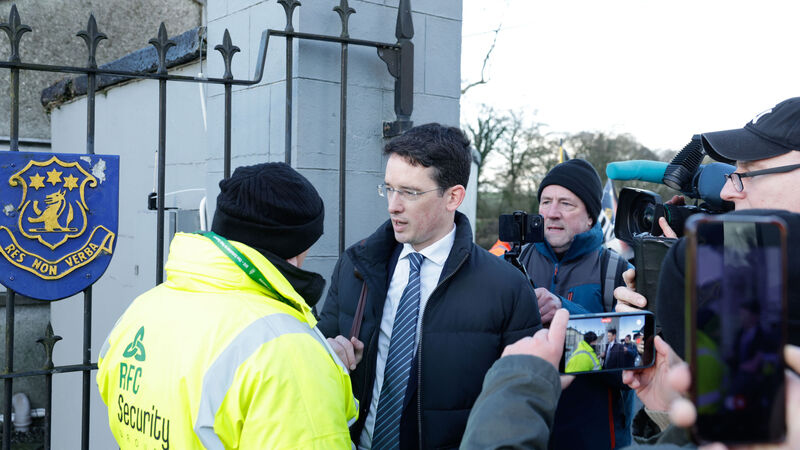
Enoch Burke is prevented from entering Wilson’s Hospital School in Multyfarnham, Co Westmeath, on Thursday due to a High Court order barring him from the premises. Picture: Conor Ó Mearáin

The release of Enoch Burke from Mountjoy Prison after weeks in custody for repeated breaches of a High Court order might ordinarily have marked a pause in a saga that has already tested the patience of the courts, the school system, and the wider public. 

Instead, it has only reinforced the sense that the State is trapped in an absurd loop of its own making.


Within hours of walking free, Mr Burke had returned to Wilson’s Hospital School — prompting the High Court to move once again on Thursday to facilitate steps that could see him brought back before it, and potentially back behind bars.

Mr Burke was jailed for contempt after persistently trespassing at the school, in defiance of a clear court order directing him not to attend the premises. 

On Wednesday, a High Court judge ordered his release “for one reason and one reason only: the interest in the administration of justice”, so that he could prepare his case against the Department of Education. 

The condition attached was unambiguous: He was not to trespass on school property. If he did, the court would have “no hesitation” in returning him to prison.

Yet even as the terms of his release were being discussed, Mr Burke repeatedly told the court he intended to go back to the school. 

The judge heard this. Everyone in the courtroom heard it. The public heard it. And still, the order for release was made. The fact that events have unfolded exactly as Mr Burke foretold only further amplifies the absurdity.

This is where the case passes from farce into something more troubling. Mr Burke’s conduct, obstinate and performative, has long since ceased to surprise. 

As an individual citizen, he bears full responsibility for his actions and for the legal consequences that flow from them.

He alone chooses to defy court orders. He alone chooses to place himself in conflict with the law. There should be no ambiguity about that.

But the courts are not private actors in a drama of defiance. They are the ultimate instrument of the State. Their authority rests not only on the power to punish, but on the credibility, coherence, and consistency of how justice is administered. 

When a court releases a man who openly declares his intention to breach the very condition on which that release depends, it invites the charge that the system itself is participating in an exercise of futility.

The judge was explicit that the decision was taken in the interests of justice, to allow Mr Burke to prepare his case. 

That consideration deserves respect. The right of access to the courts is fundamental. But so too is the principle that court orders are meaningful, enforceable, and not optional. 

When enforcement becomes a revolving door — release, defiance, re-arrest, rehearing, release again — the administration of justice risks appearing not measured, but mechanical, stripped of both deterrent force and common sense.

There is also a human cost that must not be lost in the procedural maze: A school community repeatedly disrupted; staff and students drawn unwillingly into a legal spectacle; public confidence eroded by a dispute that seems designed never to reach a conclusion.

An endless cycle of committal and release serves no one. It does not advance Mr Burke’s legal claims. It does not protect the school from continued disruption. It does not enhance respect for the courts. 

At some point, the system must find a way to assert its authority that is proportionate, decisive, and capable of bringing matters to a close.

Absurdity may begin with one man’s intransigence. It should not be perpetuated by the institutions charged with upholding the rule of law.

Dental crisis

For a country that likes to present itself as a world leader in living standards, innovation, and social progress, Ireland has a blind spot that is impossible to ignore: The condition of its healthcare system.

Nowhere is that failure more clearly exposed than in dental care. The Irish Dental Association’s warning that the public dental service is in a state of crisis should not be dismissed as sectoral pleading. The figures alone are damning.

Treatment volumes have collapsed from almost 1.6m in 2009 to just over 970,000 in 2023. Participation by dentists has fallen sharply. Patients are struggling to access even the most basic care. 

What remains is a threadbare emergency service focused on extractions rather than prevention. That is not a modern public health system; it is damage control.

Dentists are leaving the State schemes because they are no longer viable. Fees are significantly below the real cost of providing care. 

Treatments and materials are restricted in ways that do not apply to private patients. 

Layers of administrative approval make routine work slow and financially risky. 

Screening is supposed to occur three times during primary school.  In reality, many children are being seen once, or not at all. 

The predictable outcome is withdrawal. Goodwill cannot compensate indefinitely for a system structurally designed to lose professionals.

The deterioration of the school screening programme is particularly alarming. 

Screening is supposed to occur three times during primary school. 

In reality, many children are being seen once, or not at all. This is not a marginal shortfall; it is a systemic retreat from prevention, and the cost of that retreat will be paid later in pain, complex treatment, and avoidable expense. 

The State’s response so far has been piecemeal. 

The HSE can point to increases in adult treatments and assessments, but these do not alter the underlying trajectory.

An outdated scheme, abandoned reform talks, and a growing shortage of dental professionals point to a system running on inertia rather than design. 

If healthcare is the truest measure of a society’s standard of living, then Ireland is falling well short of its own rhetoric.

Dental care is not cosmetic, it is foundational. It affects nutrition, development, employability, and dignity. 

A country serious about wellbeing does not allow preventable decay to become the default experience of public care.

Boston bros

Ben Affleck and Matt Damon are the original Hollywood bromance, and one of the few that never felt manufactured. 

Long before red carpets and awards campaigns, their bond was forged on the little-league parks of Boston, shaped by shared ambition, failure, and a stubborn belief that they could write their own way in.

Friends since childhood, they have collaborated on more than a dozen projects, with Good Will Hunting standing as both their breakthrough and their manifesto: Working-class intelligence, emotional candour, and the conviction that art could still come from the margins.

Nearly three decades on, there is more substance to these two men than their chiselled jawlines or tabloid mythology might suggest. 

Matt Damon and Ben Affleck attend the world premiere of 'The Rip' in New York. Picture: CJ Rivera/Invision/AP

Their latest move, pushing Netflix to agree that the crew of their upcoming film, The Rip, will receive bonuses if it performs well, feels like an extension of that ethos.

Through their company Artists Equity, Affleck and Damon are challenging an industry drifting ever further from shared reward and collective risk. 

In a business increasingly defined by algorithms and imbalance, their insistence on fairness is quietly radical. 

It is also unmistakably on brand: Two kids from Boston, still trying to tilt the game toward the people who actually make the movies.

More in this section

Revoiced

Newsletter

Sign up to the best reads of the week from irishexaminer.com selected just for you.

Cookie Policy Privacy Policy Brand Safety FAQ Help Contact Us Terms and Conditions

© Examiner Echo Group Limited