Irish Examiner view: Airport planners must get ready to go
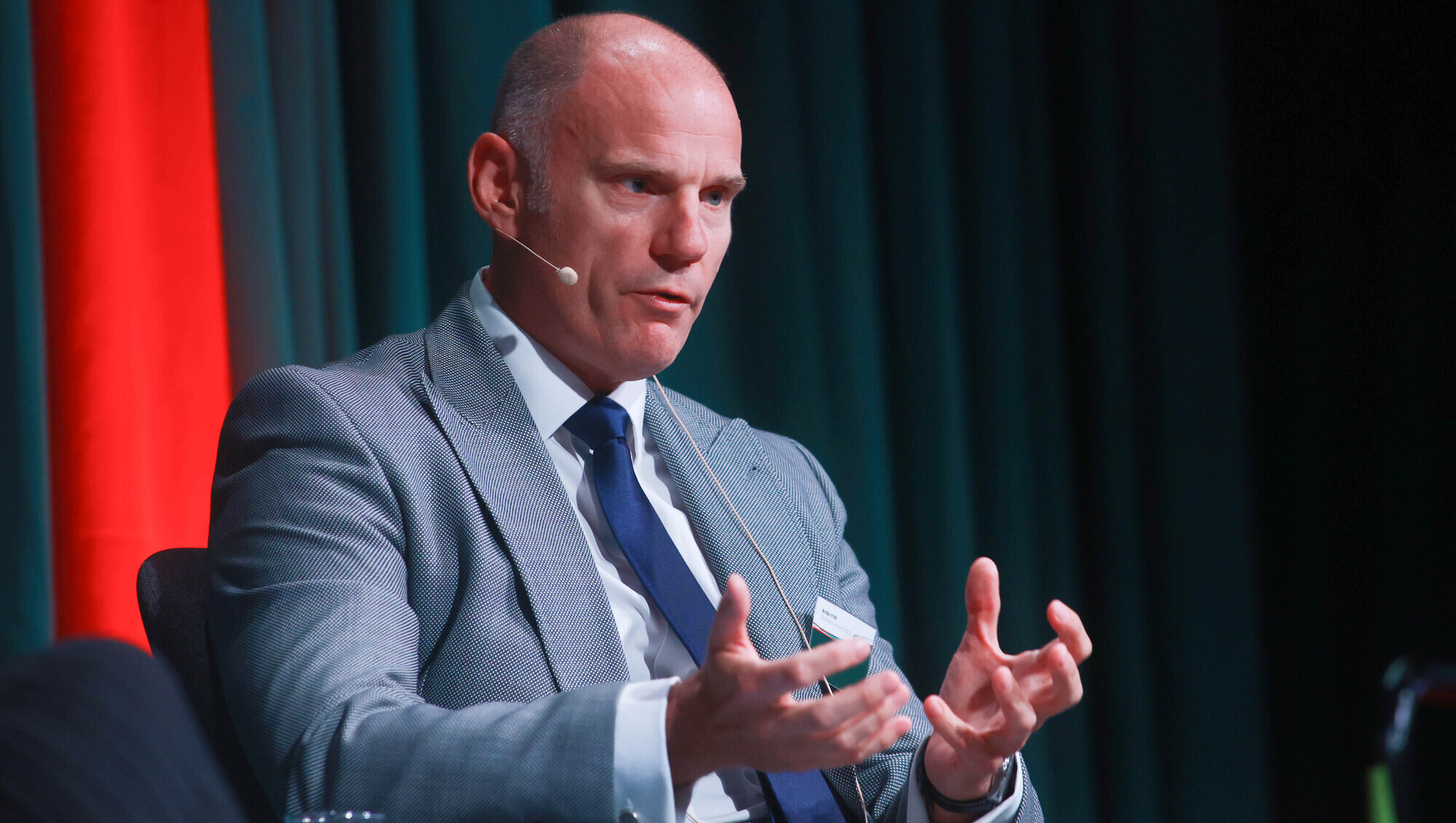
DAA chief executive Kenny Jacobs had announced that that he is to take time out of the business following months of tensions with the company’s board. Picture: Sam Boal/Rollingnews
While we wait for the European Court of Justice to share its views on the passenger cap at Dublin Airport — its initial opinion is due to be handed down by an advocate general in 26 days on February 12 — a no less interesting but tangential legal battle is being played out before Ireland’s High Court.
At one level, it has all the plot rich aspects of a sequel to corporate dramas such as to catch the attention of show runners for such as Netflix and Sky.
Why fret over creating content when real life can do that so much better for you?
At another, the statements placed into evidence provide the rest of us with a fascinating insight into the overlapping worlds of business, finance and politics.
In this case it is the dispute between the Dublin Airport Authority, the state-owned commercial entity charged with managing and developing Ireland’s principal airports, and its currently suspended chief executive Kenny Jacobs.
Mr Jacobs, a Corkonian with wide experience in leading companies (Ryanair, Tesco, MoneySupermarket, Accenture, Procter & Gamble) was stood down by his fellow board members last month while investigations took place into a raft of allegations made against him.
He has now filed an affidavit providing his view of the claims and motivations of the DAA.
Amid the cast of characters and props are Saudi princes and potentates, €70,000 bottles of whiskey, and a goodbye package reputed to be worth €1m.
The DAA, chaired by investment banker Basil Geoghegan, usually comprises 12 members including employee representatives.Â
It was expected to make its response to Mr Jacobs yesterday evening.Â
Its initial investigation, now put on hold, included two of those contemporary trigger areas of corporate responsibility: “Inappropriate behaviour” and “health and safety”.
Diverting though accounts of power struggles in the boardroom can be, we must not be distracted from the bigger picture which is the future development and scope of the nation’s airports and the role they play in a burgeoning economy.
The DAA’s purpose, to quote its own mission statement, is to “enable business and connect lives across the world.” It is difficult to see how that can be accomplished while the controversial 32m passenger limit, imposed in 2007 as a condition of the airport opening its second runway, remains in place.
A decision on this, following a ruling from the ECJ and a case before the Irish High Court brought by Ryanair and the US group Airlines for America (A4A), is likely before the end of the year.
And it is reasonable now to pose the question: What happens then? Passenger numbers are expected to exceed the 36m who travelled through Dublin in 2025. In a country already bedevilled by delays to mission critical infrastructure, partly because of skill gaps in the workforce, project managers must wonder where additional capacity will be found.
In this week’s authoritative 2025 On-Time Performance Review by Cirium, a respected aviation data analytics company, not one Irish airport was listed in the top tier of world performers.
Top-ranked global airports included Istanbul, Panama, Santiago and, among the “small airports” category, Guayaquil Jose Joaquin de Olmedo International Airport in Ecuador with 91.5% on-time departures.
Even Heathrow, the subject of much black humour in recent years, has improved dramatically with an on-target departure rate of 79.2%, making it Europe’s fourth most punctual airport behind those rigorous Scandinavians in Oslo, Copenhagen, and Stockholm. Dublin’s score was 71.9%, marginally ahead of Paris Orly, Berlin, and Gatwick.
London attributes improved performance to technological upgrade, the integration of AI into daily work schedules and new check-in systems.
Given the stated importance of our airports in generating growth and commerce we must be considering now how we will handle any surge in demand.Â
We have too much bitter experience of logistical, resource and planning obstacles impeding grand visions and laudable ambitions.
To paraphrase the poet TS Eliot in : “Between the idea and the action falls the shadow.”Â
It’s a warning to be heeded.
Podcasters the world over, and particularly those who specialise in “true crime” reporting, may like to pause this morning and raise a glass in memory of the man who started it all, Truman Capote, whose groundbreaking novel was published 60 years ago today.
Its compelling, immersive, non-fiction narrative of the murder of the Clutter family on an isolated Kansas farm in 1959 established a writing genre which many have followed.
The general obsession with true crime, unsolved mysteries, cold cases, dark tourism, mispers, and the grisly narratives which encourage some ordinary citizens to play amateur detective — sometimes to the point of monomania — can be traced back to his door.
Capote, assisted in his enterprise by a young Harper Lee, author of the Pulitzer Prize-winning , spent six years writing the story of the killers Dick Hickock and Perry Smith.
He visited them daily in prison “to win their trust” and attended the execution of Hickock by hanging.
His work explored moral ambiguity, psychological complexity, and social factors, all furrows that were ploughed by the groundbreaking Serial podcast of 10 years ago and the hugely successful West Cork series pioneered on Audible.
They all owe a debt to the man who started it.
It is tempting to be struck by the increasing tenor of public commentary about the shape of things to come when the island of Ireland, to borrow a phrase from antiquity, becomes “a nation once again”.
There was some serious speculation this week as to how a new public service broadcaster might be established to serve a unified country and replace the existing corporations of RTÉ and the BBC.
These doughty organisations have each been around for more than a century and carry huge legacies and traditions. Both are beset by problems. RTÉ is struggling to recover from scandals of finance and governance which have damaged public confidence. The reputation for rigour that it was rebuilding will not have been helped by the resignation of its experienced CFO Mari Hurley — who will depart after less than two years for a similar position with Ires Reit, the biggest residential landlord in the State.
The BBC has different problems in that it has been heavily attacked from the right in the UK over allegations of political bias and inaccurate reporting, particularly in respect of Donald Trump and its news and cultural coverage of Gaza.
The imbroglio over the mis-editing of Mr Trump’s speech, delivered during the day of the attack on the US Capitol in January 2021, for inclusion in a 2024 Panorama documentary sealed the fate of its director general, Tim Davie, and has led to a €9bn defamation claim against the corporation.
Both national broadcasters face a similar challenge from predominantly younger audiences who claim that they don’t use the programmes on offer because of their preferences for selective streaming platforms.
This is, in our opinion, a self-serving argument which does not attach sufficient weight to adequately funding an independent public service broadcaster to operate in the increasingly complex and noisy media landscape of the mid-21st century.
That provider has to be robustly independent of commercial interest and political interference if it is to maintain the confidence of the majority of the electorate.
The academics and researchers who have been speculating on this future from Ulster University and Dublin City University envisage 10 hubs across the country — in Cork, Dublin, Limerick, Waterford, Galway, Belfast, Derry, Enniskillen, Newry, and Athlone — and a wholly new organisation funded directly through taxation.
Another wholly new organisation for a united Ireland is something Drew Harris had in mind when he pondered all-island policing in the first interviews he has given since his retirement last September.
Mr Harris, the former commissioner of An Garda SĂochána, deputy chief constable of the PSNI, and a veteran of the Royal Ulster Constabulary, didn’t sugar coat the difficulties of establishing a unified service, which would have 20,000-plus officers and be second only in size to the Metropolitan Police in London — which has jurisdiction over nearly 10m people.
Examples of building such a behemoth were “pretty rare” he understated, and achieving such legitimacy in the unionist communities would be a “generational” matter.
In a thoughtful interview, Mr Harris also dwelled on the changing nature of policing itself, and the potential need to separate security matters from conventional crime fighting.
Liberal democracies such as Ireland and Britain are precious and face mounting threats, including interference with elections and cyber-attacks, he warned.
They might need “new models of national security” to protect themselves.
He didn’t enlarge upon what these “new models” might be. But it is important that debate moves forward on what a unified Ireland might look like.
We can expect the ambient noise on this subject to increase.