Political winners and losers can generally be defined by the length of time they can last at the centre of power.
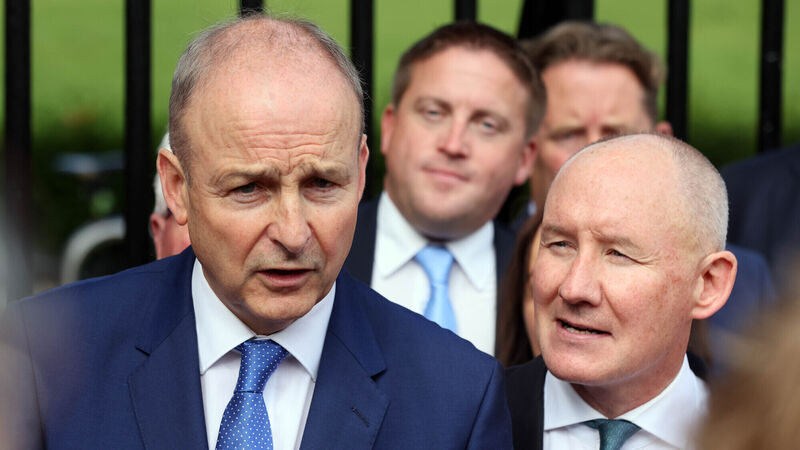
In longevity terms alone, that puts Taoiseach Micheál Martin right up there.
He has sustained his career at the epicentre of Fianna Fáil for going on 50 years; he came through the controversial Charles Haughey years when scandal and sustained allegations of corruption dogged the then leader and the party.
He survived the bitter Bertie Ahern years when, despite the huge achievements in establishing peace in Northern Ireland, the party once again fell from grace.
He also emerged from the Brian Cowen-era when the country’s fiscal improprieties landed us in the maw of the International Monetary Fund (IMF), which was called in to bail us out of an unprecedented financial collapse.
Martin survived all that and emerged to lead his party out of electoral meltdown and back into government — despite predictions he would become the only Fianna Fáil leader in history to never hold the highest political office in the land.
Despite his best efforts, it now looks likely he’ll survive the fiasco of the failed presidential election campaign, although serious questions remain — chief among them: Why did Martin choose Jim Gavin in the first place given he was a political novice, and any due diligence carried out was scant at best?
Martin again accepted yesterday that “we didn’t get this right”, about the process to select Gavin as the party’s presidential candidate and that he has “taken full responsibility for that...
“Our process is not correct” and “we did nothing different to what happened in ‘97 and 1990, but it’s not a good process”.
While it appears his position is once more as secure as is possible in modern politics, the sad fact remains that the debacle has probably further undermined voter confidence in the whole political process.
The electoral system here has undoubtedly been damaged by this ignominious episode, but it has come at a time when politics globally is fighting against apathy and wavering belief that the system works.
Martin and his government colleagues now need to step back from this mess and try not only to solve the many crises facing the country — housing, immigration, and health being just some of the issues — but to restore the public’s faith in the value of a robust democratic system.
If they cannot do so, then all their political lives will be short-lived.
No timeline for promised remedial works
It did not necessarily need a genius to ascertain that the answer to the problem of overcrowding at University Hospital Limerick was the provision of more beds.
A Hiqa report into the long-standing issue provided exactly that answer, albeit with three potential solutions.
That said, health minister Jennifer Carroll MacNeill possibly insulted everyone’s intelligence by asserting that “the key problem here is that there are not enough inpatient beds in the Mid-West to meet demand”.
Even so, the three potential solutions include extending capacity at UHL, build an elective hospital near to UHL, and the building of a new hospital in the region with an emergency department.
All very well and good, but anyone with an iota of smarts could have pointed to each of these remedies as being essential. The citizens of the Mid-West, who have for so long had to endure overcrowding and lengthy waiting times for any sort of a bed, will undoubtedly welcome the minister’s promise to advance all three solutions to this issue.
They will have one pertinent question, however: What timeline is in place to do the necessary work?
As of now, there is no timeline. And, for the doctors, nurses and, most importantly, the patients, the ideation of problem solving is wonderful, but the reality is considerably different.
Beijing is not fooling anyone
The thin veil that is now democracy in Hong Kong was further sullied this week with the conviction of former media tycoon Jimmy Lai on charges of sedition and foreign collusion.
While asserting that Lai was entitled to hold whatever political views he liked, the judges and the country that found him guilty actually brought into question those views and his entitlement to them.
While such high-profile trials are rarely held in public on mainland China, they still are in Hong Kong. However, since the 2020 imposition of the draconian National Security Law on the island and its citizens, the judges who decide on matters such as Lai’s alleged sedition are appointed by the China-controlled Hong Kong chief executive.
Such judges are appointed for a year and can be removed at any time if they are regarded as a threat to national security — ie if they do not do Beijing’s bidding.
China has, therefore, created a twin-track justice system in Hong Kong: One for dealing with day-to-day crime, and another for problem people like Jimmy Lai.
Beijing is not fooling anyone here, and the opacity of the system which convicted Lai of the most heinous of crimes is an extension of central policy. By claiming the system is a fair and equitable one, the Chinese and their puppets in Hong Kong are only kidding themselves.
CONNECT WITH US TODAY
Be the first to know the latest news and updates