Irish Examiner view: Ireland's military spending must prepare for the present
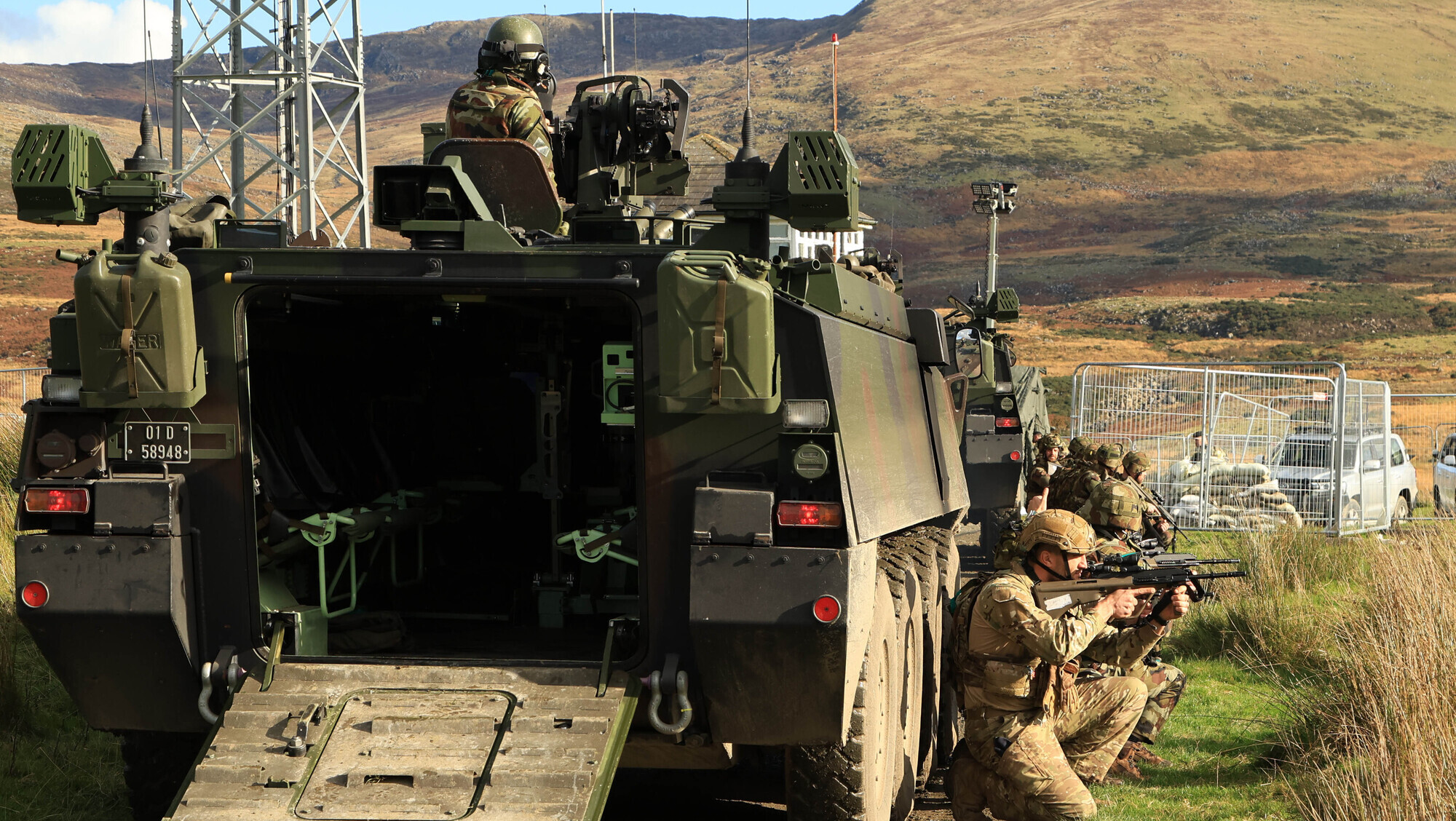
Members of the Defence Forces with a Mowag armoured personnel carrier training at the Glen of Imaal. Picture: Colin Keegan/Collins
Ireland is far from the forefront of military spending. Indeed, it is hardly at the bleeding edge of warfare generally.
Spending has been relatively low for a long time, leaving not only our army reduced in strength, but our naval service unable to patrol Europe’s largest territorial waters.
And as Liz Dunphy noted in her report on Saturday, our military rules of engagement have not been updated since 1980 — more than a generation ago in human terms, and several generations in terms of weapons development.
But then, we’ve never really had a pressing need to ramp up defence spending.
We’re a neutral country, with a proud record of taking part in peacekeeping missions, and no activities overseas that would garner us enemies or rivals.
Alas, however, the world is now in a place where that matters less than it used to — Europe, and its interconnected nature (such the undersea cables off our coasts), maybe provide a certain level of collective strength but we are increasingly seen as a weak spot.
The drone incursions around the time of Ukraine president Volodymyr Zelenskyy’s visit emphasised that, because while they were spotted, there seems to have been no effort to engage them, unlike in France recently where drones seen near a nuclear power plant were shot at.
And while anti-drone technology exists, we don’t have it in this country, although moves are afoot to have some sort of system in place sooner rather than later. Unfortunately, due to the ongoing illegal invasion of Ukraine by Russia, our tenure of the EU presidency has a far more heightened security dimension than it would have had in previous years.
Even if it did not, drone attacks, AI-powered disinformation campaigns, and cyber incursions are very much the forefront of warfare now, and given our exposed economy, vast marine area, and pivotal position connecting North America and European data networks, it is incumbent on us as a State to be ready to face those challenges now, rather than when it’s too late.
Much has been written on these pages, and elsewhere, on the rise and explosive spread of artificial intelligence (AI) technology.
By and large, the general consumer will associate “AI” (a clever branding for a prediction engine) with generative tools such as ChatGPT, Nano Banana, and others.
Most of the hype is based on these pieces of technology somehow being a step on the way toward so-called artificial general intelligence, though there’s little evidence they offer anything other than some assistance or, to quote Ethan Hawke, a “plagiarism mechanism”.
Neil Michael’s report in Monday’s edition explores how we should prepare more for automation and digitisation, job displacement rather than replacement.
That, in part, is because there has been a fall-off in white-collar entry-level jobs due to technological changes, even if higher human expertise is needed to ensure that the technology isn’t producing faulty results – and an MIT study recently showed that most AI projects generate no return on investment or otherwise fail.
That is despite a surge in workers making use of AI tools — which may or may not include chat-based software — even though it’s not always clear if that is employer-mandated usage, or just trying to find ways of making work easier.
Some of the tech giants have argued that AI can and should be used wherever possible in their companies. You will not be surprised to learn that one of the biggest proponents of this is Nvidia, on whose chips most Western AI systems are trained and operated, while Google CEO Sundar Pichai has said his job would be “one of the easiest” for AI to replace.
But then, he would say that, given that his company’s AI tools are quickly eating into OpenAI’s market share, and shareholders do not want to be backing an AI sceptic.
And while technology and other advances have regularly disrupted jobs throughout history, on the whole more jobs have been created than outright eliminated.
And as Neil Michael’s report suggests also, some of those who have seen their jobs made redundant (because it’s the job that’s redundant, not the person) have left on voluntary parting programmes anyway.
These people may have been fortunate to leave with a nest egg before moving into a different field or company, and not everybody who leaves a job is so lucky.
The only thing that is really clear about the future of AI and the workplace is that it is far too soon to tell if the technology will even deliver on half the promises of its creators.
Age is increasingly just a number, between the ongoing trend of later pension ages as well as the great many active retirees living as broad a life as they did in their youth — sometimes broader. And this is, in turn, increasingly being recognised as a business opportunity, with the “silver economy” — or “longevity economy” to give it its more proper title — worth a considerable amount of money, some of which is still there to be earned by companies and entrepreneurs offering the right services for the clientele.
Older life is frequently dynamic, and there is no reason to think that is going to change any time soon.
As reported in Friday’s Money & Jobs, the sector, which ranges from health and banking to tourism (and not just cruise ships), has been estimated by a European Commission study to be potentially worth €5.7tn, contributing 32% of EU GDP and supporting 38% of EU employment.
Life in retirement can constitute up to a third of our lives, so it is only fitting that a whole and fully flesh out service industry cater for that time.
John Daly’s report also pointed out how important the silver economy could be to our vital hospitality industry: “By 2030, seniors are projected to make up 35% of all international travellers, according to the World Tourism Organisation... Their focus on wellbeing and comfort includes cruises, spas, and personalised tours — often in off-season travel to avoid crowds and optimise costs. Senior tourism is projected to generate €500bn by 2030, reflecting an average growth rate of 7% per year compared to 2020.”
We should not ignore that there are many older people who struggle with financial and health issues, nor should we ignore the gravity of some of those situations.
However, on the whole it seems better that what Americans call senior citizens are better recognised as economically as well as socially important, at home and abroad.

CONNECT WITH US TODAY



Be the first to know the latest news and updates