Irish Examiner view: Mood swings as vote nears on end-of-life

British prime minister Keir Starmer is supporting a change in the law, although there will be a free vote as a matter of conscience. Picture: iStock
The bill entitling an act to establish a legal framework for assisted dying in Ireland was one of the measures which lapsed with the dissolution of the Dáil and the Seanad for this general election.
That means any progress when the 34th Dáil is selected can be informed by what happens in the jurisdiction next door, where matters are no longer as clear cut as they once seemed.
This Friday, MPs will vote on a private members’ bill put forward by Labour’s Kim Leadbetter, parliamentary successor to her murdered elder sister Jo Cox in the Yorkshire constituency of Spen Valley.
British prime minister Keir Starmer is supporting a change in the law, although there will be a free vote as a matter of conscience. While there had been considerable momentum in the campaign with eloquent interventions from the TV personality Esther Rantzen and deathbed recordings from the actress Diana Rigg, more than 100 MPs ,including half a dozen members of the British Cabinet, are said to be opposed or undecided.
The justice secretary, Shabana Mahmood, in a letter to constituents said it would place the country on a “slippery slope towards death on demand”,

Scroll for results in your area
Much of the recent argument has focused on the provision and standard of palliative care, with supporters of legal change saying that an excellent service must be provided alongside the option of assisted dying if terminally ill people are to have a genuine choice about the end of their life.
Our neighbours have more than 200 hospices that provide some 300,000 people with palliative and end-of-life care. These cost around €1.8bn to operate with a mere €600m of this being supplied by the British government. Most of their funding relies on donations, legacies, charity shops, and fundraising. One in five of them has been cutting services including closing beds and making staff redundant.
Legalising assisted dying harms progress in hospice care, an international study carried out by Oxford University has found, with Professor David Jones of the Dominican Blackfriars Hall concluding that the two forms of service “compete for funding”, with “no evidence” that funding increases are sustained. His findings contradict previous reports which found no correlation.
This is a sorry business, and into it has stepped the influential figure of Gordon Brown, the former PM and chancellor, who says the debate is moving too fast given the “profound ethical and practical issues” and the state of the national health service. Instead of a yes/no vote, he wants a commission to devise a “fully funded, 10-year strategy for improved and comprehensive palliative care”.
Mr Brown carries emotional, as well as intellectual, weight into this argument, saying that the death of his 11-day-old daughter in 2002 convinced him of the “value and imperative of good end-of-life care”. He added that the time he and his wife, Sarah, spent with their baby Jennifer “as her life ebbed away” was “among the most precious” of their lives.
There is some evidence that the views of politicians lag behind public opinion. A recent YouGov poll found almost three quarters of Britons believe in principle that assisted dying should be legal, with 13% against. Meanwhile, 55% of respondents would go further than the current proposal, saying assisted dying should be legal for people with debilitating incurable conditions that are not terminal.
There will be further powerful advocacy this week on both sides and our own lawmakers will be listening intently. Legislators will be studying Friday’s outcome closely, as will the many in this country who have an interest in the subject.
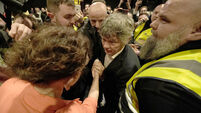
That Taoiseach Simon Harris executed what in tabloid newspaper circles is known as a “reverse ferret” — a fast change of direction — over his encounter with care worker Charlotte Fallon in a Kanturk supermarket might tell us something about the tightening nature of the general election campaign.
Mr Harris’s exchange, in which he was told that the disability sector had been “ignored” and that he was “not a nice man”, was captured and, of course, widely shared on social media.
Mr Harris was aware that he appeared brusque, and took to Instagram later to express regrets.
“I was in Kanturk last night at the end of a very long day, and I was talking to a woman who works in a Section 39 disability organisation and she was raising issues with me,” he said.
“I want to say I didn’t give her the time that I should’ve given her, and I feel really bad about that because it’s not who I am.”
Mr Harris also called Ms Fallon, who works with St Joseph’s Foundation, to apologise for not engaging more fully. Fellow ministers Helen McEntee and Paschal Donohoe were called upon to defend their party leader.
“His commitment to support those who have additional needs within our society is the north star of Simon Harris’s political career,” said Mr Donohoe.
Chance encounters and impromptu comments are dangerous for politicians, which is why many avoid them.
Mr Harris may be more at ease in Tuesday night’s leaders’ debate on RTÉ and rather less prone to combat fatigue opposite more familiar opponents.
When people consider the impact of the world’s most successful industries, too little attention is paid to gaming — which is experiencing unprecedented and rapid growth.
The global market is projected to amount to €504bn next year, up from €396bn in 2023, and this is important for Ireland which has a foothold on this virtual territory.
The revenue for Larian, which has an enormous hit with , is run through the Republic and there are studios in Dublin, Ghent, Warsaw, and Quebec. The company has posted a €249m pre-tax profit.
Another gaming giant, Epic Games, which has its Europe, Middle East and Africa headquarters in Dublin, booked more than €1.54bn in revenue through its Irish subsidiary.
Meanwhile , the best-selling video game of all time, has announced plans to enter the real world by opening theme parks, hotels and retail outlets initially in Britain and the US.
Even this giant has an Irish connection. In 2015, was given to every secondary school in the North for free as part of a cultural technology festival. Perhaps Minecraft World will arrive here more quickly than we think.

CONNECT WITH US TODAY



Be the first to know the latest news and updates