Irish Examiner view: Pool strategy a big step forward for all swimmers
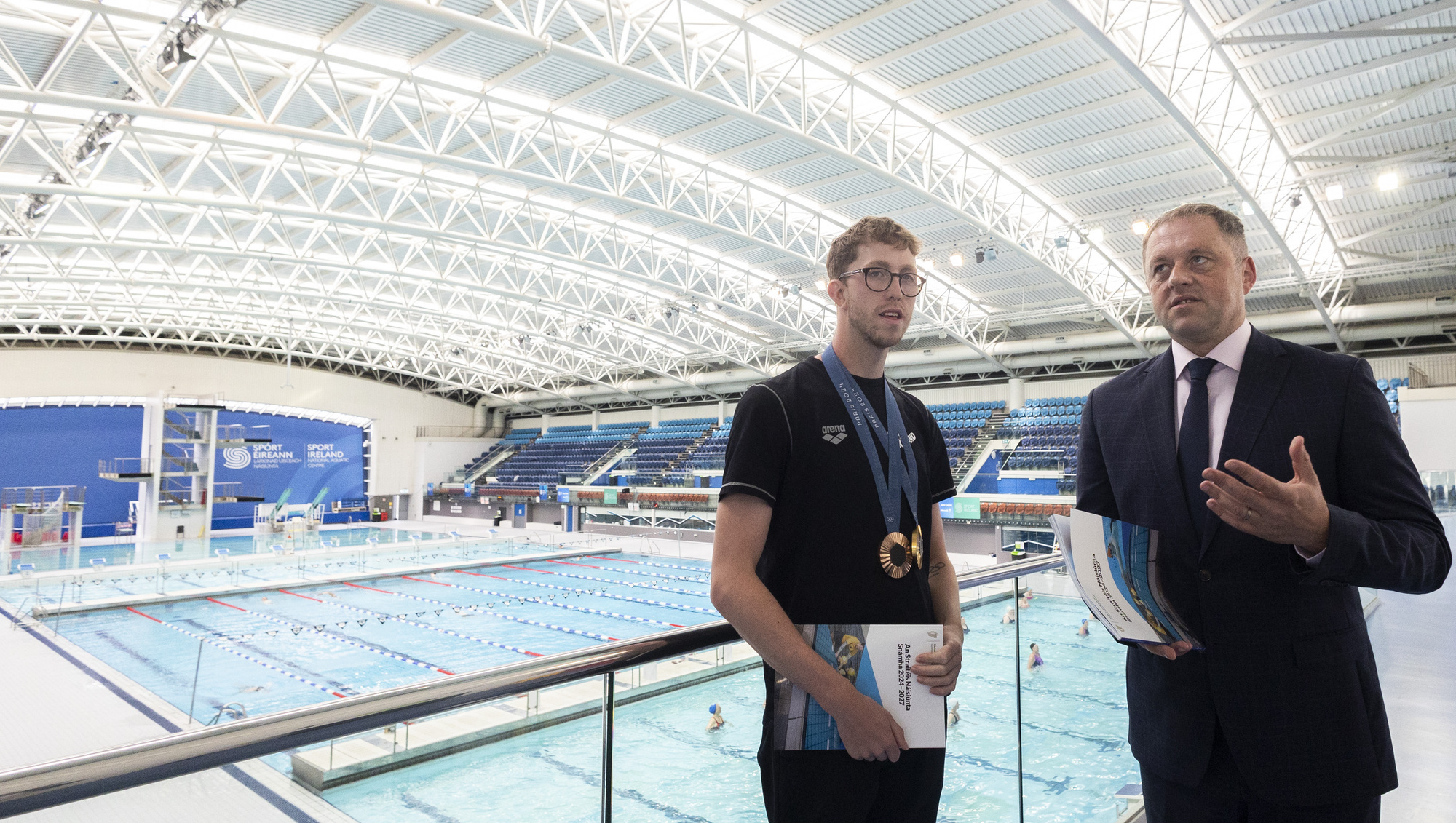
Daniel Wiffen and Thomas Byrne at the launch of the national swimming strategy at the National Aquatic Centre. Picture: Sam Boal/Collins Photos
The plan has been in gestation for several years and is intended to address the gaps and deficits in swimming provision.
The announcement is welcome, as access to swimming pools is uneven around the country, to say the least. This is particularly noticeable when compared to the ubiquity of facilities for the major field sports, and it is long past time that more people were given opportunities to swim in more parts of the country.
Mr Byrne cited other plans for sports facilities yesterday, ranging from the national badminton and velodrome centre to a national cricketing centre of excellence, which are also laudable.
It is worth pointing out, however, that swimming is slightly different to many other sports in that it is also a basic life skill which every citizen should have the chance to master.
All sports and games are loud in claims of how much they benefit participants, but it is difficult to find any which can surpass the enormous mental and physical health benefits derived from swimming. As a physical exercise which can be enjoyed by all ages and at all levels of expertise, swimming is difficult to beat.
While Mr Byrne mentioned plans to construct and upgrade pools around the country, swimming also enjoys a considerable advantage over other pursuits in that it can also be practised in rivers and lakes, as well as the sea itself. So-called ‘wild’ swimming confers another benefit in that it raises consciousness about our environment and appreciation of our natural resources.
On that front, imaginative projects such as the Cork Lido, whose supporters are advocating for a European-style lido facility for the River Lee, should be given serious consideration. This is how swimming is also a means of opening up urban spaces, yet another advantage it enjoys over other activities.
The national swimming strategy deserves wholehearted support. Not all of us can be Olympic medallists, but almost all of us can be swimmers.
Norma Foley put it bluntly this week: “I am now in a space where I’m looking to introduce a ban on the mobile phone at post-primary.”
On the face of it, this looks like a good move, surely. There is good evidence that schoolchildren find it difficult to re-focus in class once they have been distracted by their phones, with accompanying consequences for their classmates and teachers. It can hardly be conducive to learning if pupils are using their phones in class.

It was surprising, then, to read the director of the National Association of Principals and Deputy Principals, Paul Crone, state “we can’t be naive enough to think that they’re [pupils] not going to have a mobile phone”, and push for consultation with students and parents on any mobile phone ban.
When Mr Crone added, “...already all second-level schools would have a strong [phone] policy in place over many, many years”, however, his comments pointed up some of the contradictions involved in this area.
Conceding that pupils will bring phones to school is an overt acknowledgement that strong policies in this area are necessary. Yet if those policies were strong enough — or enforced properly — then a phone ban would hardly be considered necessary, even as a last resort.
These policies may be considered ‘strong’ in an abstract sense, but how strong can they be if they don’t work?
At a time when teacher shortages are in the headlines ahead of the return to school, an apparent reluctance to consider a blanket ban on mobile phones in secondary schools is puzzling.
Surely any measure which would improve concentration levels among pupils, while also lowering demands on teachers who have to police phone use, should be welcomed by those at the coalface in our schools.
And all this without the malfunctions which occur with wearying regularity.
However, the tide may be turning. Retail experts in the US are predicting that outlets such as Costco, Walmart, and Wegmans may have to shut down self-checkout as an option because the cost of security staff at those locations is offsetting any potential savings on checkout staff costs.
British supermarkets appear to be taking the same tack, with Morrisons admitting the self-service option had “gone too far”, Asda announcing it would be putting more staff on checkout duty, and Booths removing self-checkouts entirely after customers complained that they were slow and frustrating to use.
Will Irish outlets follow suit? They will surely take note of what their counterparts overseas are doing, as well as one significant figure: Estimates of annual losses worldwide to self-checkout theft range as high as $4.5bn, or €4.03bn.
A strong argument in favour of telling customers you are now opening till number three.


CONNECT WITH US TODAY



Be the first to know the latest news and updates