Irish Examiner view: Nell McCafferty was a powerful voice for social justice
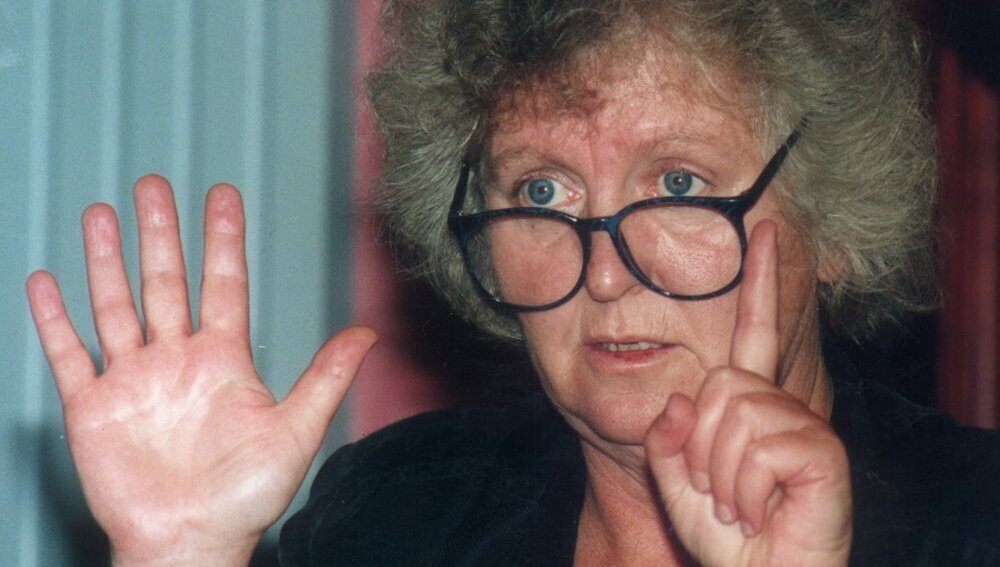
NELL MCCAFFERTY
The passing of Nell McCafferty this week closes the door on a specific era of Irish life.
The Derry native reported on a wide range of subjects in a lengthy career in journalism, but for many she will be forever associated with a variety of issues which might be generally termed matters of social justice.
Though her rise in journalism in the 70s coincided with the explosion of the Troubles in her home place, she made her name with groundbreaking reporting on the operation of the family courts in Dublin and was also involved in the struggle for women’s rights in the Republic.
The reality of that struggle was underlined the following decade in the Kerry Babies case, which McCafferty covered in detail, eventually publishing a book on the matter with a resonant title: .
If her later work did not have the same urgency and energy as that of the 70s and 80s, then that is no indictment, she never lost the fearlessness or spirit that inspired her writing.
McCafferty was an intrepid reporter of systemic inequality and injustice in an Ireland that was often actively and overtly anti-woman.
Those accounts of the chaos which was visible in the family courts (and by extension, existed behind the facade of many Irish families) radicalised readers.
She was a witness to the shameful treatment of Joanne Hayes at a tribunal which had been set up to investigate the behaviour of the gardaí in the Kerry Babies case, but which was so distressing for Hayes that she had to be sedated when giving evidence.
That was the Ireland Nell McCafferty reported on.
She invited our society to regard itself as it was in reality, not as a false ideal.
She helped to change the country and to make it a better version of itself: A considerable achievement for any journalist.
Ar dheis Dé go raibh a hanam.
The annual report from Forensic Science Ireland (FSI) offers an informative overview of the organisation’s work.
Its DNA database assisted over 730 investigations last year and, in one case, helped secure a conviction in the killing of Nora Sheehan, which occurred in 1981.
However, its work regarding drugs — and cannabis in particular — raises different concerns.
The FSI has stated that there is a ‘Wild West’ marketplace for cannabis in Ireland, adding that there is a “dizzying array” of synthetic versions of the drug in circulation and that it accounted for 42% of all cases analysed.
The variety in types of cannabis and cannabis-related products has led to problems in a variety of areas, according to the FSI.
Mislabelling of the cannabis ingredients in certain products has led to adverse side effects from ingestion, for instance, a phenomenon which is on the rise.
The FSI also cited a case in Cork in which four children were hospitalised after using vapes which contained HHC, a semi-synthetic cannabinoid.
The prevalence and potency of synthetic cannabinoids such as HHC are ongoing challenges.
The old saw that cannabis was a ‘gateway’ drug to lethal substances, and was not as dangerous in and of itself, may no longer have currency, but that has been replaced by a far more sinister reality.
We recently learned, for instance, of overdoses in Portlaoise Prison due to the suspected use of nitazene, a potentially lethal synthetic opioid.
Yet if schoolchildren need to be hospitalised after using vapes with cannabinoids, then cannabis-related products are a significant threat to public health in and of themselves without ever becoming a stepping stone to other drugs.
The FSI’s work in solving murders may grab the headlines, but it has pinpointed a different challenge here which will have to be addressed.
At first glance, it looks like one of the reliable flashpoints of the easily offended, a case for someone muttering about health and safety gone mad.
The Royal Society of Chemistry in Britain has called for licking an iced lollipop to become an essential part of the national curriculum for primary schoolchildren in England.
To give that society its due, it is not proposing that school lessons be devoted to instructing small children in the exact methodology of licking a lollipop.
There does not appear to be any suggestion of lesson plans organised around the steps necessary to first unwrap and then consume a Choc Ice.

The society is advocating that this and other activities — such as kneading dough, digging in the soil, planting vegetables, and playing with shadows — become part of children’s early science education because of fears that the subject may be squeezed out of the primary school curriculum across the water.
A society spokesperson said: “One of the recommendations for chemistry is that by the age of 11, all children should start to understand how temperature works and how heating and cooling can change things.
“What better prop is there for a teacher to help explain this than an ice lolly?”
Clearly it can be a challenge to engage children with scientific concepts, and it is worth pointing out that experiences such as planting in gardens or kneading dough are not available to all kids.
However, at the risk of getting the wrong end of the (lollipop) stick, this plan seems to have one fatal flaw.
Whether they’re familiar with the laws of thermodynamics or not, is there a child alive who doesn’t already understand that licking a Calippo cools you down?
CONNECT WITH US TODAY



Be the first to know the latest news and updates