Irish Examiner view: The second hand of destiny is still ticking
Korean War anniversary reminds us how close we came to world war — a risk we are revisiting with Russia's invasion of Ukraine
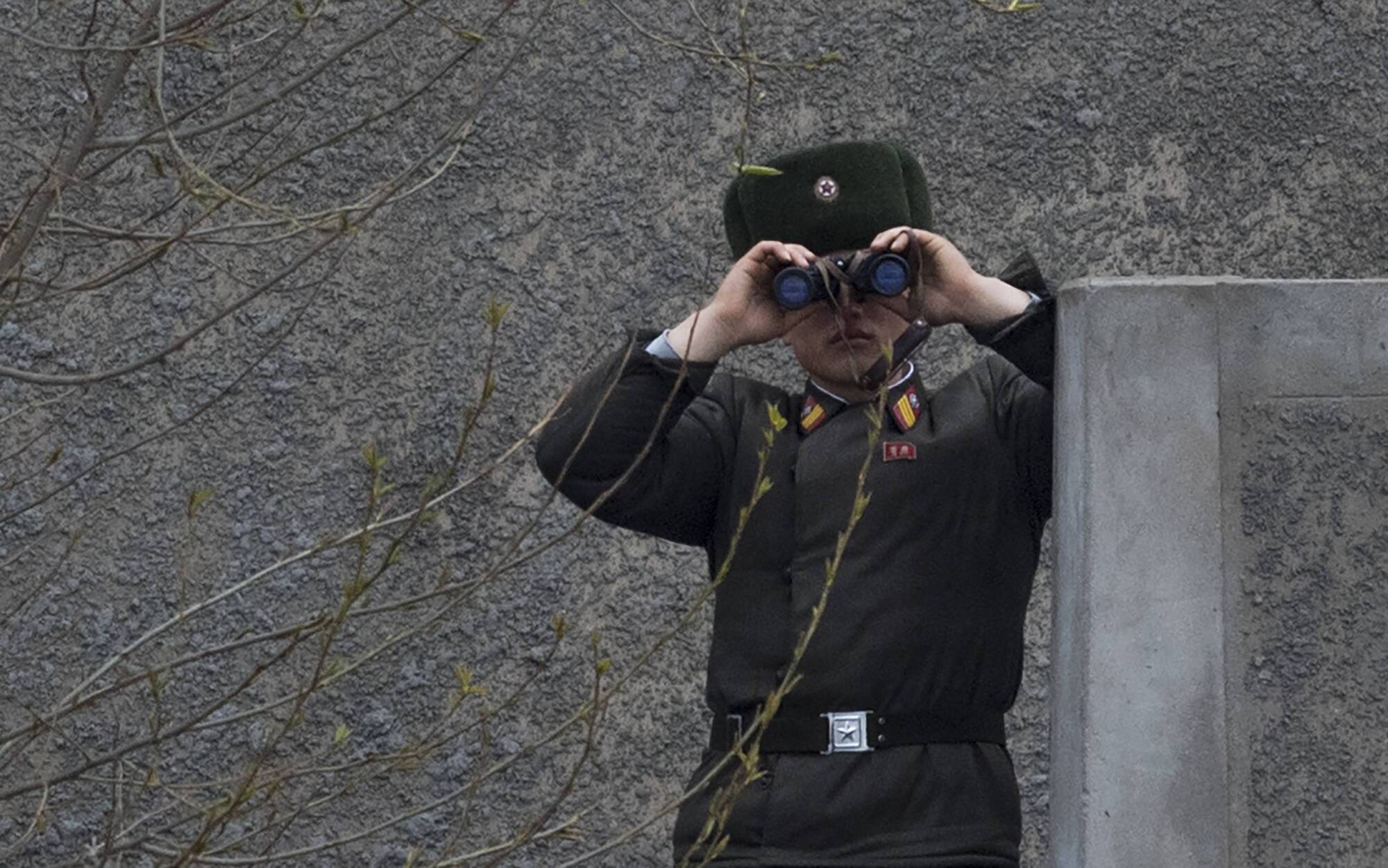
A North Korean border guard scrutinising the Chinese side of the frontier across the Yalu river near the Chinese city of Dandong. File picture: Johannes Eisele/AFP/Getty

A North Korean border guard scrutinising the Chinese side of the frontier across the Yalu river near the Chinese city of Dandong. File picture: Johannes Eisele/AFP/Getty

You would need to be an octogenarian to maintain a clear memory of the last time the armies of the democratic West openly lined up against the forces of China in a shooting war.

Yet while the 70th anniversary of the end of the Korean War is marked this Thursday, many of the issues it failed to resolve remain live and dangerous to this day. And, at its core, the relationship between Moscow and Beijing is an even greater conundrum now than it was then.

The list of belligerents from the 1950s is chilling. Mustered behind North Korea were China, the Soviet Union, and the USSR satellite states of Albania, Bulgaria, Czechoslovakia, East Germany, Hungary, Mongolia, and Poland.

Facing them were South Korea, backed by the UN with fighting forces from the US, the UK, Canada, Turkey, Australia, Philippines, New Zealand, Thailand, Ethiopia, Greece, France, Colombia, Belgium, South Africa, Netherlands, and Luxembourg.

Medical support was provided by Sweden, India, Denmark, Norway, Italy, and West Germany as well as the Americans who managed to base an iconic film and comedy series, M*A*S*H, on the history of the conflict. Further logistics were provided by Israel, Taiwan, Japan, Pakistan, Uruguay, El Salvador, Spain, and Yugoslavia.

Ireland did not become part of the UN until 1955 so had no direct involvement in the action, which commenced in the midsummer of 1950 when North Korea invaded South Korea following a series of border clashes along what became famous as the 38th Parallel, the dividing line conjured up after the Japanese occupation during the Second World War.

But many Irish people of birth and heritage died in the service of the UN, or as non-combatants working with missionary orders, and their sacrifice is marked with a special memorial in Seoul, the capital of South Korea. The greatest number of fatalities occurred in a battle in January 1951 in a location known as “Happy Valley”, where the Irish played a key role in a last defence against an onslaught on Seoul by North Korean and Chinese forces.

Then, as now in Ukraine, division was on grounds of political doctrine. The Russians — who had a close relationship with the Communist Chinese — sponsored Pyongyang.  The US backed the capitalist South. 

Then, as now, there was tension over the position of Taiwan, which had been formally recognised by the UN, prompting Moscow to boycott the organisation.

The devastating war claimed some 5m lives and hundreds of thousands of casualties. 

At that time, Russia was seen to be the senior partner, although China provided most of the manpower. American forces, led by General Douglas MacArthur, came close to crossing the Sino-Korea border before MacArthur was restrained, and eventually sacked, by US president Harry S Truman. MacArthur had said: 

I can almost hear the ticking of the second hand of destiny. We must act now or we will die.

It was as close as we have come to world war at any time since 1945, until the Russian invasion of Ukraine has unleashed new and horrifying risks to global security. But this time there is a difference.

China is the most powerful power broker and Russia is supplicant for its support in its aggression. Taiwan is still viewed as unfinished business by those in the compound of Zhongnanhai next to the Forbidden City in Beijing. And the Supreme Leader of North Korea is the belligerent grandson of Kim Il Sung, the man who turned on his neighbours in the south in 1950.

Danger, whichever way you look.

A parable of loneliness today 

We may never know the full details and background to the case of the English couple who were found dead at their home in Cloneen, Tipperary, in June 2022, having not been seen for 18 months. But the story remains poignant and, in its way, a parable of modern loneliness.

The reclusive Nicholas Smith, 82, a retired sea captain, and his wife Hilary, 79, left assets worth several hundred thousand euro, according to reports, in addition to the value of their bungalow. 

A torn-up letter analysed by gardaí appears to be a statement written on Christmas Eve 2020 by Ms Smith in which she said it was “not your normal letter”, that she was writing it with “arthritic hands” and that she was “weak due to lack of food”.

She lamented the quality of the Irish healthcare system, although there has been no evidence presented that either she, or her husband, received anything other than competent care. It is apparently clear from the text that the couple harboured distrust of the medical profession.

When individuals cut themselves off from the world, it allows no scope for external perspective and debate. All that is left is a terrible isolation and the repetition and reinforcement of fixed ideas. It is why we all need companionship, and never more so than when we get old.

Although the final letter was said to have been written on December 24, 2020, at least one of the couple is likely to have still been alive on January 8, 2021, when a passage was highlighted on an eBook reader. It was from the thoughtful ML Stedman novel, The Light Between Oceans, set in Australia and about a childless couple who find a baby girl in a washed-up dinghy and decide to raise her as their own child. 

In it, the author writes: “Isolation spins its mysterious cocoon, focusing the mind on one place, one time, one rhythm.”

A reminder not to withdraw into ourselves. That way lies darkness.

A new challenge

Running a local authority for a prolonged period can be a little like banging your head against a brick wall — lovely when it stops. 

All that political pressure, with dozens of councillors, competing priorities, societal change, impact of central government policies, budgets to be balanced, alterations to corporate rules and guidelines. Like the sea, always changing, but always the same.

Well done, then, to Tim Lucey, who is leaving Cork County Council at the end of September after more than four decades serving the people of Cork.

Mr Lucey faces another challenging role as head of Greyhound Racing Ireland, which has not been without its tribulations and controversies in recent years. The body received €17.6m in State funding for 2022.

We wish him well for the future.

More in this section

Revoiced

Newsletter

Had a busy week? Sign up for some of the best reads from the week gone by. Selected just for you.

Cookie Policy Privacy Policy Brand Safety FAQ Help Contact Us Terms and Conditions

© Examiner Echo Group Limited