Irish Examiner view: Health reform is a challenge for the age
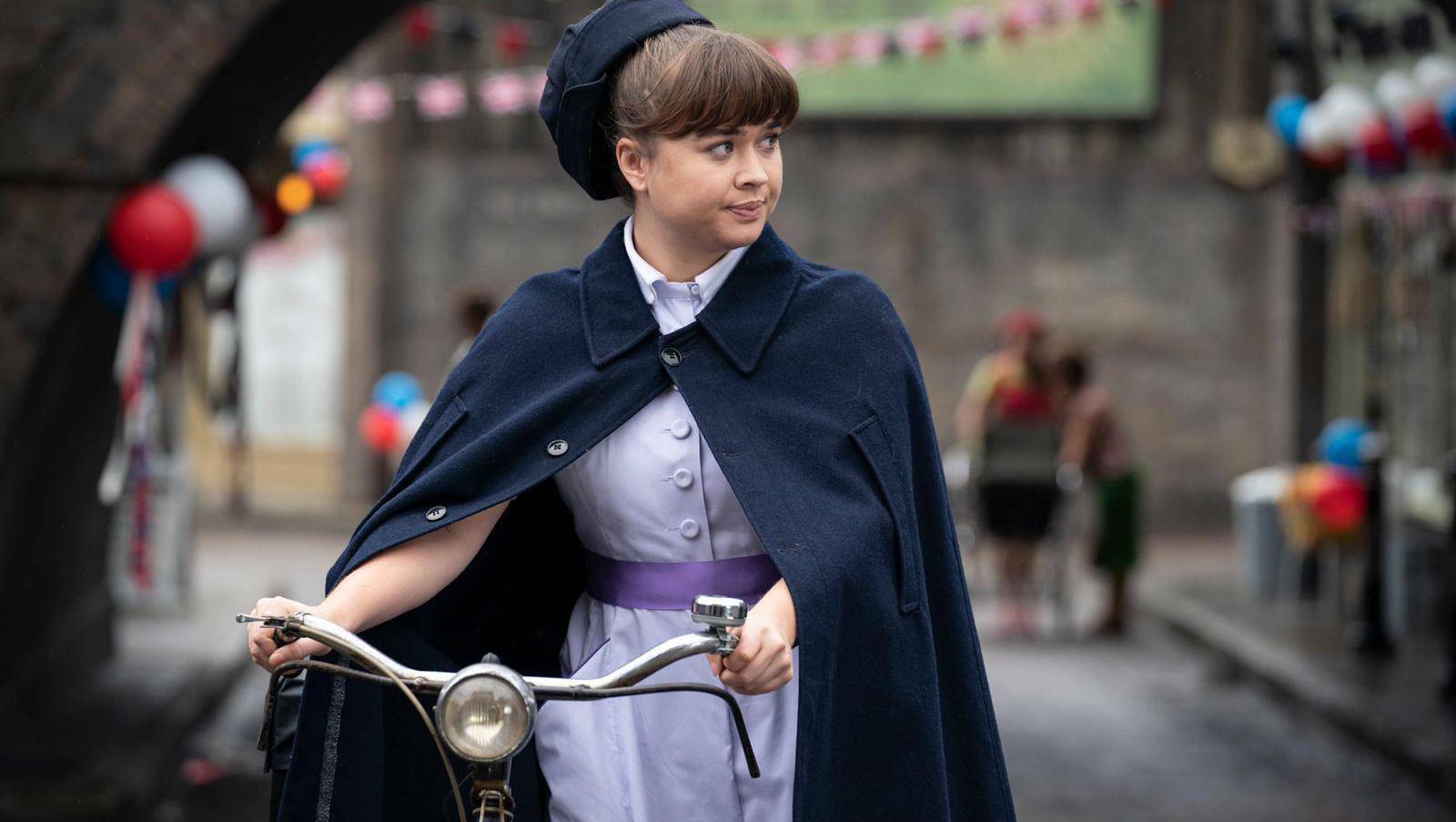
Nancy Corrigan, played by Megan Cusack in the BBC series 'Call the Midwife'. Irish nurses were the backbone of Britain's NHS in the 1950s and '60s. Today, Irish personnel make up some 21% of staff in our neighbour's health system. File picture: BBC
The 75th anniversary of Britain’s National Health Service passed with relatively little comment in the Republic this week, perhaps because we were all so agog with news of high jinks emerging from Donnybrook. And perhaps because it is a painful reminder of our own failure, nearly eight decades after the achievement of our neighbour, to provide, via becalmed Sláintecare reforms, an accessible single-tier health and social care system, where equitable access to services is based on need, and not ability to pay.
And there is another complication to furrow collective brows. Ask anyone who supports the reunification of Ireland what their thoughts are on ensuring that the health benefits made available to citizens in the North — currently the most heavily subsidised area of the UK at patient level — will apply in the future, and you will struggle to receive convincing and credible answers. Like Sláintecare, it is a conundrum for the forward planning and strategic thinking teams.
Yet Ireland’s contribution to Britain’s health service has been formidable, and the prevalence of the comforting image of “the Irish nurse” has stayed in that country’s collective psyche for generations. In part, this is due to an energetic recruitment campaign for trained and trainee nurses during the Second World War and following the peace. Nursing staff were exempt from wartime restrictions on Irish immigration.
During the 1950s and '60s, NHS staff travelled around our country signing up teenage girls for training and employment. In a revealing piece of research and podcasting involving London Metropolitan University and the London Irish Centre, they were described as “the backbone” of the NHS.
During the '60s, some 11% of all nurses recruited to hospitals in the south east of England were born in the Republic. By 1971, there were 31,000 Irish-born nurses in Britain — constituting 12% of all nursing staff.
Even now, post Brexit, and with the allure and paycheques of the Australians, there are 10 times as many Irish workers in the NHS than those from other major European countries such as France and Germany. We account for around 21% of NHS doctors, nurses, and infrastructure staff. Only India and the Philippines have more nationals than us.
Neither Britain nor Ireland train enough healthcare staff for our own needs, and the demand for workers with medical expertise is likely to increase. Indeed, we can see this already in the recent stories about gaps in dentistry provision and the repeated failure to fill vacancies on our wards.
When charismatic Welshman Aneurin Bevan introduced the National Health Service in 1948 under the reforming Labour government of Clement Atlee, the first public information leaflet said: “Anyone can use it — men, women, and children. There are no age limits, no fees to pay. You can use any part of it, or all of it, as you wish.
“It will provide you with all medical, dental, and nursing care ... you will also be entitled to all forms of treatment in general or special hospitals, whether as an in-patient or as an out-patient. These include ... maternity care, sanatorium care, care of mental health, and all surgical operations.”
Medicines and drugs were to be free, upon prescription, from any participating chemist.
It was a hugely ambitious project and has now proved to be ultimately unaffordable as the range of treatments is of a scope that was never originally envisaged. Its 1948 budget was £250m. Since then, population has aged; new ailments have been discovered; DNA was just an idea in the heads of Francis Crick and James Watson; the link between tobacco and cancer was a theory; vaccination programmes were unknown; the contraceptive pill had not been developed and there were no state abortions; there were no heart/kidney/liver/lung transplants. There were no CT or MRI scans; no screening for breast cancer.
Its 2023 budget is €211bn, a scarcely conceivable sum and one way beyond the conception of Nye Bevan who said: “No society can legitimately call itself civilised if a sick person is denied medical aid because of lack of means.”
The promise remains of a free-at-the-point-of-use universal health care system. How a united Ireland will subsume the advantages enjoyed by 2m people on this island into its own vision of the future will be one of the challenges of our age.
CONNECT WITH US TODAY



Be the first to know the latest news and updates