Irish Examiner view: Pope must seize chance for change
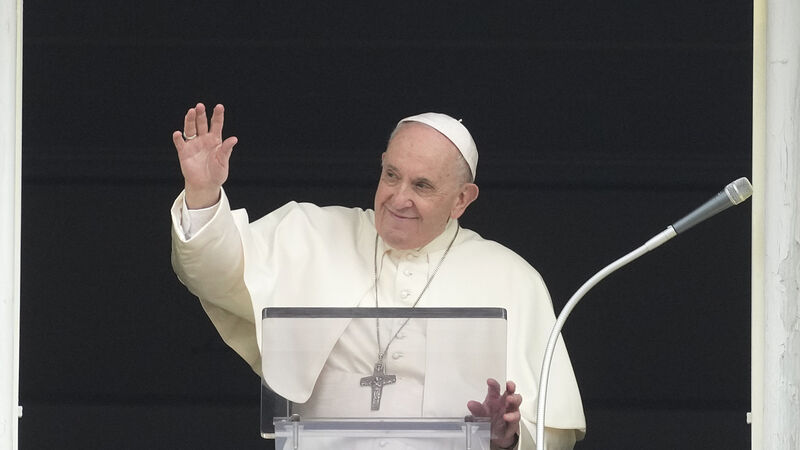
Pope Francis waves to faithful during the Angelus noon prayer in St. Peter's Square at the Vatican, recently. Picture: AP Photo
Known for shunning the trappings and luxuries of former Buenos Aires cardinals, it was hoped Pope Francis, the first Bishop of Rome to be elected from the Americas, would modernise the Church which provides spiritual guidance for more than 1.3bn Catholics, through radical reform.
He has spoken eloquently about the suffering of women, acknowledged the “male authoritarianism” of the Church and yet continues to deny women a level playing field — through ordination or decision-making power — in the Church’s future.

The lack of reform or vision led former President Mary McAleese to describe the Church in 2018, five years after Pope Francis was elected, as “one of the last great bastions of misogyny”.
He has vigorously and impressively challenged lawmakers on climate policy, as recently as last weekend when he told parliamentarians ahead of COP26 to use “the fundamental virtues of good politics” in their ambitions to tackle climate collapse.
While the round-the-world papal trips jar with this sentiment, it is an area in which he has at least provided steadfast leadership. His mixed-messaging on homosexuality continues to cause confusion and the Vatican’s stance that priests cannot bless same-sex unions continues to blight his reform agenda as a result.
The Pope’s supposed ordinariness, his commitment to the poor and to change were all factors that enthused Catholics and many lapsed Catholics, upon his appointment.
But just last week, a report in France brought back into the public eye the Church’s single biggest failing that it cannot and must not be allowed to forget.
The horrific report found that hundreds of thousands of children were sexually abused by clergy and lay people connected to the Catholic Church over decades.
Pope Francis has been criticised for his, and the Church’s, response to the continuing scandal of sexual abuse of children. This time, he expressed “shame” for himself and the Roman Catholic Church and acknowledged failures in putting the needs of victims first.
Reform of an institution as vast as the one he leads was always going to take time and the lack of appetite for structural reform cannot be pinned solely on its spiritual leader.
But the latest exercise in listening and understanding, launched on Sunday, might be his last chance at establishing the Catholic Church as a spiritual guide for many who have strayed from Catholicism.
A two-year consultation, For a Synodal Church: Communion, Participation and Mission, will seek the views of every Catholic parish in the world. The three-stage process will see a “listening” phase, which will include emphasis on seeking views of those on the fringes of Church decision-making, including young people, women and minorities.
Following discussion by bishops at both a national and international level, they will come together in 2023 in Rome to debate the views of parishes around the world.
Critics say the process could dilute traditional doctrine; advocates argue it could lead to a more inclusive, reflective, and modern Church.
All beings are not equal in the eyes of the Church and in a world where marginalised and repressed voices in society are coming to the fore in a way they haven’t for generations, the church has some ground work to achieve before it achieves reform, or even simply trust, within certain communities.
In his homily at St Peter’s Basilica on Sunday, Pope Francis spoke about needing to listen to those who haven’t been listened to and alluded to the need to take action that diverts from the Church’s caveats or stock responses.
He said: “Are we prepared for the adventure of this journey? Or are we fearful of the unknown, preferring to take refuge in the usual excuses: “It’s useless” or “We’ve always done it this way”? In 2023, Pope Francis will mark a decade as pontiff. The answer to the question he posed, will determine whether he will be remembered as an inclusive reformist, or another wise man who failed to heed his own advice.