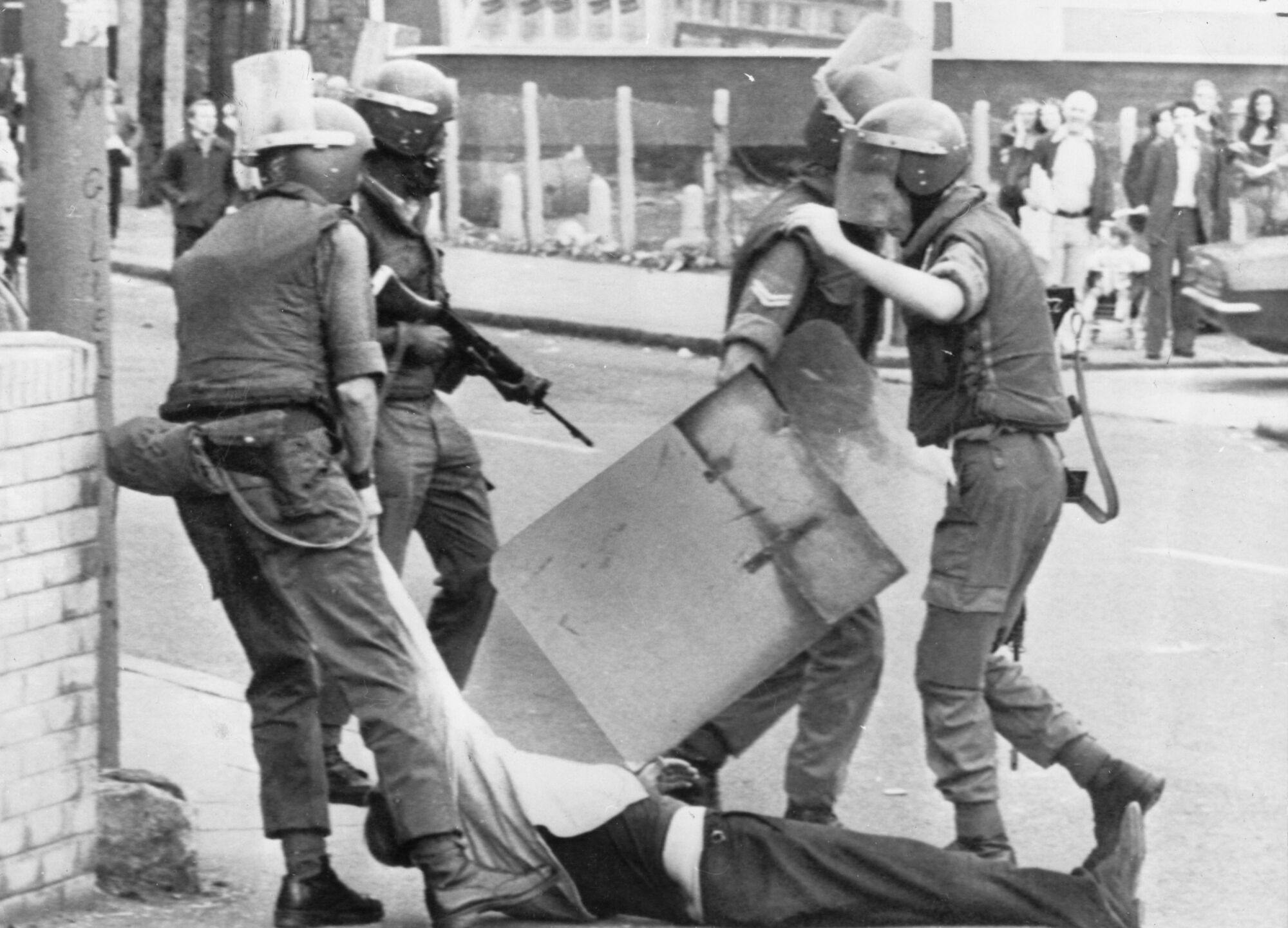
Today marks the 50th anniversary of a watershed in our history. On Monday, August 9, 1971, relationships between communities on this island, those communities’ relationship with politics, and relationships between these islands were reframed in dramatic, toxic ways. Internment without trial was introduced and the ensuing chaos was the significant contributory factor to three decades of murder and mayhem, more than 3,500 deaths, and almost unknown injury and tragedy. A fuse was lit and the outcome was inevitable. Dysfunction, to one degree or another, endures.
Though called Operation Demetrius, it could not hide behind such cynical Oxbridge branding today. Would it be called ethnic cleansing? Within 48 hours of the first door smashing, around 7,000 people were forced to flee their homes, hundreds crossing the border southward. In those two days, the death toll stood at 17, among them 10 Catholic civilians shot by the British army. Those who would cower at the ethnic cleansing charge need only consider the facts. Internment was used until December 1975 and 1,981 people were held; 1,874 were nationalists, just 107 were loyalists, the first of whom were not interned until February, 1973. The early internees were so badly treated — tortured — that in November 1971 our government brought allegations of brutality to the European Court of Human Rights.
As it is impossible to imagine a similar outrage in Europe today, it is important, too, without stirring embers, to reflect on the culture, especially the leadership of Northern Ireland prime minister, Brian Faulkner, and British prime minister, Edward Heath, that led to such alienating failure. Faulkner had sought to shut down the IRA and succeeded only in provoking greater violence. People with no connection to the IRA were detained. That Heath was appointed as an opposition whip by Winston Churchill in 1951 places him in a milieu today as remote as Mars and may explain his Victorian disconnect, one that indulged the worst of loyalism.
Those events, and many more like them, offer myriad opportunities to point fingers, to seek some kind of elusive finality. As recent Heath-style evasions show, that closure may not be achieved, so it may be best to focus on other lessons. Had decency prevailed, and had democracy been honoured rather than crushed by an old imperial mindset, then three decades of bombs, balaclavas, and butchery might have been avoided. Had John Hume not been excoriated, it might not have taken three decades to reach the Belfast Peace Agreement.
It is a convention of today’s political discourse that these events seem an ancient history to a growing proportion of our electorate. That is unwise and contrived. Maybe the best way to honour those caught in that 30-year maelstrom is to work for the justice they sought for all communities, rather than respond in ways provoked by internment and, six months later, Bloody Sunday. Had politics offered those so misused a real alternative, then the long list of atrocities might not still weigh so heavily. As ever, and as with every difficult issue, real, positive engagement is the answer.

Subscribe to access all of the Irish Examiner.
Try unlimited access from only €1.50 a week
Already a subscriber? Sign in
CONNECT WITH US TODAY
Be the first to know the latest news and updates