Irish Examiner view: Can a nuanced history make for a more inclusive present?
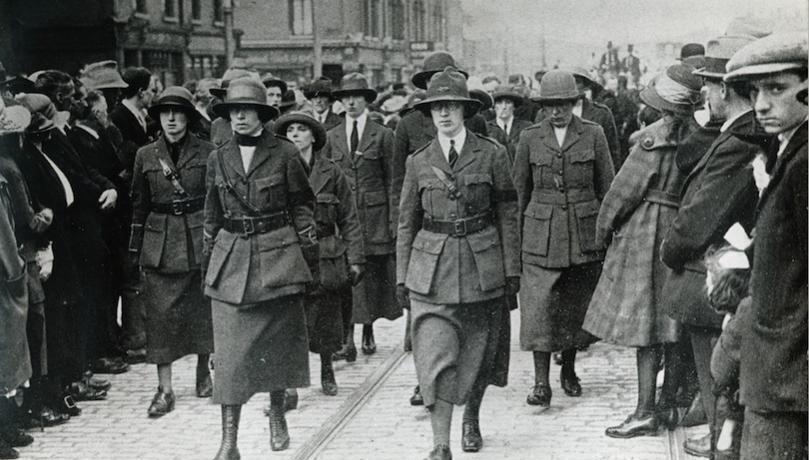
Yesterday marked the anniversary of the establishment of Cumann na mBan in 1914
For the second year, our Easter celebrations will be curtailed due to Covid-19 restrictions. There won’t be any big family gatherings, well-attended church services, public commemorative events, or collective Easter egg hunts.
The general public will, as it has done so many times before, dig deep to find resilience and ingenuity to mark this time of renewal in an attempt to raise flagging spirits at a difficult time. And it has been an incredibly difficult week as we have seen the privileged and entitled flout Covid-19 restrictions to train at dawn or jump the vaccine queue to administer “jabs for boys”.

Public health guidelines and the question of who obeys them has been raising tensions in the North too, following the decision not to bring charges against senior Sinn Féin politicians for going to Bobby Storey’s funeral last June. Deputy First Minister Michelle O’Neill caused further division by apologising for the effect of her actions rather than the actions themselves, which were rightly perceived as an affront to the thousands of families who stayed away from the funerals of loved ones.
It is reasonable to suggest that there was a lot more than Covid rules behind the Storey funeral row because Sinn Féin was paying its respects to a veteran republican who was considered the IRA head of intelligence before turning towards peace.
While a funeral is not in itself a historical commemoration, it illustrates how memorial ceremonies so honoured by one community can be construed as a provocation by another. That point is particularly relevant at this time of year when the Easter Rising of 1916 is remembered.
We have seen, over many decades, how history — or at least a version of it — has come to serve various political interests in the present. It is very welcome, then, to see historians and academics unearth new sources, or examine old ones with new eyes, to bring us a more nuanced account of the past.
Yesterday marked the anniversary of the establishment of Cumann na mBan in 1914, an organisation whose role in achieving Irish independence was forgotten — deliberately, some would say — until very recently.
How that happened is a little clearer when you consider one cinematographer’s attitude, as described recently by Professor Lindsey Earner-Byrne, the first Chair of Irish Gender History at UCC. While filming fighting on Sackville St (now O’Connell St) in Dublin, he shouted at a woman cycling down the street to get out of the way as she was ruining the picture. “I’ve risked my life for nothing,” he said, “for no-one will believe that serious fighting is taking place if a girl cycles through the thick of it.”
The "girl", however, was 30-year-old Máire Comerford, a member of Cumann na mBan who was also risking her life to dispatch messages. The stories of those women and their unseen, unsung work are, at last, coming into the light.
As this more inclusive, gender-balanced and thoughtful historical narrative emerges, let us hope that it will shape the present day too. With a bit of perspective-adjustment, tolerance, and inclusion, there is a place for everyone and their beliefs — religious, political, and personal — this Easter.