Irish Examiner View: Families of Bloody Sunday victims waiting 50 years for justice
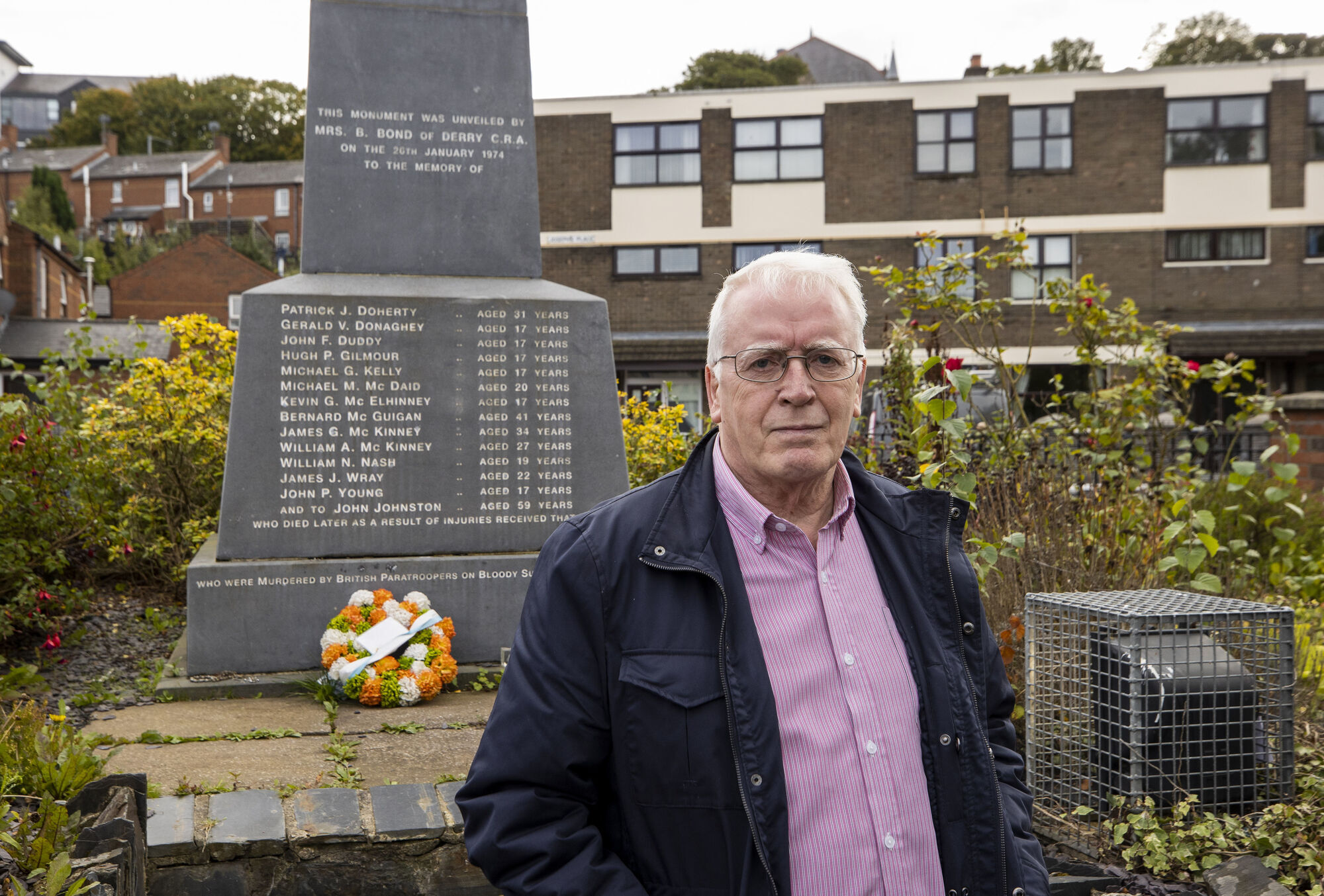
John Kelly, whose brother Michael was shot dead by one of the soldiers, stands at the Bloody Sunday Memorial in the Bogside of Derry city. File picture: Liam McBurney/PA
The North's Public Prosecution Service (PPS) could be more aptly described as a persecution service following its decision to stand by a ruling it made last year to charge just one former soldier over the British army’s role in the Bloody Sunday massacre of 1972.
On January 30 of that year, soldiers from the Parachute Regiment opened fire on 26 unarmed civilians during a protest march in Derry against internment without trial. A total of 13 people lost their lives that day, while another died later and a further 15 were injured. In March 2019, the PPS announced that just one veteran, known only as Soldier F, would face criminal prosecution.
To their credit, the relatives of the 13 unarmed civilians killed on Bloody Sunday in Derry have pledged to continue their fight for justice and have said they intend to seek a judicial review of the decision. John Kelly, whose brother Michael was shot dead by one of the soldiers, said their campaign for justice will go on.
His stirring words will no doubt embolden the campaign for justice but there is no guarantee that the courts will be any fairer than the prosecution service, judging by the treatment of the victims’ families in the past. In 1972, the Bloody Sunday families were paid a small amount of compensation paid “ex gratia without admission of liability,” amid a lingering suspicion that those killed and injured were partly to blame.
It was not until 2010 that the Saville Inquiry exonerated the victims, declaring that none of those killed or injured posed any threat, declaring: "The immediate responsibility for the deaths and injuries on Bloody Sunday lies with those members of Support Company whose unjustifiable firing was the cause of those deaths and injuries."
Following that report, the then British prime minister, David Cameron, addressed the House of Commons where he acknowledged that the paratroopers had fired the first shot, had fired on fleeing unarmed civilians, and shot and killed one man who was already wounded. He then apologised on behalf of the British Government by saying he was "deeply sorry".
Yet despite the Saville report and that fulsome apology, it was not until 2018 that any real compensation was paid out to a Bloody Sunday survivor. This was seen as a first step towards the goal of achieving real justice for the victims but that could prove elusive.
Those with long memories will recall the words spoken in 1980 by Lord Denning, then Britain’s most high profile judge. He threw out a civil action by the Birmingham Six against West Midlands Police, justifying his decision by saying that to accept their case that police officers had lied about their confessions and beaten them would have opened up "an appalling vista".
Not as appalling as waiting almost 50 years for justice.