Irish Examiner view: We must remain cautious amid new restrictions
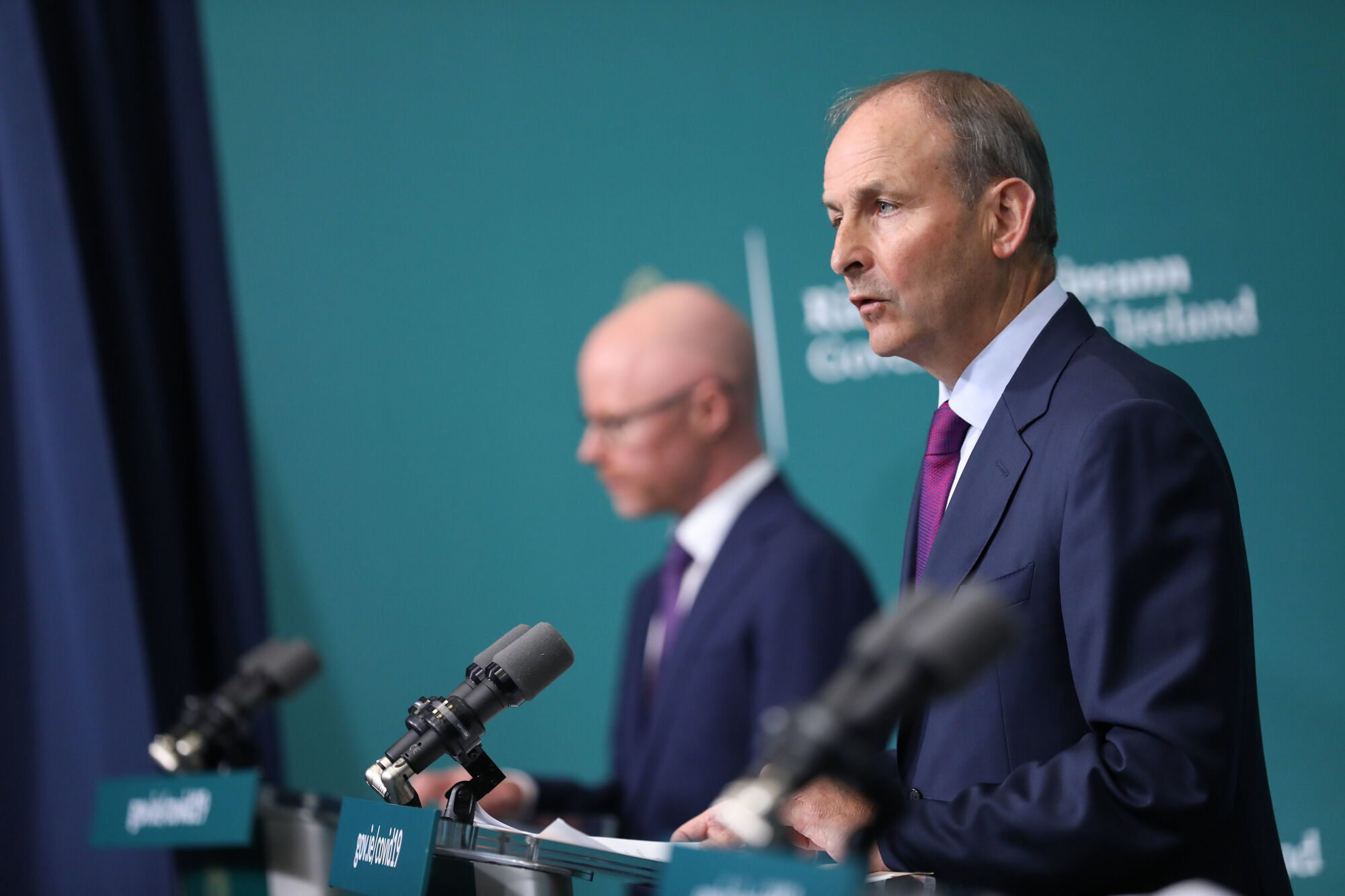
Taoiseach Micheal Martin and Health Minister Stephen Donnelly at the post-Cabinet press briefing at Government Buildings yesterday. Picture: Julien Behal
Though yesterday’s Government reimposition of coronavirus restrictions — some new, others variations of earlier restrictions — is disheartening, it appears unavoidable.
Dissenting voices might challenge the decisions amid a fresh sense of gloom at what’s to come and what appear to be the arbitrary nature of some of the guidance dished out, but public health experts make recommendations based on the responsibility of saving lives.
It is not long ago that each day brought news of dozens of deaths. It is difficult to prove beyond doubt that these measures will be decisive and avert the kind of crisis medical leaders have warned would overwhelm our hospital system.
But when so much is uncertain, while a vaccine remains elusive, there seems little option but to be extremely cautious and accept these life-wilting limitations — especially if schools are to reopen and, more importantly, stay open.
The depth of the challenge was underlined yesterday when Health Minister Stephen Donnelly warned that the next three weeks will be “incredibly important” as more than 1,100 new cases were recorded in the last two weeks and a spike in deaths may follow.
In fact, it would be more than surprising if one did not manifest itself.
As the WHO expressed concerns that Covid-19’s spread was driven by people in their 20s, 30s and 40s, many of whom were unaware they were infected, the Government advised over-70s to limit social interaction and, if possible, shop only during designated time windows while wearing a mask.
Moves to contain house parties and to close pubs and restaurants that breach guidelines are a response to indifference to measures designed to protect public health and will be generally welcomed.
Equally, social gatherings are to be restricted to parties of six from no more than three households.
These measures follow public health experts’ alarm over the recent rise in cases, which they have shared forcefully but privately with cabinet members.
Even if yesterday’s measures seem challenging, they remain modest in comparison to what we have withstood in our fight against Covid-19 to-date.
Abroad, French employment minister Élisabeth Borne yesterday announced that France is preparing to make face masks compulsory in all workplaces. The Paris government also moved to add open-plan work areas to a lengthening list of places where people must cover-up.
It is still possible, hopefully, that we might avoid those impositions but it might be prudent to at least psychologically prepare for them. These international comparisons do, despite all, offer some cheer in these grim days.
We, and most of Europe, have avoided the polarisation dividing America where wearing a mask has almost been weaponised in that country’s culture wars.
Emotion trumps science and gun-wielding “patriots” refuse to wear masks in supermarkets while others defend their “personal space” more forcefully than might be tolerated in a more harmonious society.

CONNECT WITH US TODAY



Be the first to know the latest news and updates