Darkening mood has an impact - Brexit fears hit consumer confidence
For anyone afflicted with a predisposition towards pessimism, these are trying times.
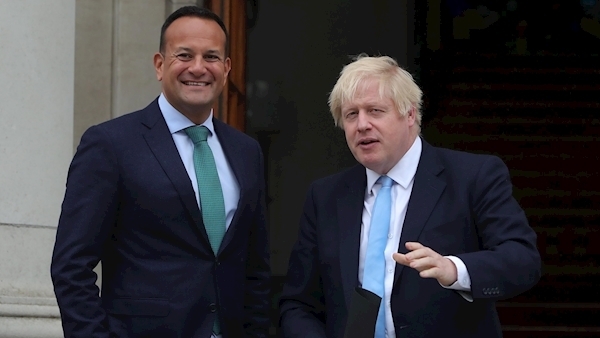
Monday’s Dublin visit by British prime minister Boris Johnson, though all the formal niceties were observed, seemed a perfect vignette in a world racing towards a new sort of hell in a handcart.
Taoiseach Leo Varadkar’s guest offered assurances in his thundering Bullingdon bass though he did not bolster these promises with even a sliver of substance. But then, he had other adventures on his mind.
Later that day there were extraordinary scenes in the House of Commons when MPs staged a protest against its five-week condemnation to irrelevance — a prorogation the Speaker of the House said represented “an act of executive fiat”.
That Johnson was likely to lose his sixth Commons vote in as many days — he did — must have played on his mind when he spoke in Dublin too though that humiliation, more votes lost in less than two months than Tony Blair lost in a decade, has had no discernible impact on him or his die-in-a-ditch Brexiteers.
This coup-as-circus, this circus-as-coup is, however, not unnoticed. Johnson’s claim that he is renegotiating has provoked one of the UK’s closest EU allies to express alarm at the “breathtaking” developments in Westminster and Johnson’s failure to table alternatives to the backstop.
Dutch minister, Sigrid Kaag, described events in London as “unbelievable” and warned the EU’s patience is ebbing away.
Two Irish business reports show that concern has replaced impatience.
Yesterday, ifac, a services firm for the farming, food and agribusiness sector, warned that Brexit-driven uncertainty has doubled.
Growing public awareness means food businesses are moving on packaging, veganism and provenance while 74% of food and agribusinesses are working to reduce their contribution to climate change.
It is indicative of the disruption in our world that these issues, by far the most important facing us, are overshadowed by Brexit.
The farm/food sector is not alone. Consumer confidence is at its lowest level in five years as householders worry about the impact Brexit might have on job security.
Estimates that up to 100,000 jobs might be jeopardised by a no-deal Brexit drive those fears which, if realised, would have a catastrophic effect on this society.
The Fiscal Advisory Council added a sobering warning yesterday afternoon too.
Despite all of those slings and arrows, the vitality of our economy is remarkable.
Despite a slowdown in Britain and continental Europe, darkening trade wars and Brexit, the economy continues to grow solidly. Wage growth, already at 4%, is accelerating while inflation struggles to reach single digits. A positive stability has been achieved.
These are the complex, often contradictory, realities occupying those preparing next month’s budget. It is hard not to sympathise with their dilemma.
It might be easier to pick the first three horses in Listowel’s eight races today than it would be to predict what might happen post Brexit.
Is it any wonder that food and farm businesses and consumers too are increasingly apprehensive.
Managing that apprehension, and a deepening anger, becomes more important by the day.

CONNECT WITH US TODAY



Be the first to know the latest news and updates