Peace in Ireland is sacrosanct: Good Friday disagreement and the DUP
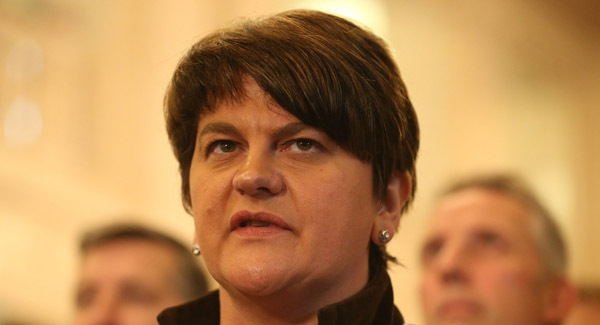
Arlene Foster’s declaration that the Good Friday Agreement is “not sacrosanct” is shocking, but hardly surprising, as the party she leads, the DUP, opposed it in the first place.
In advance of attending the British Conservative Party annual conference in Birmingham yesterday, she said it was wrong to suggest the 1998 peace accord could not be altered to accommodate the final Brexit deal.
In tandem with her newfound friend, Boris Johnson, Ms Foster appears to be exhausting the vocabulary of disrespect and denial: Disrespect in the form of repeated attempts by her and her party to undermine what is an international treaty; and denial of the political realities surrounding Brexit.
The agreement made at Belfast was signed by the British and Irish governments and voted for overwhelmingly by the people of Northern Ireland and the Republic in a joint referendum, so any attempt to undermine or circumvent it is contemptuous of the wishes of people on both sides of the border.
That show of disrespect and disregard, for the wishes of the people of the North, and of the UK as a whole, was heightened by her party colleague Jeffrey Donaldson, who said on RTÉ radio that while the DUP’s preference would be to continue operating under the Good Friday Agreement, “changes would have to be made to it”, in the event of a no-deal Brexit.
Taken together, that means that it is the DUP’s position that the agreement should be altered regardless of whether there is a deal or not on Brexit.
That is simply not going to happen and to even suggest it could shows just how much Ms Foster and her colleagues are in denial.
She insists that, in Brexit negotiations, the North be treated exactly the same as Britain, but it is already different, politically, economically, and constitutionally.
The Good Friday Agreement is not up for negotiation in Brexit talks. pic.twitter.com/JwKLrnLUN1
— Leo Varadkar (@LeoVaradkar) October 2, 2018
The Irish government has no say in the running of England, Scotland, or Wales, but it has enjoyed a consultative role in the affairs of Northern Ireland since the Anglo-Irish Agreement of 1985, signed by Margaret Thatcher and Garret FitzGerald.
That was the biggest constitutional change made by any UK government since accession to the EEC in 1973.
Whether the DUP, or the wider unionist community, likes it or not, the North is different to the rest of the UK and is likely to remain so for the foreseeable future.
Foster also appears to have aligned herself with Johnson, endorsing his vision for Brexit and declaring that she would support him as British prime minister.
As Taoiseach Leo Varadkar heads for Brussels tomorrow for talks with the president of the European Council, Donald Tusk, and the EU’s chief Brexit negotiator, Michel Barnier, it is important that he watches our back and keeps a weather eye on what any Foster-Johnson alliance might cook up.
It must never be forgotten that the Good Friday Agreement is what brought peace to this island, after three decades of bloodshed that left 3,000 people dead.
It must be made clear to Arlene Foster and co that, as far as we are concerned, peace on the island of Ireland is sacrosanct and, until any change to the Good Friday Agreement is accepted by all citizens, north and south, it, too, remains sacrosanct.

CONNECT WITH US TODAY



Be the first to know the latest news and updates