Conor McCabe: Protesters' grievances are real — they're bearing a heavy load

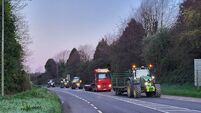
Protesters in Tralee, Co. Kerry, on Sunday. In choosing to block roads and depots, the contractors sidestepped their greatest leverage: their position as a critical chokepoint within the grass-fed system. Photo: Dominick Walsh © Eye Focus LTD
Although they don't appear to be over yet, commentary on the fuel protests is already beginning to focus on images circulating on social media of those at the fringes, in particular the far-right.
This is unfortunate, as the pressures faced by those at the heart of the protests are real and need to be addressed. They have deep roots and causes, and speak to systemic issues in the way agricultural goods are produced in Ireland.
Any understanding of those issues requires delving into Irish farming, which does not provide the food on our supermarket shelves so much as provide milk and live cattle for processors, slaughterhouses, and exporters.
The country exports around 90% of its output, mainly in the form of dairy and beef products. Our agricultural system is geared towards these goals, which has gone into overdrive since the end of the milk quota in 2015, with herd expansion and capital-intensive investment becoming the norm.
This model leads Ireland to import around 83% of its basic fruit and vegetable needs, including around 330,000 tonnes of potatoes, onions, carrots, cabbage, and lettuce a year.
The dairy and meat products on our table may come from Ireland, but almost everything else comes from countries such as Britain, Germany, France, Spain, and the Netherlands.
The grass-fed system which underpins it is land-hungry and fertiliser-dependent, increasingly pushing out other competitors for land such as horticulture and tillage.
Key to the system are agricultural contractors. They are a crucial component of the grass-fed chain, providing heavy machinery and related labour at critical times of the year.
They help manage workloads in silage harvesting and slurry spreading, which allows farmers to forgo investment in related equipment and avoid associated depreciation costs.
Contractors carry the financial risk — loans, repayments, insurance, maintenance — while enabling the system to function.
In other words, responsibility for the time-sensitive targets at the heart of national policy is carried in no small part by agricultural contractors who are struggling to make repayments on loans for the necessary heavy machinery, and who are now faced with fuel bills that may tip them over the edge.
The challenges they face in providing this service are made all the worse by their present marginal position in policy formation.
This is a sector that deserves our support; they should never have been put in a position where they had to demand it. Whatever people may think of the protests and blockages, the concerns and grievances are real.
It also needs to be acknowledged, though, that the protests themselves had problems. A blockade is a tactic, not a strategy, and without a coherent plan it lacks focus and purpose.
In choosing to block roads and depots, the contractors sidestepped their greatest leverage: their position as a critical chokepoint within the grass-fed system. Instead of exploring that position, the protests became swept up in the dynamics of social media spectacle.
The lack of a unified set of demands compounded the issue.
Depending on the spokesperson, the protest shifted from calls for fuel price caps to demands for new oil exploration off the west coast.
At first, organisers said they would go home once the government agreed to meet them. When told — incorrectly — that such a meeting had been granted, they announced that this was no longer enough.
The bravado drew cheers on O’Connell Street, but it revealed the underlying problem: without a strategy, the protests had no clear destination.

It is little wonder the government refused to engage. What, exactly, was there to engage with?
In order for the blockades to have worked effectively, they needed to speak to an overall objective.
The right to protest does not mean that the protests are right. You still need a plan, including an exit strategy, and the fuel and road blockages had neither.
As a result, the government is speaking only to the established organisations and striking a deal that reflected sectoral interests rather than the needs of the wider community.
This result should not distract from the deeper issue. Our agricultural system demands significant operational responsibility from contractors, but gives them little institutional voice.
It is a feature of a model that concentrates power in processors, exporters, and established farm organisations, while dispersing risk onto those who keep the system running.
This is the real story behind the fuel protests. The grievances are not fringe, nor are they manufactured.
They are the outcome of an agricultural model that has become narrow in its focus and operation. The pressures are structural; they are not going away any time soon.
There is a need to focus on the deeper issues facing agriculture and land use in Ireland.
One is climate change, which is expressing itself in wetter seasons and later silage dates; the other is the plight of agricultural contractors and farmers, caught between the output demands of exporters on one hand, and the physical limits of the grass-fed system on the other.
Government and state agencies frequently cite the “competitive” production costs of Irish dairy, but low costs are never cheap: somebody always has to pay.
This comes at the expense of a genuinely viable income for many farmers and contractors, working within an agricultural production chain in danger of becoming a monoculture of milk, if not there already.
Furthermore, a country that imports 83% of its vegetables is not food secure, no matter how competitive its dairy exports. This is the Gordian knot that needs to be cut, and no amount of tax credits will do it.
- Conor McCabe is a researcher and author of .


CONNECT WITH US TODAY



Be the first to know the latest news and updates