David O'Mahony: The real world is quickly surpassing any horror speculative fiction can create
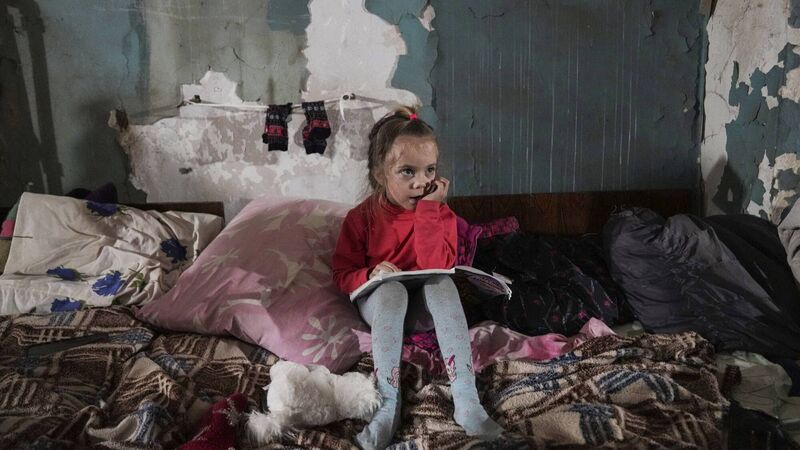
I think of the girl in Ukraine doing her schoolwork while sitting in the shattered remains of a house. She looks like she is living in a post-apocalyptic wasteland. File photo: AP/Evgeniy Maloletka

A danger of writing speculative fiction — that’s anything from fantasy and science fiction to alternate histories — is that real life can catch up, and even eclipse it. And, regrettably, here we are.
If you saw our front page on Tuesday, Stolen Innocence (check the epaper if you haven’t, I’ll wait), you’ll have seen not just the suffering of children in so many war-torn countries, but their attempts to retain some elements of daily life in spite of, or alongside, conflict.
Something that struck me while choosing the images, and I remarked on it to my colleague Chani Anderson later, is that some of the children look like they’re living in post-apocalyptic wastelands.
And in a way, they are — I think, for instance, of the girl in Ukraine doing her schoolwork while sitting in the shattered remains of a house.
One of the most powerful forms, and one that offers the opportunity for the most useful mirrors to princes, is dystopian fiction. I’m thinking , , , , . All of these are commentaries on the times in which they were produced or written, and you can see when they’ve been adapted to other media that the commentary is similarly updated.
So, for example, leans more heavily into the cyberpunk aspect of the novel , with looming, brutalist architecture alongside environmental collapse, along with endemic use of technology in every aspect of life (you see some of this too in the film , such as personalised sales avatars appearing to remind you of previous purchases because of obligatory eye scans).
The film version of , meanwhile, while retaining the overarching Christofascist authoritarianism of its source material, is heavily reworked to focus more on American political changes in the early 2000s as opposed to the criticisms of Thatcherism and overall anarchist theme that features in the graphic novel, which was written in the 1980s.
A key departure is that the protagonist, V, wants to return freedom to the people in the film, whereas he’s a more aggressively ruthless figure in the graphic novel who wants to bring about anarchy as a response to fascism.
Interestingly, in the graphic novel the British government uses a supercomputer called Fate to rule the country. I’m pretty sure the perils of giving AI such wide influence on daily life was explored in that documentary series called (we’re approaching the year was set, so perhaps fiction will become fact soon).
Climate catastrophe, Christian-coloured fascism, technology making life worse for people, freedoms heavily restricted by authoritarian regimes, minorities persecuted, the oppression of women on the basis of “protection” (I’m looking at you, America – I mean, ), endemic lying shaping the narrative (I’m looking at you, America – I mean, ), widespread apocalyptic nuclear damage (hopefully I’m not looking at you, America, despite the eyes your Dear Leader is making toward Iran).
I write horror fiction, and so know more horror writers than the average bear, and I can tell you that the world has got to such a state that some of them have given up writing entirely. The logic being, how can they come up with material that’s more horrific than what’s going on around us?
One writer I share a publisher with released a novel set in a future civil war United States just weeks before Trump was voted in. I’ve also come across a writer who had a dystopian trilogy finished and ready to go but says it will never see the light of day because all its twists about who runs the world have come true.
In the re-imagined series, mankind repeats the cycle of creating AI, ending up in a war for survival with it, and being exiled to the cosmos at least twice on different planets, with the strong assertion being that Earth is headed in the same direction.
And that, of course, is if Gaian and political collapse doesn’t get us first.
But there is still beauty in the world. Resistance, defiance, art that serves to uplift — all of these things stand in our stead as a species, and may see us through the coming years.
As I write this, my daughter informs me she’s playing a game involving a time machine, while simultaneously on a bus and doing her schoolwork. She’s also dressed as Spider-Man, mask and all (albeit introducing herself as Spider-Girl with twin brothers).
Maybe there’s something in that, that sort of cheerful innocence amid a sea of troubles. It’s a spark of pure creativity and imagination in a way that reminds us there are still things worth treasuring, no matter how grim the outside world might become.
And if we hold on to that spark, and keep it gently fed, we might be in a better shape when we come out the other side.
CONNECT WITH US TODAY



Be the first to know the latest news and updates