Housing 'affordability' means different things in rental debate
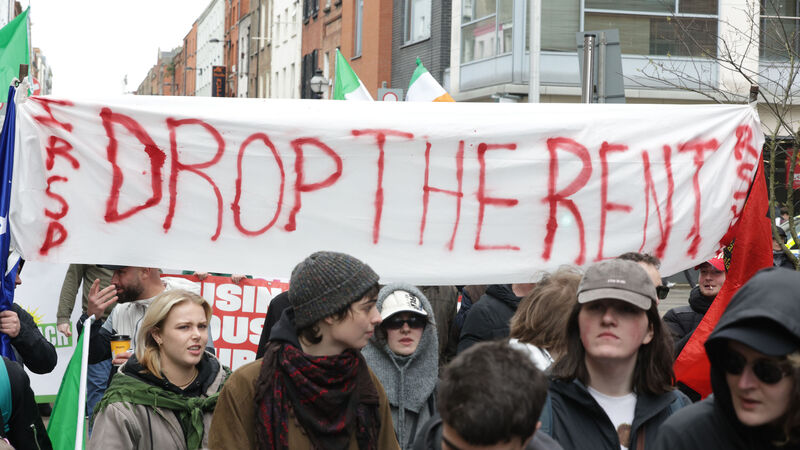
The Community Action Tenants Union and Dublin City Council tenants at a demonstration in March to protest the council’s sweeping rent increases, which average 30% and are set to take effect on April 6. Picture: RollingNews.ie/Leah Farrell
The new rules on rent increases in the private rental sector came into effect at the beginning of last month, in a context of heated political debate. Tenants might be left scratching their heads as the Government claims the new rules will ease affordability issues, while the Opposition claim they will create an affordability crisis.
To make sense of this, we need to look at the different understandings of housing affordability being used in this debate, as well as the evidence on rents, supply and affordability.
Before diving in, a quick reminder of what the new rules involve. From 2016, the majority of tenancies have fallen under Rent Pressure Zones (RPZ). Within these, annual rent increases were capped within and between tenancies. This means that landlords could not increase rents above the cap (first set at 4%, later reduced 2%) even if a new tenancy began.
The new rent rules maintain the within tenancy rent caps, but landlords can now set rents at market rates when a new tenancy begins. As the average tenancy in Ireland is about three and a half years, we can expect most properties to revert to market rents within a few years.
Importantly, landlords can only re-set the rent to market rates for a new tenancy if the previous tenant moved out voluntarily. They can’t evict, legally at least, in order to get a new tenant in and jack up the rent.
The term affordability is at the heart of our housing debate, but is seldom defined. To say rents will become more affordable obviously involves a comparison. The question is more affordable compared to what?
When economists say the rental sector will "become more affordable" if supply increases, they are comparing a future scenario in which rents are partially deregulated (scenario A) to an alternative future scenario in which the 2% RPZ caps remain (scenario B). This is the sense by which the minister for housing appears to be using the term.
When housing policy scholars (as well as the Opposition) think about greater affordability, they are comparing a future scenario to the present scenario. Specifically, they understand greater affordability as meaning that in the future tenants will pay a lower proportion of their income on housing costs. In this meaning of the term, more affordable rents mean tenants feel a tangible economic benefit compared to their current situation.
Consequently, and herein lies the confusion, the Government and Opposition could both be right. The new rules might ultimately ease rent inflation, but tenants might still be objectively worse off than they are today.
Another source of disagreement and confusion is the relationship between increased rents, supply, and affordability. Here the evidence is pretty clear, but requires some unpacking.
We have strong evidence increased supply leads to rents being lower than they otherwise would be. This holds true even if the new supply is at the high end of the market, as most new apartments are, for example.
This is because of a process called filtering. When new high end accommodation comes on stream, better off tenants move in, thus freeing up their previous home. A chain reaction then occurs in which more units become available all the way down, so to speak.
But this isn’t where the story ends. There is also a large body of research that suggests a more cautious interpretation of the likely effects of our partially deregulated new system.
First, some research suggests that even if rents increase, supply won’t necessarily increase. This is because developers may hoard land and ration increases in supply to boost prices. There is not a lot of evidence that this is occurring in Ireland (although we know very little about land markets in this country due to an absence of data).

However, it certainly seems true developers would never knowingly build enough housing to drive investment returns below market rates. Thus, the cost of housing implies a floor, keeping rents above a certain point, and as costs are high in Ireland, we can expect that floor to be reflected in high rents for new properties, irrespective of how much supply there is.
Second, it is argued the type of supply matters. In particular, there is now quite a bit of research showing that (a) institutional landlords set higher rents and (b) increased institutional investment can drive average rents up at a neighbourhood level.
Third, it is argued the effect size of increased supply on affordability is too small to make a meaningful difference, even in the long term. A recent study in the US context argues that "no realistic [supply] shock could be large or quick enough to provide significant relief to today's cost-burdened households in major US cities".
Finally, higher rents generally correlate with higher house prices and institutional investment is associated with lower levels of homeownership. This means we may see declining rates of homeownership if apartment supply ramps up, as the Government hopes it will.
In sum, if the new rent rules lead to higher supply, we can expect this to positively impact on affordability for new properties over the medium to long term. In the short term, however, affordability is likely to deteriorate as it will take many years for new supply to have a positive impact on affordability.
Moreover, while overall the effect will likely be positive, specific neighbourhoods or areas might become less affordable. Thus, for example, large parts of our cities may become increasingly inaccessible even for working couples.
On top of this, the new rules are likely to lead to declining homeownership in locations where institutional investment is concentrated.
Supporters of the Government will argue that, ultimately, increasing supply is the only show in town. While it is easy to decry higher rents and foreign funds, we need both if we are to supply our way out of this crisis. At one level, this seems likely to be correct.
Critics, however, will point out the cure is indistinguishable from the disease.
Ultimately it is politics, not evidence, that will be the deciding factor. At the risk or putting it somewhat simplistically, if you believe a decline in homeownership and the gentrification of our cities is a price worth paying for a housing system which is overall more balanced in terms of supply and demand, you will likely side with the Government and welcome the new rules. If, in contrast, you think this is too high a price, you will likely oppose the new measures.
The politics of this, however, goes beyond what side we take on this one issue. Many tenants and would-be homeowners will more disillusioned with Government and the ability of public institutions to resolve their housing issues.
This undermines the legitimacy of institutions, experts and, ultimately, democracy (if this seems like hyperbole, recall this processes of disillusionment is already well under way in the US and much of Europe). And if the public lose confidence in supply side responses, it seems likely they will instead focus on the demand side, ie immigration, thus posing a risk to social cohesion and Ireland’s economic model.
- Michael Byrne is an associate professor at the School of Social Policy, Social Work and Social Justice at UCD and the author of
CONNECT WITH US TODAY



Be the first to know the latest news and updates