Our leaders must show courage in commitment to peace by keeping the triple lock
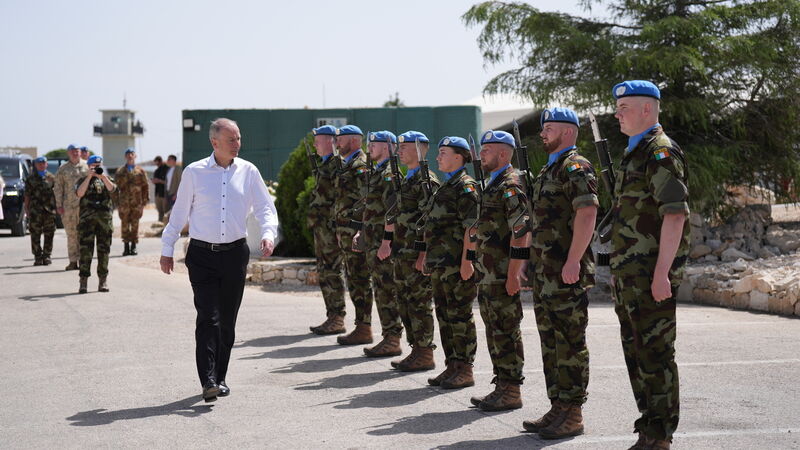
Micheál Martin inspecting the troops of the 124th Infantry Battalion at Camp Shamrock in Debel, Lebanon, in 2024.
We write as academics and university workers to reiterate our deep concern at the Government’s efforts to remove the State’s triple lock on the deployment of the Irish Defence Forces overseas.
The triple lock ensures that no more than 12 Irish troops can be deployed to overseas missions without a UN mandate. As such, it guarantees that significant overseas troop deployment can only take place as part of UN peacekeeping missions and in line with international law.
Read More
Since we wrote about this last year, the 2025 Defence (Amendment) Bill has passed through pre-legislative scrutiny and is due before the Dáil imminently. At the same time, we have witnessed a dramatic deterioration in the global geopolitical situation, with expanding conflict and the continued erosion of international law and multilateral institutions.
In the past three months alone, we have seen the United States carry out illegal attacks on Venezuela and Iran, threaten to invade Greenland, and escalate a devastating and illegal embargo on Cuba, whilst Israel has expanded its assault on southern Lebanon where it has attacked UN peacekeepers.
During this same period we have also seen the president of the United States establish the so-called ‘Board of Peace’ to oversee the reconstruction of Gaza outside the structures of multilateral diplomacy and without the involvement of Palestinian representatives, whilst withdrawing funding from 66 international organizations, including 31 UN entities, and the International Fund for Ireland, which has been central to the peace process on this island for 40 years.
What is most concerning from an Irish perspective, is the lack of clarity from minister Helen McEntee, who has refused to categorically state that the US and Israeli attacks on Iran are illegal under international law.
This despite an early statement by the UN Secretary General clarifying that the US-Israeli attack was in contravention of the UN Charter which prohibits “the threat of the use of force against the territorial integrity or political independence of any state, or in any other manner inconsistent with the Purposes of the United Nations”.
The equivocal response of the Irish government stands in stark contrast to that of Spain. Prime minister Pedro Sanchez has barred the US from using its military bases and Spanish air space to US planes involved in the war on Iran.
Meanwhile, the Irish government hides behind the ambiguous label of ‘militarily neutral’ while continuing to allow Shannon Airport to be used by US warplanes.
The Irish Government claims that in the absence of the triple lock, overseas troop deployments would remain in line with international law. However, the Government's response to recent events casts this in doubt.
In his capacity as opposition leader, Micheál Martin acknowledged that although “the United Nations is not working as it should... we must not abandon it as an essential part of the international system”.
Yet today as the international system comes under unprecedented attack, the government seeks precisely to abandon it by removing the UN as the legislative cornerstone of the State’s foreign policy.
This is not just a matter of abstract principle. If the State deploys troops to EU- or NATO-led missions without a UN mandate, as the 2025 Defence (Amendment) Bill would allow, then it may quickly find itself in direct conflict with some of the world’s most powerful nuclear-armed states.
For us, it seems clear that the benefits of operating within the UN system, while maintaining an independent, neutral policy, far outweigh the risks associated with operating outside it.
We urge the government to use this moment of heightened conflict to re-affirm Ireland’s commitment to international law and the institutions of multilateral diplomacy, not just by retaining the triple lock, but by speaking out against obvious breaches of international law and efforts to undermine the UN.
Whilst these institutions are in need of reform they emerged as a direct response to the catastrophic world wars of the last century and remain the most important bulwark against another.
We believe that the rapidly worsening geopolitical situation is not reason to abandon neutrality but rather places greater onus on the Government to protect it.
Neutrality has been crucial to the State’s security, keeping it out of international conflicts, and protecting it from attack. Crucially however, neutrality has also meant the State playing an active role in promoting international law, multilateral diplomacy, and Ireland’s constitutional commitment to the peaceful resolution of international conflict.
This has served the State well, earning it global credibility as an honest diplomatic broker, and a respected peacemaker, a reputation that the people of Ireland are justly proud of.
At a time when the world is on the brink of a global war that has already produced an energy crisis impacting Irish households and which threatens nuclear catastrophe, we urgently need courage from political leaders willing to redouble their commitment to peace, international law, and multilateralism.
Protecting the triple lock would send a message to the Irish people and the global community that Ireland remains committed to just that.
- This article is based on a longer letter sent to the Taoiseach on March 29, 2026, signed by over 400 academics and university workers based in Ireland and working abroad.


CONNECT WITH US TODAY



Be the first to know the latest news and updates