Don't let what's happened in London replicate itself in Cork
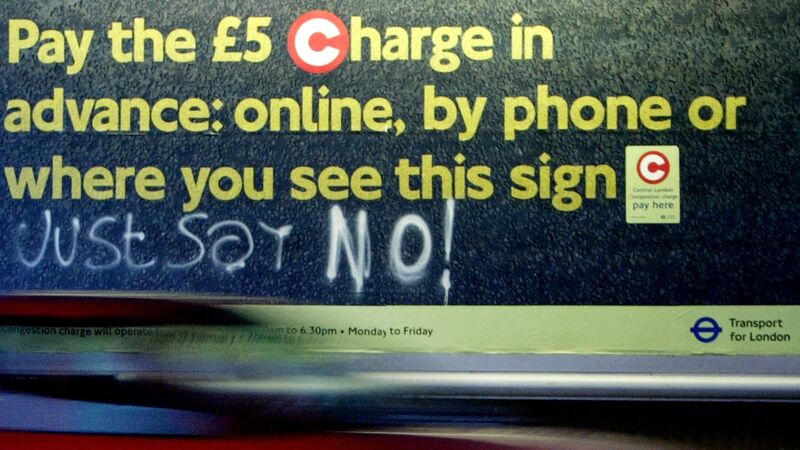
A congestion charge poster in London in 2003. London has long been one of Europe’s most congested cities. File photo: Ian Waldie/Getty Images
Dr Johnson may seem an unlikely starting point for a column published in Ireland. The 18th century polymath was a Tory and a deeply committed Anglican, two creeds which have not aged well in the Republic.
Johnson, rather like Goethe, the man who was good at everything, possessed that singular quality of knowing a great deal about whatever is worth knowing. He was a two-legged Georgian version of Google and his magisterial dictionary, published in 1755, contained 42,773 words and 114,000 illustrative quotations from the likes of Shakespeare, Jonathan Swift, Dryden and Milton.
Among his specialist subjects was London, where he lived for nearly two thirds of his 75 years, reputedly at some 17 different addresses. And Johnson came to mind when a reference in the recent Future Cork debate caught my eye, partly because it concerned the city where I lived for 17 years, but even more so because it had much to say about my birthplace, and home, for two thirds of my life.
There will be few who quibble with the arcadian vision for the development of Leeside presented by Monika Jain, principal city planner of Transport for London.
Read More
Rich culture, innovation, public spaces, proximity, sustainability. The greening of the city in a climate-resilient way. The full nine yards of modern metropolitan planning.
It struck a chord because Londoners have been hearing this for a long time now as the squeeze on vehicles is extended and accelerated with the ultimate objective of abolishing traffic, and its accompanying pollution particulates and poor air quality, forever.
All of this, you might imagine, is carried by universal acclaim.
But you would be wrong, even in a city which possesses the kind of joined up transport system of which Cork can only dream.
There are a few facts to consider while embarking upon the revolutionary journey which logic dictates must end with the abolition of private transport in the urban environment, which is not something people have voted for, or even desire.
Cork emerged as a meaningful entity under the Vikings some 1,100 years ago. London was founded by Roman legionaries in 43AD. Some critics say Londoners have been coming the old soldier ever since.
Whatever the progress of two millennia — we no longer have Black Death, there are no cholera epidemics caused by contaminated water supply, and the city doesn’t burn down anymore — traffic management, or rather the methods deployed to “encourage” and “nudge” people to change their habits, remains a major cause of contention.
And, although the scale is different, there are lessons Cork can learn.
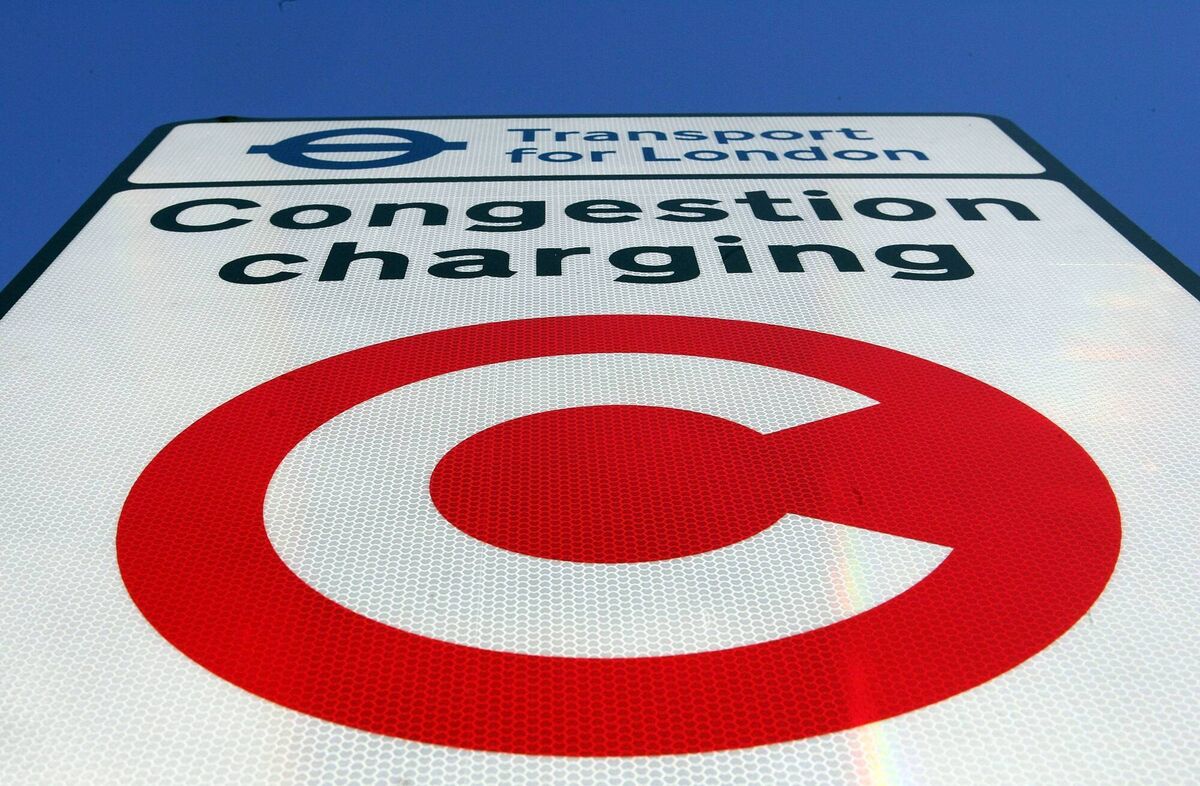
London has long been one of Europe’s most congested cities. Despite a profusion of new bus corridors, cycle lanes, low traffic neighbourhoods, pedestrian-friendly initiatives, traffic calming, 20mph limits, congestion charging (€21 per day) and ulez (Ultra Low Emission Zones) exclusion zones (€14 daily), it is getting worse.
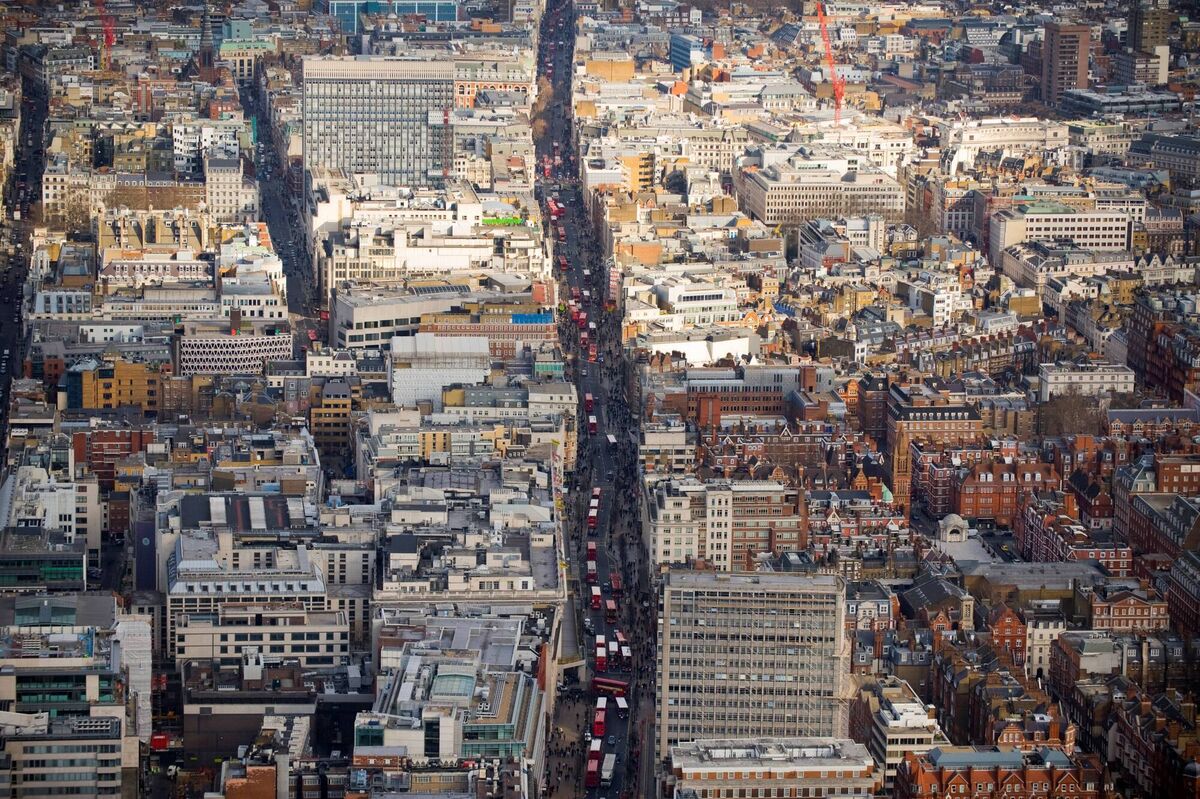
Time lost by drivers in traffic increased from 97 hours (2022) to 99 hours (2023) to 101 hours (2024). Some data from the annual TomTom survey for last year shows that motorists spent the equivalent of about six days a year in jams.
There are explicit reasons for this. More vehicles are attempting to cram into less space. Private hire services such as Uber have increased exponentially, with many drivers circulating until their apps deliver up customers. Online delivery vans, making frequent stops, slow traffic.
Constant roadwork and infrastructure upgrades impede flow. Ongoing construction brings road clogging HGVs and closures every day. More people are commuting again and peak times are heavier. There have been a dozen significant strikes on Tube and buses in the past three years.
Each, or any, of these may be manageable in isolation. People may be prepared to make allowances. But where the worm turns is in the deep, and growing, suspicion that many policies are being enacted not for laudable, and supportable, environmental reasons, but as a money grab.
While that can dovetail neatly into the modern pantheon of conspiracy theories, the reasons why many people think this are easily listed.
When Ken Livingstone introduced congestion charging in 2003, he had four pillars of justification:
- cutting gridlock;
- improving journey times;
- reinvesting in public transport;
- improving air quality and public health.
His charge was £5 per day (just over €7 at the rate of exchange 23 years ago). By 2026 this had increased by 260%.
Electric vehicles lost their exemption from congestion charging in January. They will, from April 2028, face a new tax of 30p (35c) per mile with drivers expected to self-declare annual mileage in advance and validate that figure either through the MOT test or at authorised garages.
This will include miles incurred outside the UK although drivers will be subject to the tolls and local taxes of the host country. Anyone taking their EV from the North into the Republic will suffer the same financial double jeopardy although electric vehicles registered overseas will be exempt from charges in Britain.
If all this presents as the kind of imbroglio identified by Sheriff Ed Tom Bell in Cormac McCarthy’s (“if it ain’t a mess, it will do until the mess gets here”) it pales alongside the aggressive revenue collection policies adopted by local authorities, desperate to boost their coffers.
In London, half of the councils view themselves as being on the edge of financial collapse due in great part to the explosion in costs for SEND — children with special educational needs. The boroughs predict a shortfall of around €600m this year.
Town Halls see motorists as a cash cow at the same time that central government has identified the need to replace declining fuel duty revenue. And there is no shortage of evidence to support this assertion.
This month, Croydon (population 400,000) was forced by a High Court judge to scrap six LTNs after he ruled that they were illegally established to generate cash rather than reap “modest” environmental benefits. Now the local authority, which has declared itself bankrupt three times in five years, has to refund motorists millions of pounds in unjustified fines.

CCTV enforcement — British authorities love CCTV cameras linked to automatic number plate recognition — showed that the borough raised £1.4m (€1.6m) from one LTN in just one month.
While Croydon is an extreme example of money harvesting it is far from unique and in the overwhelming majority of cases, the victims are ordinary citizens attempting to go about their daily business.
They are assailed by speeding fines; penalties for misreading misleading and often opaque restrictions on roads; hawkish charges from incentivised parking wardens, or civil enforcement officers as they are now known.
Add to that the perpetual scandal of unmanned car parks where services can only be activated by complicated and frequently misfunctioning apps and it is easy to understand why the patience of UK drivers — that’s 75% of the adult population — is wearing thin.
It was noticeable how few expressions of sympathy there were over the collapse of the country’s largest parking provider, the private equity-led NCP, in the middle of March with the potential loss of more than 700 jobs. NCP charged as much as £60 (€90) for a full day in central London.
It is a political issue which is unlikely to go away. The Alliance of British Drivers pressure group says: “Motoring fines are a money-making racket dressed up as environmental policy.”
According to Co-op Insurance, UK drivers received 9.61 million points on their licences in 2024, a 12% increase from 2023.
Mission creep by bureaucrats, politicians and authorities in general is a trap Irish policy makers will do well to avoid. But for me, it is too late.
Until last week, I lived in Caledonian Road, the “Cally”, a location which, like Kilburn, used to be very familiar to London’s Irish population. And with some famous pubs too.
Nowadays, it is lauded in a song hugely familiar to Arsenal supporters following its adoption as their anthem to rival, .
These streets are our own, sings Louis Dunford in his mordantly sentimental but moving tribute . The full version is rarely offered up but it has something profound to say about the kind of social engineering now taking place in cities around the world:
After 50 years, I have driven my last mile in the capital, proffered my last pound of council tax to the metropolis, and paid my last penalty notices (equivalent to €250 since you ask) for trivial car transgressions.
I will henceforth view it through the eyes of a visitor rather than a local, ironically one exclusively using buses and trains. I draw the line at the heavyweight bikes which litter the streets or dodge recklessly among pedestrians.
Which brings us back to Dr Johnson who famously observed that “a man who is tired of London is tired of life”.
Let’s put that to the test. There is a great deal happening in the UK. Society’s tectonic plates are moving. It is time to find out more.
CONNECT WITH US TODAY



Be the first to know the latest news and updates