The reality behind Ireland’s anti-submarine warfare plans
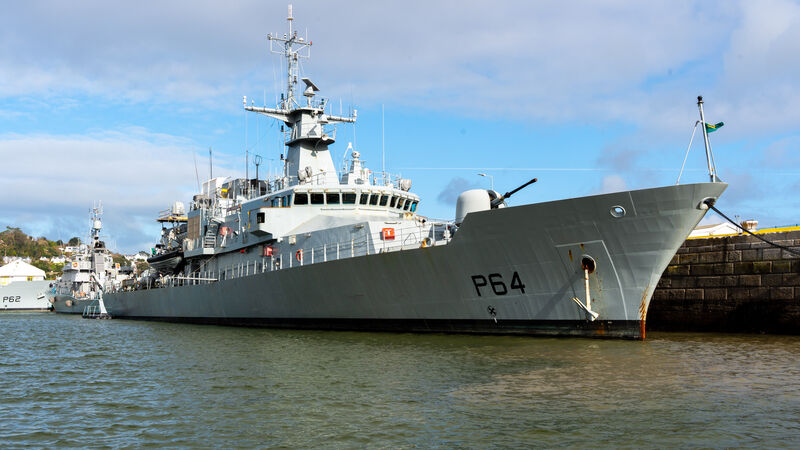
The LÉ George Bernard Shaw docked at the base in Haulbowline. The North Atlantic is seen as a strategically significant environment, according to Tony Geraghty. Picture: Noel Sweeney
Over the past number of months there has been increasing media reporting on new capabilities being developed by Ireland in the maritime domain.
These include the naval service purchasing towed array sonar systems intended to improve detection of activity beneath the surface, and the air corps considering procuring sonobuoys for deployment from its maritime surveillance aircraft. Both developments have been framed in different ways.
In official terms, they are part of a move toward “sub surface domain awareness”.
In broader commentary, they are sometimes described as steps toward anti-submarine warfare. Both descriptions contain elements of truth, but neither fully captures the wider context of what these systems are designed to do, or their current limitations.
Across Nato and wider Western defence planning, there has been a marked shift in emphasis toward the sub-surface domain.
Strategic assessments increasingly describe a long-term resurgence in Russian submarine activity and capability. This includes increased patrol patterns in the Arctic, modernisation of nuclear-powered attack submarines, and continued investment in nuclear-powered ballistic missile submarines. Western naval planners have also highlighted growing concern around the mapping and surveillance of undersea infrastructure, including cables and energy routes.
At the same time, the North Atlantic is once again viewed as a strategically significant operating environment. Submarine activity is not limited to military confrontation in a narrow sense, but extends to intelligence gathering and the potential disruption of critical infrastructure.
In Ireland’s case, this infrastructure includes gas pipelines, electricity interconnectors, and data cables. These systems underpin not only communications, but also energy security and economic activity across Ireland and wider Europe.
Anti-submarine warfare itself is often misunderstood. It is not a single platform or a discrete capability. Nato definitions describe it as a coordinated system of sensors, platforms, and command and control designed to detect, track, and, where necessary, deter or neutralise submarine threats.
In practical terms, it is a multi-layered and continuous activity involving surface vessels equipped with sonar systems, maritime patrol aircraft deploying sonobuoys, helicopters capable of rapidly localising contacts, and shore-based command centres that fuse and interpret data from multiple sources.
Each element plays a distinct role. Ships with towed array sonar provide long-range passive detection of underwater acoustic signatures. Aircraft and helicopters extend coverage over wide areas and deploy sonobuoys to build a temporary underwater sensor field. These sensors detect and transmit acoustic data back to operators for analysis. Importantly, none of these systems operate in isolation.
Their effectiveness depends on integration, persistence, and the ability to maintain continuous awareness of a highly dynamic underwater environment.
Anti-submarine warfare is, by its nature, a 24/7 operation. It requires constant coverage, repeated detection cycles, and sustained presence in areas of interest.
It is within this context that Ireland’s emerging capability should be understood. The naval service’s acquisition of towed array sonar represents an initial step into passive underwater detection.
Systems of this type, widely understood to be based on established European designs, require careful integration into both ship systems and broader command structures. They also typically require specialised teams of operators and analysts, often more than a single vessel’s crew can sustain, particularly in navies with limited manpower.
As a result, such capabilities can be concentrated in dedicated detachments that move between platforms rather than being embedded permanently across a fleet – such as the naval service.
The ships currently in service with the naval service, while highly capable in patrol and constabulary roles, were not designed as dedicated anti-submarine vessels.
Their propulsion systems do, however, offer a degree of acoustic advantage through reduced noise output compared to traditional designs, as they also have low-speed electric propulsion systems.
Even so, their role in a modern anti-submarine warfare context would be limited to sensor deployment and environmental awareness rather than sustained submarine tracking or engagement.
In parallel, the air corps may in time deploy sonobuoys from its existing maritime surveillance aircraft. These aircraft are surveillance platforms, capable of long-range monitoring and data collection. However, they are not purpose-built maritime patrol aircraft designed specifically for anti-submarine warfare. Modification of airframes and avionics is required to integrate full anti-submarine functionality.
This includes sensor fusion systems, acoustic processing capabilities, and communications links capable of supporting real-time sub-surface tracking. Such integration is complex and reflects a broader challenge of adapting surveillance platforms for roles they were not originally designed to perform.
There is also the matter of anti-submarine torpedoes used to neutralise submarines which is not being discussed.
Taken together, these developments place Ireland at an early point on the sub-surface domain awareness spectrum.
This spectrum ranges from basic environmental awareness, through passive detection capability, and ultimately toward fully integrated ASW systems capable of persistent tracking and co-ordinated response. Ireland’s current position is closer to the foundational stage of this continuum. It represents a meaningful development in national maritime awareness, but not yet a complete anti-submarine capability in the sense understood by larger naval forces.
A further constraint lies in operational reality. anti-submarine warfare is not only technically demanding but also resource intensive. It requires continuous presence, trained acoustic specialists, and a high degree of platform availability.
At present, the naval service faces limitations in platform availability, alongside ongoing retention and training challenges. These factors reduce the ability to maintain persistent coverage, which is a core requirement for effective underwater domain awareness. Without persistence, detection becomes episodic rather than continuous, limiting overall effectiveness.
In broader terms, a fully developed anti-submarine capability typically involves a balanced mix of assets. These include anti-submarine warfare-capable frigates equipped with embarked helicopters, maritime patrol aircraft designed specifically for underwater detection, dedicated helicopter squadrons trained in anti-submarine operations, and integrated shore-based command centres capable of fusing large volumes of acoustic and sensor data, and finally torpedoes to neutralise threats.
It is this combination of platforms, rather than any single system, that defines effective anti-submarine warfare at a national level.
Ireland’s current trajectory therefore represents a foundational step rather than a completed capability.
It enhances awareness of the underwater environment and provides an important new layer of maritime sensing. However, full operational anti-submarine warfare remains dependent on a broader ecosystem of platforms, personnel, and sustained operational capacity.
The key question moving forward is not whether Ireland should develop awareness of its subsea environment, but how far along the spectrum toward a fully integrated anti-submarine warfare capability government chooses, over time, to progress.
- Tony Geraghty is a maritime security expert and a former Irish navy commander
CONNECT WITH US TODAY



Be the first to know the latest news and updates