Our school meals programme must use community hubs and on-site kitchens cooking local produce
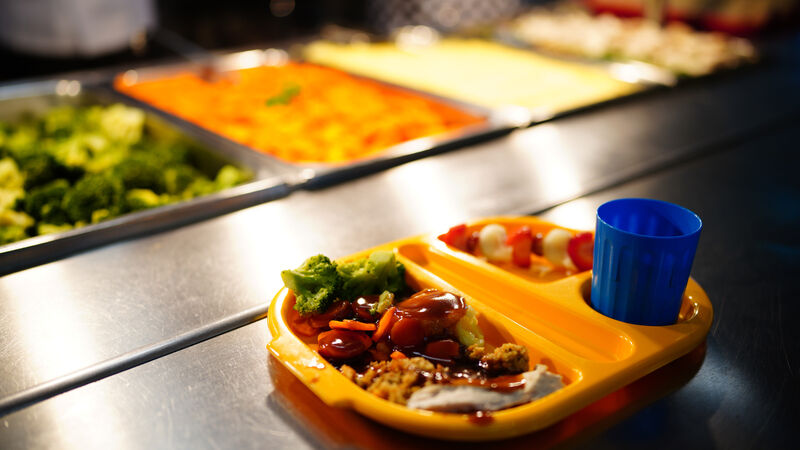
As well as advocating for universality of the programme, the Children’s Rights Alliance advocated for improving nutrition standards of the current school meals on offer. File photo
Ireland is one of only a small number of countries to provide truly universal free meals to all students regardless of income. This is something to be proud of.
Our school meals programme is intended to provide at least one nourishing meal to children whose family might not have the means to feed them; a social safety net for the 95,167 Irish children whose families are living in consistent poverty and the quarter of a million children experiencing deprivation.
Read More
A report Evaluating the Impacts of the school meals programme was released last week after a six-week Joint Oireachtas Committee on the subject. The report contains some excellent recommendations.
What is clear from the recommendations is that we need a comprehensive re-think of the policy, a clear plan, and swift action. The report also makes clear that improving the current school meals programme is not about making a few small tweaks; it is about a transformative overhaul.
The Children’s Rights Alliance made a submission to the Joint Oireachtas Committee in which they stressed the importance of this universal access to school meals to reduce stigma for those who need them the most. At the moment, however, the universality of Irish school meals is in danger of being eroded as more and more parents opt out of the programme.
The Children’s Rights Alliance also advocated for improving nutrition standards of the current school meals on offer. These two recommendations are interlinked - parents are opting out of the programme mainly because they do not consider the food nutritious. We need to look at why this is the case.
Some suppliers of school meals work on an assemble and re-heat model. They do not cook any element of the hot school meals. All of the meal components are processed off site. Meat is bought in pre-cooked and preserved, as is pasta and rice.
Sauces are bought in large tubs and stirred into this pre-processed meat or pasta. Takeaway containers are filled with the mixture and the food is heated inside these containers. The Joint Oireachtas Committee report makes it clear that the level of processing currently involved in producing most school meals must be addressed.
It is not easy to deliver 400,000 hot meals a day for €3.20 a meal. The programme has been set up so that providers are working with long food supply chains to keep costs down.
The distribution is also onerous with companies driving the meals very long distances each day. For example, a child in Donegal can be receiving a meal assembled in Limerick, or a child’s meal in Galway could be coming from Dublin.
This means much of the current meal budget is going towards logistics, distribution and packaging, as well as marketing and running websites or apps, rather than on food ingredients.
Using kitchens to cook our children’s meals from scratch with fresh ingredients has been recommended as the best way forward by the Joint Oireachtas Committee and it should be the bare minimum required. To achieve this the committee has recommended integrating on-site cooking facilities into schools.
This would be a progressive and very welcome path forward and should be the standard for all new school builds. It will unfortunately take a very long time to implement.
An additional recommendation within the report is the prioritisation of community hubs. I would advocate that this should be a main recommendation and one that can be implemented with more speed than in-built school kitchens.
A network of around 100 community kitchens, starting with existing community providers, could be resourced and funded. Many community kitchens are already working to produce freshly cooked meals for Meals on Wheels and other services.
Extensive capital investment and accelerated capacity building would be needed to expand these kitchens, but it is possible, and is the sort of transformative thinking we need from government.
Community kitchens can become local hubs by sourcing from farmers in the vicinity, and delivering to schools within their catchment areas. This model could build wealth in communities by using the €320m-a-year public investment to directly benefit Irish farmers.
We do not need to look too far for similar models. In Wales a campaign called Welsh Veg in Schools, aims to get more organically produced Welsh vegetables into primary school.
It sees the school meal funding as a market opportunity to catalyse vegetable production and build farming resilience for the future.
Read More
It has been recognised that Welsh organic vegetables can be more expensive than imported conventionally grown vegetables, and another scheme called Bridging the Gap supports school meal suppliers to bridge that financial gap.
A local council north of Cardiff, called Caerphilly, is a good example of success. They are investing the school meals funding back into their farming community, and vastly shortening the food supply chains by implementing a menu of food produced by local small businesses and independent producers in their area.
The principal officer Marcia Lewis said that “prioritising the use of local produce on school menus not only enhances the project’s value for pupils but also supports the local economy and promotes sustainability.” The meals in Caerphilly are free and the changes have seen an uplift in the number of pupils signing up for them.
In the Isle of Man, an overhaul of school menus in 2025 saw four times more fresh produce from the island being used in school meals. When the Department of Education, who funds their school meals programme, did a review prior to this they found around 50% of the food was ultra processed. This has been reduced to just over 5%.
The new menu is seen as better for supporting long-term health and positive food experiences as well as being supportive for regional sustainability. Menu cycles are used which provide a balance of nutrition and let children experience a variety of food.
Food education has also been increased. Experience shows that integrating education and good food culture into schools is fundamental to the acceptance of a healthy, sustainable school menu by the whole school community.
School meal programmes exist in at least 148 countries worldwide, reaching over 407 million children daily. These programmes are recognised globally as multi-sectoral game changers and as one of the smartest policy investments available to governments and policy makers.
We need a comprehensive plan from Government on how we will transition our programme in line with these examples of international best practice and the Joint Oireachtas Committee recommendations.
This is particularly important before rolling the programme out to secondary schools or investing further public funds.
We need a school food programme where meals are cooked from fresh local ingredients, and where the meals nourish our children, our land, and our communities. A programme that is built on a system of care not profit.
- Dr Michelle Darmody has been working alongside Ruth Hegarty of Food Policy Ireland to form the School Meals Coalition which now includes: Open Food Network Ireland, Learn Local, Food Cloud, GIY, Clean Technology Centre, Airfield Estate, Food on the Edge, Cultivate, Food Policy Ireland, Food Ed Ireland, Chef Network, Voice, Talamh Beo, Irish Organic Association.
CONNECT WITH US TODAY



Be the first to know the latest news and updates