Clodagh Finn: Women's museum plan is welcome news
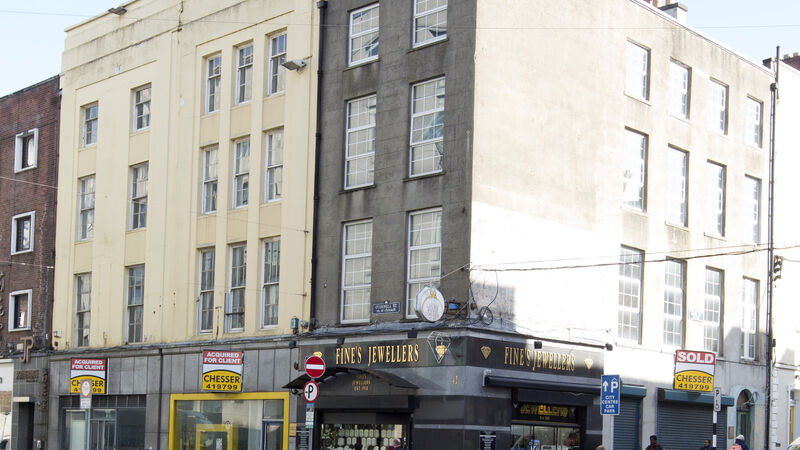
The six-storey property on O’Connell Street will now, it is proposed, host a permanent exhibition telling the stories of the women of Ireland. File photo: Liam Burke/Press 22

What encouraging news. Plans are underway to establish a dedicated women’s museum in the centre of Limerick in a landmark building that has been donated to the State by businessman JP McManus.
The six-storey property on O’Connell Street and former home of the International Rugby Experience will now, it is proposed, host a permanent exhibition telling the stories of the women of Ireland.
A long, detailed process lies ahead but, announcing plans on Tuesday, culture minister Patrick O’Donovan gave the women of Ireland reason to celebrate. McManus’s gift, he said, offered “great potential to amplify the representation of women’s voices and lived experiences, in all their diversity, and with a special focus on under-represented and marginalised communities”.
That is music to the ears of half the population of Ireland who have, for so long, been written out of the country’s narrative. The news also provides heartening proof that speaking out matters.
For a number of years now, women from a range of backgrounds have been lobbying government to take steps to ensure that women are properly represented in our cultural institutions and collections. It is good to see that the work, and more importantly, the recommendations of the Advisory Committee on Women’s Stories were referenced several times by the minister.
HISTORY HUB
If you are interested in this article then no doubt you will enjoy exploring the various history collections and content in our history hub. Check it out HERE and happy reading
That committee was established in 2024 to consider the possibility of creating a dedicated women’s museum and, more widely, to look at ways of re-imagining existing institutions to correct a still very lopsided gender balance.
Journalist Lise Hand, a member of the Irish Women’s Museum Advocacy Group, yesterday welcomed the new proposals. “Women’s stories aren’t footnotes or appendices — they’re a central and integral part of the story of this island, and this is a hugely exciting opportunity to redress a long-standing inequity in our history. Women’s stories aren’t niche, they are about all of us.”
Fellow journalist and member Justine McCarthy said: “It’s heartening to see the government is working to fulfil its promise to realise a dedicated national women’s museum. My one reservation is that our group explicitly sought an all-island museum and Limerick is quite a distance from north Antrim.”
Once the details have been worked, the difficulty will be in deciding how to shoehorn the lives and experiences of so many neglected women into a single building.
Read More
Yes, the award-winning building has six storeys but to outline the scale of what is needed, just take historian and author Sharon Slater’s fascinating book as an example. With a few notable exceptions — Dolores O’Riordan and Kate O’Brien for instance — most of the women in it are little-known.
Ellen O’Grady (1863-1949) went to school in Presentation Convent on Sexton Street before making history in 1918 when she was appointed the first female Deputy Police Commissioner in New York. Did you know that?
Or what of Ann Diamond (1827-1881) from Adare, Co Limerick? She was a midwife who created a new high street in the small town of Red Jack’s, New Zealand, in the 1860s. She built a nine-room hotel (Diamond’s hotel), a general store, a concert hall and a billiard saloon.
Closer to home, the women in the well-known 19th-century O’Brien family of Cahirmoyle made significant contributions in the world of the arts and politics. One of them, Lucy Crane (1864-1926) was awarded a CBE for her role as assistant director of the Women’s Royal Navy Service during the First World War.
I can imagine, too, that museum curators would relish re-telling the story of the daring escape made by nine women from Limerick Gaol on May 23, 1830. A visitor had slipped them an iron bar, a file and some nitric acid. They sang as they worked to free the locks before making their escape by ladder over the wall. (Spoiler alert: they were all captured later and returned to gaol.)
This is but a small sample of the stories from Limerick itself and already the proposed museum is rapidly filling up. That, of course, is just a symptom of how overlooked women have been in the making of Irish history.
How did that happen?
In his book (1995), anthropologist and historian Michel-Rolph Trouillot explained that silences enter the process of historical production at a number of crucial stages. In an Irish context, women were erased at all of them.
At the most basic level, their contributions weren’t recorded in the first place. If they were, those written testimonies often didn’t make it into the archives.
And when women’s contributions surmounted those two obstacles to land safely in the annals, they were later overlooked by historians.
Now, at least, we have news of a project that will go some way towards correcting that. In the long term, though, what we need is a new way of seeing. One which recognises that women and what they do represent half of the whole human story.

CONNECT WITH US TODAY



Be the first to know the latest news and updates