Ciara Reilly: Definition of need has changed to save money on SNAs
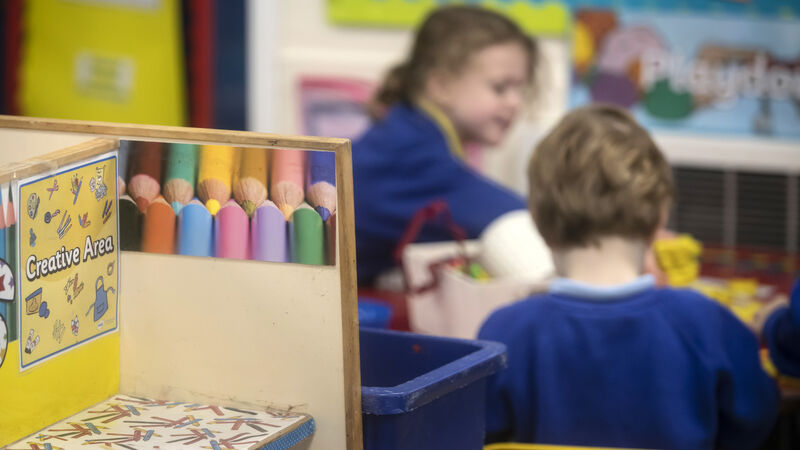
Class size and the shortage of adequate adult support will emerge as central themes at the upcoming National Convention on Education, writes Ciara Reilly. File Picture: Danny Lawson/PA
Yesterday, the minister for education, Hildegarde Naughton, announced that the Department of Education is to pause a planned review of special needs assistant (SNA) allocation.
The pause is being framed as responsiveness, listening, engagement, and evidence that the system works when people speak up. However, from where I am standing, this pause feels neither reassuring nor meaningful. It feels calculated. It feels familiar. It feels disingenuous.
We have been here before, and we will be here again unless big changes happen in how we act and respond to these things.
The announcement of a pause follows the revelation that more than 190 schools across the country were told that their SNA allocations would be cut next year. The projected consequences have rippled through school communities.
SNAs with decades of experience have been discovering, through clinical emails addressed to principals, that their posts were to be withdrawn with no established deployment panel for them to rely on. Pupils were to lose the support they have come to depend on. Schools braced to rebuild timetables and supervision structures, with staff expected to stretch even further in systems already operating at breaking point.
As a mainstream class teacher, I can say firsthand: SNAs are extraordinary. They hold children through medical needs, trauma, anxiety, transitions, meltdowns, and moments that would otherwise end in exclusion.
Many are the emotional backbone of their schools. This review was cruelly impersonal
However, here is the uncomfortable truth: None of this arrived suddenly. It was entirely predictable. This is policy unfolding exactly as designed.
The role of an SNA is defined in a 2014 circular issued by the Department of Education. The National Council for Special Education (NCSE) then reviews each school’s needs profile and allocates SNA support accordingly.
This framework has existed for years. What has changed is its enforcement. Over time, the language of entitlement has softened: Individual SNA allocations have been replaced by whole-school profiles.
The SNA role has quietly narrowed to a model defined around personal care, blind to educational need. This happened incrementally, largely out of public view, until its cumulative impact finally landed in classrooms and homes across Ireland.
As a result, SNA allocations are now tied almost exclusively to primary care: Toileting dependency, catheter or stoma care, PEG feeding, seizure management, or other serious medical and safety risks requiring continuous supervision.
Just as important is what no longer qualifies. A child who needs prompting to stay on task does not qualify. A child who needs help with emotional regulation does not qualify. Nor does a child dealing with sensory overload, who needs instructions repeated, transitions supported, or distress managed.
Let that land. An autistic, overwhelmed child who cannot cope in a busy classroom, or a child who is dysregulated and unable to access learning without adult support, will not automatically receive an SNA.
When schools are told their allocation has been reduced, it is not because their pupils suddenly need less help. It is because the definition of need itself has been narrowed.
This is where the conversation must become honest. With respect to those campaigning now, this trajectory was written into being over a decade ago.
Chronic shortages
The same can be said about special education more broadly. It has not collapsed overnight. It has been slowly hollowed out through chronic shortages of school places in special classes, the quiet removal of complex needs from special education teacher allocations, and growing uncertainty around the designation and protection of special classes themselves.
What looks like a sudden crisis is, in truth, the cumulative effect of years of decisions that have thinned out capacity while demand has only intensified.
We are in a slow bicycle race towards failure, watching it unfold while hoping someone else will pull the brakes.
Teacher unions do not frame SNA allocations as a teacher issue. Opposition voices rise once damage is already done. Policy shifts roll forward quietly, thresholds tighten, supports narrow, and deployment models change with minimal challenge when it matters. By the time families feel it, the decisions are already embedded.
Inside classrooms, the practical reality is stark. If SNAs are increasingly restricted to care-based roles, the educational and relational work simply relocates to the class teacher.
That means behavioural support, emotional holding, sensory awareness, literacy intervention, maths catch-up, preventative regulation, crisis de-escalation, and the constant stream of micro-decisions required to keep nearly 30 children safe, engaged, and learning, all while delivering the curriculum.
In addition, our special education teachers will be pulled from their responsibilities to take over the tasks once supported by our SNA colleagues.
In class, we cannot sit quietly beside one child who is falling behind without knowing their classmates are waiting.
We cannot run small groups with the frequency that makes them effective. We cannot respond to every escalation without sacrificing teaching elsewhere. Teaching narrows towards the middle. This is not because teachers believe in it, but because it becomes the only way to keep the room functioning when overload has been normalised.
The most vulnerable learners lose out because they need more time than any one adult can provide. High achievers lose out because enrichment becomes a luxury.
Teaching becomes triage
Perhaps most corrosive of all is that teachers walk into classrooms already knowing they will not be able to do the job the way they should because capacity has been structurally constrained.
Yet they are still told to differentiate, still told to be inclusive, still handed new frameworks — as if we are one document away from solving a problem fundamentally about adult numbers and time. If this is the direction of travel, then the only credible response is a significant reduction in class sizes.
Smaller class sizes
More than 250,000 Irish primary pupils are currently in classes of 25 or more, with tens of thousands in classes of 30-plus. Smaller classes are not cosmetic. They create space for relationships, make differentiation realistic, allow early intervention, and give teachers time to sit beside the child who is slipping quietly while still stretching the child who is ready to fly.
I can say with complete confidence that class size and the shortage of adequate adult support will emerge as central themes at the upcoming National Convention on Education.
Why we require a national convention to confirm what is already evident in classrooms across the country is another question entirely.
You cannot hollow out one support pillar and expect the structure to stand. Inclusion without support is not inclusion. It is abandonment. If SNA numbers are reduced, class sizes must fall. If specialist roles are narrowed, teaching posts must expand. Otherwise, we are forced to draw a very simple conclusion: This is not reform. It is a cost-saving measure.
Real inclusion costs money. It costs planning. It costs political courage.
Until we are willing to pay that price, what we are offering children is not progress. It is survival dressed up as reform. It is government policy that now must be owned and justified.

Subscribe to access all of the Irish Examiner.
Try unlimited access from only €1.50 a week
Already a subscriber? Sign in
CONNECT WITH US TODAY
Be the first to know the latest news and updates