Courts need to presume counselling notes will not be disclosed in sexual violence trials
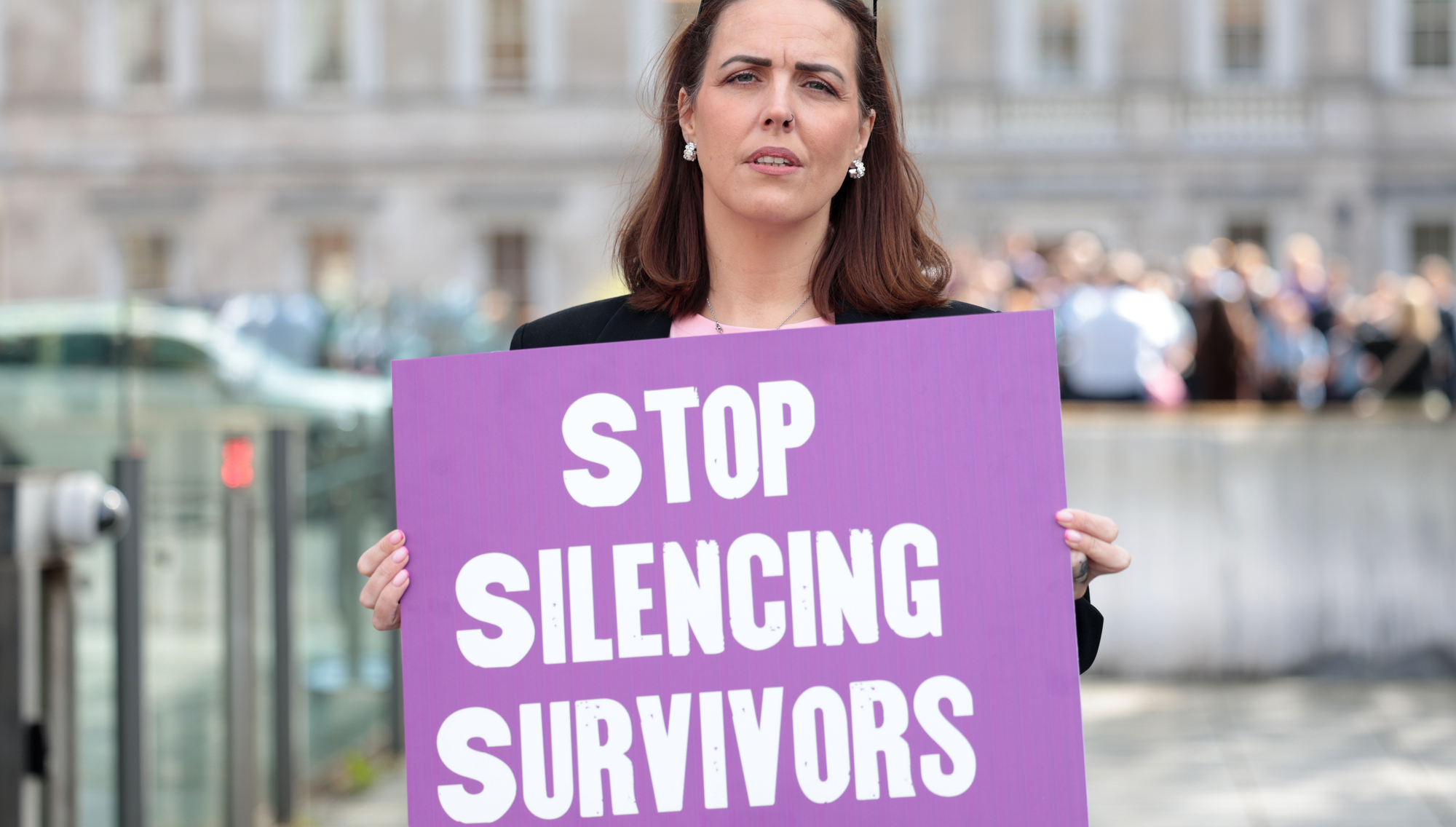
Hazel Behan, survivor and campaigner with Survivors of sexual violence, in front of the Dáil last year to hear Ruth Coppinger introduce her bill to outlaw counselling notes being used by defendants in gender-based violence trials. File photo: Leah Farrell/© RollingNews.ie
Rape Crisis Ireland (RCI) is calling for a presumption of non-disclosure of counselling notes in rape and sexual violence trials.
As the Criminal Law and Civil Law (Miscellaneous Provisions) Bill 2026 makes its way through the Dáil, we have a crucial opportunity to address a fundamental injustice in our justice system — the routine violation of survivors' most private therapeutic conversations. While we welcome the minister for justice's indication that he is likely to bring forward an amendment on this matter, we are seeking reassurance that it will set the highest possible standard for protection, and that it will be implemented with the transparency and consistency survivors deserve.
When a survivor knows that their counselling sessions may be dissected in open court, that their processing of trauma may be used to discredit them, that their most vulnerable moments may become ammunition for their cross-examination, the therapeutic relationship is fundamentally compromised. We routinely hear from survivors that fear their notes being disclosed prevents them from seeking help or being fully honest in therapy.
They are also deterred from reporting or drop out of an investigation when they realise this is the price being demanded of them for justice to be pursued. This is a violation of their human rights.
The current practice of routinely seeking disclosure of counselling notes in criminal cases has evolved over time. Not long ago, it was a rare and risky demand strategy by the defence, but this strategy activated the State actor’s duty under common law to seek this disclosure as a matter of course in order to expedite the pathway to justice. Thus a rare occurrence became a necessity.
This necessitated a legislative intervention to reset what should have always, in reason and justice, been the position on counselling notes. That intervention was Section 19A of the Criminal Justice (Sexual Offences) Act 2017. 19A hasn't worked as intended. This current bill seeks to fix that.
The rationale for disclosure is that it is necessary to ensure a fair trial for the accused; a protection embedded at the very core of our Constitution. RCI does not dispute the importance of fair trials — indeed, we would vigorously defend this right. However, fairness cannot be a one-sided equation.
The right to a fair trial cannot be pursued at the expense of the survivor's fundamental rights to privacy, dignity, and health. The question is not whether the accused deserves fairness, but whether a fairness that demands systematic unfairness towards the survivor can ever be deemed fair. RCI believes a reset that balances rights, without disturbing the Constitution, can be achieved with this bill.
This is why RCI is calling for the highest standard to be applied when considering disclosure: the standard of a "real or serious risk of an unfair trial". This threshold would ensure that counselling notes are only accessed in truly exceptional circumstances where their absence would genuinely compromise a fair trial.
It would shift the burden away from survivors having to justify their privacy and towards the defence having to demonstrate real necessity and relevance.
We must also expand these protections beyond counselling notes to encompass other deeply personal records, including medical records and child protection files. A chilling fact is that this pattern of defence rigour triggering statutory duty, necessitating legislative resets will repeat itself if we do not cast the net more broadly in this legislation.
We acknowledge the significant impact this bill will have on the system and we advocate strongly for investment in both capacity and transparency to realise the intention behind this bill. The benefit of this legislation will not be fully realised without transparency in the conduct of 19A pre-trial hearings.
Legal practitioners need clear guidance to ensure consistency across courts. Survivors have a right to know how courts are interpreting and applying these standards. Transparency is fundamental to survivors' rights. Survivors must be provided with the information they need to inform their decision-making at every stage of their journey.
However, RCI acknowledges that even robust amendments to this bill cannot fully address the fundamental injustice at the heart of our system. The positioning of the survivor as merely a witness rather than a participant, the adversarial structures that treat privacy as negotiable, the cultural acceptance of victim-blaming as trial strategy — these cannot be fixed with piecemeal reforms.
This is why we continue to call for a Commission on Justice to examine the status of victims in our criminal justice system, to consider what justice truly means for survivors, and to assess how we balance rights between survivors and the accused.
Our current approach to sexual violence cases is built on foundations that no longer reflect our values as a society. We have spent decades attempting to retrofit an adversarial system designed for property disputes to accommodate the reality of gendered sexualised violence.
We have passed reform after reform, yet survivors continue to face re-traumatisation by the very system that should support them.
It is time we were brave enough to ask the bigger question — not how best can we serve this justice to survivors but what does justice actually look like for survivors.
Until then, survivors deserve a justice system that does not punish them for seeking healing, that does not use their vulnerability as a weapon, that does not trade their privacy for the appearance of thoroughness.
It is time we established a presumption of non-disclosure, set the highest standards for any exceptions, and ensured these protections are implemented with transparency and consistency. Anything less is a continuation of institutional violence.

CONNECT WITH US TODAY



Be the first to know the latest news and updates