Women hold up our national identity — but at what cost?
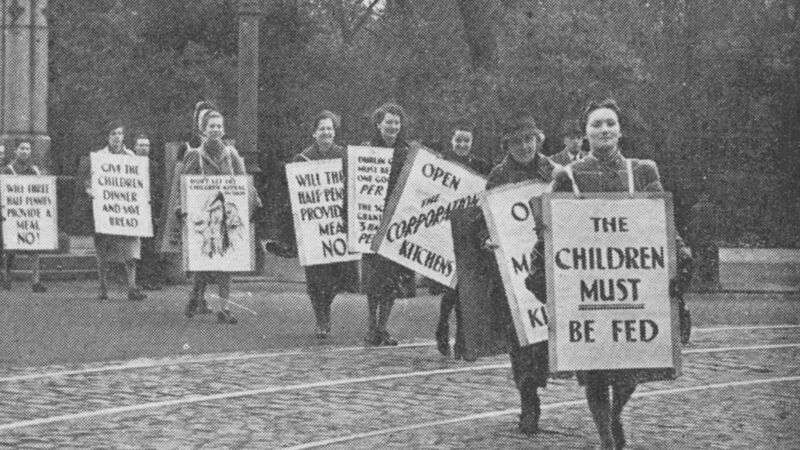
The Irish Housewives Association and other women's networks successfully campaigned to have the needs of their communities seen and addressed.
“The difference with an Irish person,” I pontificated to a friend recently, “is that we will inconvenience ourselves to help someone out.” For context, I live in England. And bigging up Ireland, romanticising it even, is part of the unofficial ambassadorial role us ‘Irish Abroad’ take upon ourselves.
Chief among the qualities of life ‘back home’ most of us preach, or miss, is community. It’s as though, embedded within us, is an inherent belief that being Irish and community-minded just go together. We pride ourselves on it.
I was surprised then, when I read something by sociology professor Liam O’Dowd, which described “communalism” as a “dominant characteristic of Irish social ideology”. I had never thought of Ireland’s “concern for community” as an orienting belief system — as something used to organise and define Irish society. I had simply assumed it was just how we are.
But, without even realising it, in ranting to my friend about how Ireland’s superior community-mindedness made it better than England, I was inadvertently evoking the history behind O’Dowd’s comment.
You see, in the late 19th and early 20th centuries, Irish nationalists were faced with a problem familiar to many colonised countries: how to successfully differentiate yourself from your coloniser and legitimise your claims to independence.
What emerged was a national identity based on an idealised vision of what many believed was Ireland’s true and original form — an agrarian, self-sufficient society organised around small, rural, close-knit communities founded on family, faith and mutual aid.
It was an identity that neatly differentiated Ireland from urban, modern, individualistic, imperialistic England, while remaining conveniently neutral enough to satisfy the various factions of Irish society.
To be Irish, then, was to be ‘communal’; it was to think in terms of ‘we’ rather than ‘I.’ It was also an ideology that was politically useful.
Following independence, consecutive governments successfully drew on it to win support for their policies. Many of the economic choices associated with the post-independence years — such as protectionism and the privileging of the family farm as the primary economic unit — were framed as expressions of Ireland’s national "community-minded" character.

And yet, for all this talk of a “concern for community”, the Irish State wasn’t exactly living up to the ideals of this self-image.
A casual wander through newspaper clippings, Dáil debates, and correspondence between ordinary people of this time reveals accounts of abject poverty and daily human suffering: stories of people on the edge of hunger, others dying from it, outbreaks of typhoid, typhus and the ever-present tuberculosis taking more, the constant exodus of young people, and a rising sense of helplessness in the face of increasing unemployment and economic struggle.
Far from protecting people, the State’s emphasis on community was more often used to justify its lack of intervention and support. Welfare provision, they said, was really a matter for family solidarity and local community.
The ideology of communalism, then, was being used to deflect — rather than catalyse —State responsibility for citizen wellbeing.
However, there was one section of society who took Ireland’s community-mindedness very seriously.
Women.
Through organisations such as the Irish Housewives’ Association and the Irish Countrywomen’s Association, and a variety of other informal and local networks, they successfully campaigned to have the needs of their communities seen and addressed.

At a time when, technically speaking, women were legislatively and socially barred from the public sphere, they made sure the "local" remained political and couldn’t be so easily overlooked by ‘them up in Dublin’. They were determined that something was done, even if they had to do it themselves (which was more often the case).
When I think upon this history, and the things that these women did, I feel a huge glow of pride. There is something about ‘women’ and ‘community’ which evokes all the best characteristics carried by women of Ireland. Their capacity to organise. Their generosity and kindness. Their grit and tenacity. How they embody the very essence of the community spirit Ireland prides itself on.
But it is also indicative of how unequal the load of creating Ireland’s communalism has historically been.
Throughout the history of the Irish State, women have borne the responsibility of this ideology. While this is partly rooted in traditional gender roles — women as primary care-givers — it is also tied to a wider post-colonial pattern which sees women positioned as "culture-bearers", tasked with embodying, performing and transmitting the values that defined the nation’s identity.
And if a “concern for community” was what made Ireland Ireland, then women were expected to make that a reality.
Today, Ireland is a long way from the State that once used an ideology of communalism to create a cohesive sense of Irish identity, or to buffer against the deprivations of a weak economy.

In the 1950s and 60s, that same ideology was repurposed to garner support for modernity and economic development — framed as being "in the interests of the community". And in “advancing” this “alternative communalist ideology,” as O’Dowd puts it, Ireland opened the doors to capitalism and neoliberalism, and to the social shifts that came with them.
While communalism is still a cornerstone of Irish identity, it is largely symbolic; neoliberalism and the individualism that goes with it are now the beliefs that orient us.
Yet, despite this social change, many women I speak with describe still feeling a deep weight of responsibility to their wider families and communities. They still feel the pull of that older ideology of communalism shaping their everyday lives.
Caught between the old and the new, women remain subject to this often gendered ideal of communalism while, at the same time, the effects of neoliberalism and capitalism have increasingly isolated them from the collective support systems and intergenerational networks they once relied on to share the load.
And the cracks are beginning to show.
Over-burdened with the responsibility of it all, many confess a growing resentment, a desire to push back against and place boundaries between themselves and these older ideals. Because, in truth, they are often a one-woman collective trying to keep an entire family or community network going, and they are exhausted.
So, while I will no doubt continue to big up and romanticise Ireland’s community-mindedness, I think there is much in this history which — this Brigid’s weekend especially — deserves a closer look. Not just for what it says about Ireland’s community-minded identity, but for what it reveals about who we have long expected to do the lion’s share of the community-building.
- Dr Belinda Vigors is a cultural theorist and oral history researcher whose work explores how Ireland’s past shapes women’s present