Sanctuary cities, ICE and federal power: what the Minneapolis shootings reveal about the US
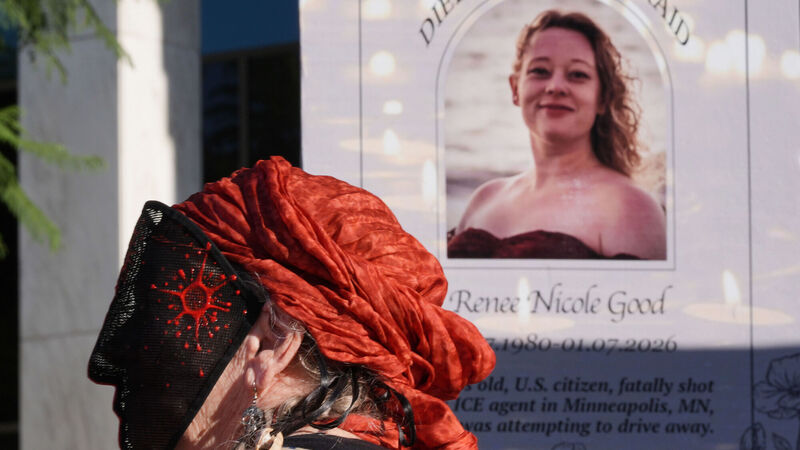
A demonstrator wears a mask in front of an image of Renee Good during a protest to denounce the Trump administration's immigration enforcement polices in Los Angeles. File Picture: Jae C Hong/AP
Minneapolis has found itself at the centre of US unrest this month. On January 7, a US Immigration and Customs Enforcement (ICE) agent shot and killed Renee Nicole Good, a 37-year-old “observer”, during a federal operation.
Footage of the incident spread, triggering protests that rippled across the country.
A week later, tensions escalated when a Venezuelan man was shot in the leg by a federal officer during what ICE described as a “targeted” traffic stop.
Minneapolis mayor Jacob Frey publicly accused ICE of “creating chaos” on the city’s streets.
The shootings transformed a long-running policy dispute into a national crisis.
However, the uproar surrounding Minneapolis is not only about two violent encounters. It is about what “sanctuary cities” have come to represent, why immigration enforcement has become one of the most combustible frontlines in a deeply fractured American public life.
Legally, there is no single definition of a sanctuary city. In practice, sanctuary policies establish boundaries: What local governments will and will not do in support of federal immigration enforcement.
For example, declining to hold people on ICE detainers, restricting the sharing of immigration data, and refusing to deploy local resources in federal operations.
Supporters argue such policies are essential to public safety. When residents are not afraid that any encounter with local authorities could trigger deportation, they are more likely to report crimes, co-operate with investigations, and access public services. Sanctuary, in this view, is not about immunity but about trust.
Opponents see something else entirely: Obstruction, permissiveness, and the erosion of the rule of law. Critics argue such policies shield undocumented migrants from enforcement and undermine national sovereignty.

Illan Wall, a lecturer in law at the University of Galway and a specialist in protest movements, traces the modern sanctuary movement to the 1980s.
“In its modern form, the sanctuary movement grew out of various religious groups seeking to provide shelter and support for refugees fleeing the USA’s proxy wars in El Salvador and Guatemala,” he says.
“Initially it was churches, synagogues, and other religious buildings that provided sanctuary.”
Those early sanctuaries were not symbolic gestures. They were acts of civil resistance, rooted in the public’s reckoning with US involvement in conflicts across Central America.
“All of this was in response to revelations about the US involvement in some of the worst human rights abuses in South and Central America,” Mr Wall says.
By the late 1980s and early 1990s, the language of sanctuary migrated from religious spaces into municipal politics. Mr Wall argues that symbolic power is precisely why sanctuary cities have remained such consistent political targets.
“Sanctuary cities have always been a target for Republicans, because they present a very real challenge to an exclusionary idea of the USA,” he says.
Under Donald Trump, that challenge has been confronted not just rhetorically but operationally.
“Trump escalated this significantly, and has sought to fundamentally undermine the sanctuary cities by flooding them with ICE agents,” Mr Wall says.
“Trump has targeted the sanctuary cities because they are one of the most visible forms of a more open and welcoming politics. They contest his ethno-nationalist vision of America in a very real way.”
Minneapolis — long governed by progressive leadership and shaped by post-George Floyd activism — sits squarely within that collision. The killing of Ms Good did not occur in a vacuum. It happened in a city where immigration enforcement has increasingly been met by organised civilian monitoring.
Mr Wall describes how protest tactics have evolved in response to the expanding presence of ICE.
“Protesters have sought to prevent the normalisation of ICE,” he says.
Groups of ‘observers’ follow federal agents as they drive around in unmarked SUVs, beeping their horns and alerting people that ICE is in the neighbourhood
When agents are on foot, observers follow them and shout warnings.
“In a very real way, they are not allowing this form of state intervention to fade into the background and become just another ‘normal’ state function,” Mr Wall adds.
Ms Good was one such observer. Her death has come to symbolise not only the risks of these confrontations, but the widening gulf between how different Americans understand the presence of federal power in local spaces.
To some, ICE operations are routine law enforcement. To others, they are extrajudicial incursions — something to be documented, disrupted, and exposed. This struggle over normality is central.
Sanctuary politics is not only about protecting migrants. It is about resisting the quiet absorption of immigration enforcement into everyday civic life. It is a struggle over what kind of power the American state represents — and whom it serves.
Local policing and federal law
At the constitutional level, immigration is a federal responsibility.
Policing, however, remains largely local. The US Supreme Court has repeatedly ruled that Washington DC cannot compel states or cities to enforce federal immigration law.
Sanctuary policies are built on that distinction. They assert that cities retain the right to decide how their police forces are used.
Minneapolis illustrates how fragile that settlement has become. Federal agents now operate in large numbers, often independently of local authorities.
The mayor’s accusation that ICE is “creating chaos” reflects not only concern about public safety but about sovereignty: Who governs urban space and in whose name.
In this sense, federal-local conflict is no longer episodic. It is structural.
Immigration enforcement increasingly arrives in cities as something done to them rather than with them. For Mr Wall, Minneapolis should be read not as an exception but as a symptom.
“It is fair to describe the US as existing in a state of unrest,” he says.
This is a simmering atmosphere of tension where flashpoints can quickly escalate into major confrontations
He warns that, in politically unstable and unpopular governing conditions, such flashpoints carry particular danger.
“Where governments are unstable and unpopular, these flashpoints run the risk of causing a cascading series of events which can spiral out of control.”
Historically, the federal government sought to suppress such dissent. What troubles Mr Wall is the sense that escalation is now part of the governing strategy.
“Since the 1960s, the federal government has sought to quell this unrest. But the Trump government seems to court escalation in order to justify further spectacular repression,” he adds.
In that context, Minneapolis becomes more than a city in crisis. It teeters as a testing ground for how far enforcement can be pushed, how visible state power can become, and how much disorder can be politically weaponised.
The Minneapolis shootings have not merely intensified a debate, they have exposed the depth of US fracture.
Sanctuary cities have become vessels into which wider fears and hopes are poured — about borders, race, security, federal power, and national identity. Each enforcement surge, each lawsuit, each viral confrontation pushes the conflict deeper into symbolic warfare.
Whether the US can return this struggle to the realm of workable governance remains uncertain. What is clear is that sanctuary now names one of the most volatile battlegrounds in American life. In Minneapolis, that battle is no longer metaphorical.
CONNECT WITH US TODAY
Be the first to know the latest news and updates