Girls are missing from crucial Stem areas such as AI, and it shows
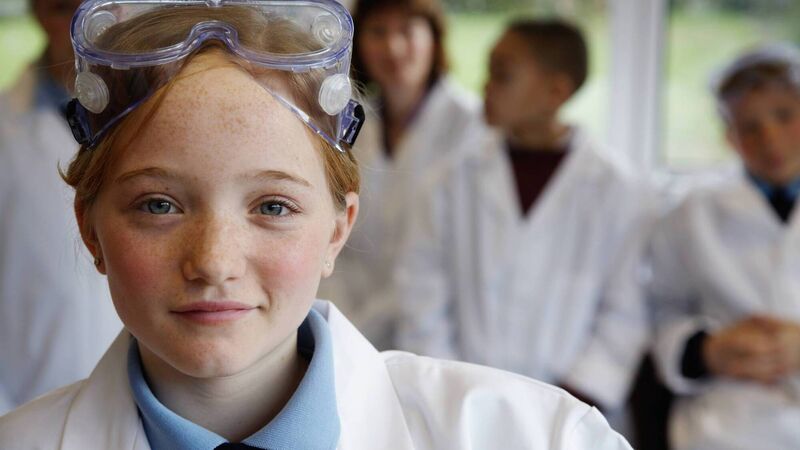
Not allowing girls the opportunity to study STEM subjects is fundamentally discriminatory. File picture
When we invest in women and girls, we invest in the future for every community and every business.
Investing now in the next generation of women will be one of the biggest drivers of innovation in the next decade, fuelling new ideas, new industries, and new leaders. It will also help secure the foreign direct investment (FDI) critical to our economy into the next century.
When we back women and girls with equal opportunity across education pathways and industry, minds shift, and culture slowly begins to change.
It may surprise many readers, but in Ireland in 2026, we continue to hold young girls back through discriminatory practices developed in the last century, that continue, largely unchallenged, today. This begins with education. The Department of Education reports that while 96% of boys schools offer a science, technology, engineering, and maths (Stem) subject at second level, only 71% of girls’ schools do. This is also reflected in the 2025 I Wish Survey, which found that only 5% of girls attending I Wish 2025 from single-sex schools reported access to construction studies, 6% to engineering, and 20% to technology. This is not a reflection of girls’ interest, ambition or ability. It reflects access — or more accurately, the lack of it. This matters.
It matters in an economic environment where it is estimated that between 75% and 80% of the fastest-growing jobs require Stem skills. It matters in an economy highly dependent on FDI, where, according to IDA Ireland, a highly skilled Stem workforce is crucial to Ireland’s value proposition.
It matters because in 2024 alone, Ireland’s goods exports, which are dominated by Stem industries, reached a record €224bn. And it matters when, according to Generation Ireland and McKinsey & Co’s Bridging Ireland’s tech skills gap through social mobility report (September 2025), the country’s projected growth of 40,000 technology roles between 2025 and 2030 may be hindered by Ireland’s skills gap, with 83% of employers reporting significant difficulties in sourcing skilled professionals.
It matters when the effect of denying girls access to applied Stem subjects at second level is to quietly write them out of the economies of the future. When access is restricted, so too is aspiration, confidence is undermined, and the talent pipeline suffers.
In many boys schools, engineering and construction studies are embedded as part of the core curriculum supported by workshops, equipment, and teacher expertise built up over generations. In contrast, many all-girl schools still lack these facilities because these subjects were not seen as important enough or relevant to young girls to warrant any significant investment. Our education system continues to reproduce inequality, not through explicit exclusion, but through choices being made at societal level — choices that have systematically limited investment in the infrastructure needed to support the development of young girls.
Access to Stem
The I Wish festival (now in its 12th year), taking place in the RDS Dublin on February 5 is a key part of the infrastructure that supports girls’ access to Stem.
I Wish showcases the role models and careers shaping the economies of the future, such as construction, engineering, and technology — careers many young girls may not previously had any exposure to or may have been represented as a male domain.
Construction is still viewed by many students and parents as a “boots on the ground” career, when the reality could not be more different. Today’s construction industry is highly innovative and technology-driven, shaped by robotics, 3D modelling, digital design, smart systems, renewables, data analytics, and project management software.
Construction roles today demand creativity and critical thinking, problem-solving skills, and an ability to collaborate — skills in which girls consistently excel, yet deselect themselves often because of mixed messaging in schools where they are denied access to engineering and construction studies and because of a lack of information on the breadth of roles within the sector.
The consequences are evident in the workforce today, where women make up just 9% of the construction sector, with only 1% working on building sites. This is not because women are incapable or not interested; it is because the system was not designed to include them.
The I Wish festival is designed to change that. The 2026 festival includes a dedicated Construction Zone supported by the Construction Industry Federation, giving girls firsthand exposure to the technologies, careers, and possibilities shaping the construction industry of the future.
In a world where science and technology are designing our futures and determining how we interact and communicate with each other, it is concerning that just 22% of the professionals in AI are women, and less than 15% hold senior executive roles. Without balanced representation, AI systems are at risk of perpetuating existing social biases and inequalities. AI systems are not neutral — they reflect the biases, perspectives, and values of their creators.
This is why we need more women in the Stem boardrooms and control rooms where these systems are built, deployed, and governed. Recent events have only served to underscore the importance of this.
We simply cannot allow fundamental decisions about our futures to be made by a significant male majority. Representation matters. I Wish 2026 will showcase roles in future technologies like AI with Dell Technologies, Logitech, Deloitte, Iarnród Eireann, Regeneron, Johnson & Johnson, and many more. Their involvement is designed to empower the young girls attending I Wish to see the central role they can play in shaping the future they want to see through AI.
However, I Wish, and similar extracurricular Stem events cannot, on their own, solve a complex societal and cultural problem. If we are serious about maintaining a strong talent pipeline, building the currency to deliver FDI, and supporting the next generation of leaders and innovators, then we must prioritise equity-driven investment in the infrastructure needed to deliver applied Stem subjects across all schools, alongside significant curriculum reform.
We need to urgently interrogate traditional approaches to subject availability and investment through an equity lens. This is not about taking opportunities away from boys — it is about finally building them for girls. Every student, regardless of whether they attend a single sex school or a mixed school, deserves the same opportunity to discover and explore where they might belong. This is when confidence is built. This is where creativity flourishes. And this, more than anything else, is what will enable Ireland to build and maintain an agile, resilient, and future-ready workforce.
When we look at the girls that attend I Wish, we do not see them only as the schoolgirls they are today — we see the women they will become. Women who will break barriers and make a positive impact in communities around the world. We see women who are driven, ambitious, and socially conscious. We see women who will use their voices for causes they believe in — from gender equality to racial justice to climate change.
These girls are our future agents of change. If we want them to lead, innovate and thrive, then we must invest in and enable them.
- Gillian Keating is a partner at RDJ Solicitors and co-founder of I Wish.
CONNECT WITH US TODAY
Be the first to know the latest news and updates