‘We all partied’ was never the truth about the Celtic Tiger and Ireland is still paying the price
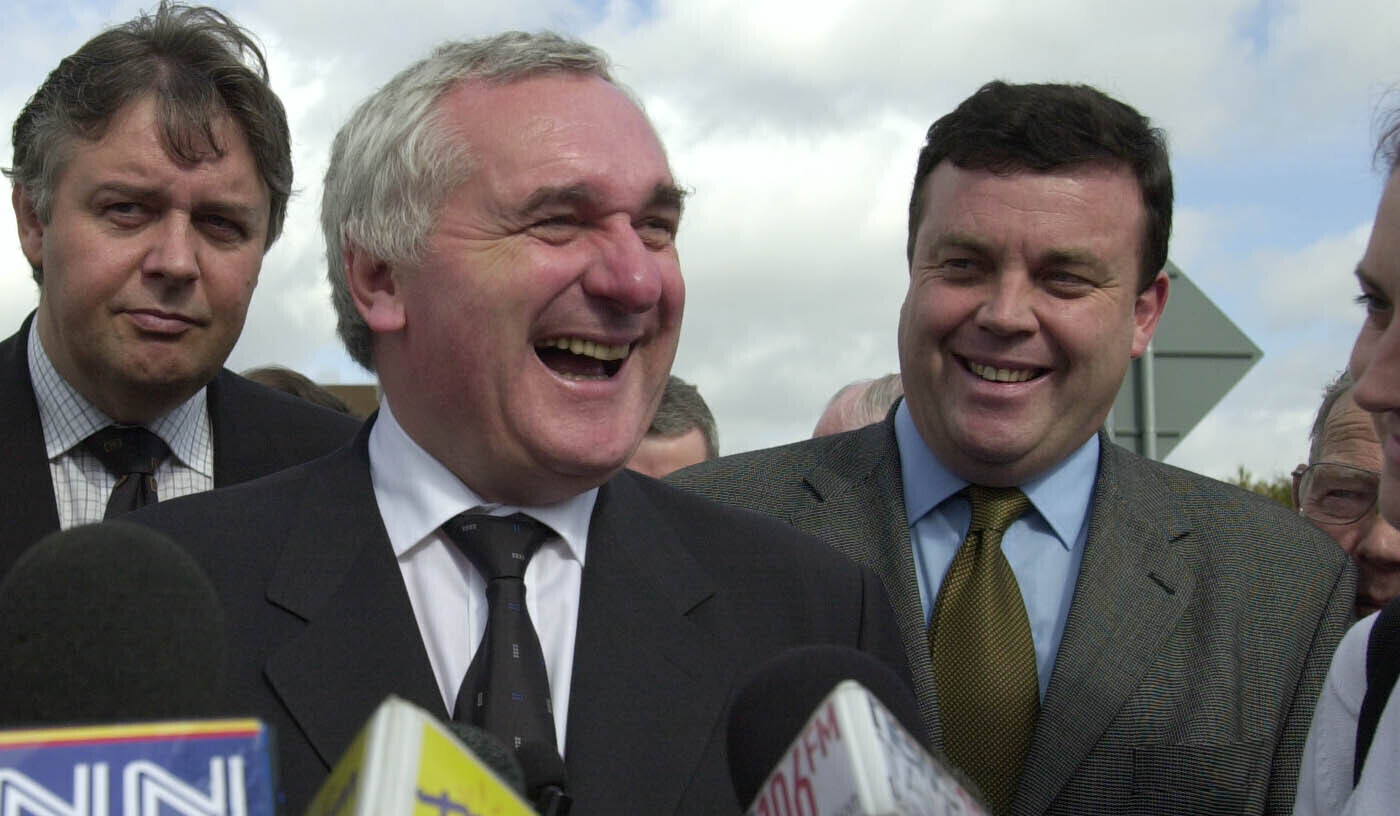
Former taoiseach Bertie Ahern with former finance minister Brian Lenihan. File picture

IT WAS a clumsy, tone-deaf phrase, uttered by then finance minister Brian Lenihan during a Prime Time interview in 2010, when pressed on whether politicians and regulators were to blame for the excesses of the Celtic Tiger era and the devastation that followed. Intended, perhaps, as an acknowledgement of collective complicity, it landed instead as abdication.
Three words that seemed to shrug at the wreckage. And yet the phrase has endured, precisely because it captured something essential about the era: The hubris, the denial, the dangerous myth that this was a free bar and that the hangover belonged to no one in particular. We all partied, Lenihan said, as if a society (fed by its government) can binge without consequence, as if the music stopping were an act of God rather than the inevitable end of a badly-managed stag party.
Twenty-five years on — let’s take 2001 as an imaginative starting point — it is worth returning to that phrase, not to sneer at it, because sneering got us nowhere, but to dismantle it. To examine how we got there, what it looked like while it lasted, how it ended, and what, if anything, we learned. And crucially, to ask who was actually drinking, who was pouring, and who was left cleaning up when the lights came on.

Ireland did not wander blindly into prosperity. The Celtic Tiger was not an accident, nor was it simply the product of luck or favourable winds. Its foundations were laid deliberately, patiently, by a generation of policy makers and economists who understood something deeply unfashionable at the time: That ideology is no substitute for strategy.
By the late 1950s, Ireland faced a bleak reality. Chronic emigration hollowed out towns and parishes. Domestic industry was weak and protected. The tax base was narrow, and ambition smaller still. John Healy’s writing on emigration captured the psychic toll of that era — the quiet despair of a country watching its young people leave, and the haunting refrain that “no one shouted stop!” on the cover of that book, with weeds growing up through an abandoned railway line — haunted even then. It hits harder now. Healy’s polemic was published in 1968. The response was radical because it was pragmatic. If Ireland had no industry, then it would import it — but it would do so intelligently. The IDA became the sharp end of that vision: Targeting foreign direct investment, selling political stability, education, access to Europe, and a young, adaptable workforce. This was not a get-rich-quick scheme. It was a long game. It was that rarest of things — a vision.

Figures such as Ray MacSharry mattered enormously in this period. MacSharry famously admitted that he did not understand economics — but he understood expertise. He listened. He deferred. He helped stabilise public finances and restore international credibility at a moment when both were fragile. It was a politics rooted in humility, and it gave Ireland something precious: A fighting chance. By the late 1990s, the results were tangible. Multinationals arrived in force. Employment expanded. Wages rose. Education paid dividends. For the first time in modern Irish history, people stayed — and many returned. The country stood at a crossroads. The opportunity was there to translate growth into permanence: To invest in infrastructure, housing, health, education, sport, and the arts; to build a society as well as an economy.
The heavy lifting was done. What mattered next was how we chose to behave.
By 2001, something subtle but profound had shifted. The discipline that brought prosperity gave way to the assumption that prosperity was permanent. Growth was no longer something to be managed; it was something to be celebrated. The expression of caution was a treasonous act. Caution became the killjoy, while regulation was recast as obstruction.

This is where the phrase “we all partied” begins to take shape. Credit flowed freely, cheaply, and with astonishing confidence. Property prices climbed at a pace that should have set off alarms, but instead became a source of national pride. A boast at weddings. Suddenly everybody had “a guy.”
A mortgage guy. A real-estate guy. A car guy. A tax guy — none of whom looked old enough to rent a car themselves.
Weekends away involved a short trip to New York to fill the bags. “Checking on the place abroad” became a common utterance. Banks competed to lend you money you hadn’t asked for: 100% mortgages, interest-only loans, terms that assumed perpetual growth. Risk was not eliminated; it was simply ignored.
Property became the national obsession. Teachers, gardaí, taxi drivers were encouraged to see themselves not as workers but as investors. Entire property portfolios were assembled by people who were earning €42,000 a year. Apartments were bought off plans in places like Bulgaria — developments that were never built, in countries buyers had never visited.
The stories became folklore almost immediately. A friend’s brother bought a private jet. Flew it, by some accounts, fewer than 10 times before he could no longer afford the fuel. Helicopters filled the skies above Galway during race week like it was the fall of Saigon (in many ways it was). Champagne flowed at product launches, at GAA fundraisers, and parish socials. Meanwhile, many of us were still going to the bog, turning turf. This was the party. But it was not evenly attended, and certainly not supervised.

Plenty of powerful voices insisted the boom had no ceiling. Bank executives spoke earnestly about a “new paradigm”. Developers warned that any attempt to cool the market would strangle supply — a claim now rendered grotesque by the scale of today’s housing crisis.
Politicians reassured voters that fundamentals were strong, that Ireland was different, that regulation would frighten investment away. There were dissenting voices, too. Economists who warned of overheating. Analysts who pointed to unsustainable price-to-income ratios.
“When the music stops, property prices will fall by 40 to 50%,” economist Morgan Kelly told the Irish Times as early as 2006.
At the time, Kelly was ridiculed by politicians, developers, and sections of the media. He was described as alarmist, irresponsible, even unpatriotic. His warnings were treated not as analysis but as provocation. Within three years, his forecast looked conservative. Even the Irish Congress of Trade Unions urged restraint, arguing that rising house prices were not a substitute for social housing policy. Conveniently, their posture was caricatured as anti-growth.
“Sitting on the sidelines, cribbing and moaning, is a lost opportunity.”
Taoiseach Bertie Ahern lectured reporters in 2007. “I don’t know how people who engage in that don’t commit suicide because frankly the only thing that motivates me is being able to actively change something.” Suicide.
Knowing what we know now, and what the few Ahern was berating were trying to tell us, his cruel indifference sits as a totem of political arrogance. And this is where “we all partied” collapses as a throwaway explanation.

Governments should never be guests at the party, never mind the hosts. They are the chaperones. Their role is not to drink the punch, but to make sure the floor doesn’t give way. The purpose of regulation is not to dampen joy, but to prevent catastrophe. A state exists to protect the fundamentals of a democracy, not to shrug when the music stops and discover there is no food in the fridge for the kids the following morning.
We know how it ended. The crash was not a hangover; it was complete organ failure. Banks collapsed. A property market inflated by fantasy imploded into negative equity. The State stepped in, socialising losses on a scale few had imagined possible. Austerity followed — not as an abstract concept, but as lived reality. Emigration returned and services were cut. Trust was eroded. The pillars that should have been built in the late 1990s were non-existent so our doctors followed our nurses on the first plane to anywhere else. As we lurched toward the housing crisis we now find ourselves in, ghost estates and dereliction took hold like Japanese knotweed. And this is why the phrase still rankles.
Because if we all partied, why was the bill not shared evenly? Why did the costs land so heavily on those who never owned a second property, never speculated, never set foot in a helicopter? None of the people sleeping rough in Cork last night were flying to the Galway Races in 2006, their bellies full of oysters and Dom Pérignon Réserve. None of the families trapped on housing lists benefited from tax breaks on speculative developments.
“We all partied” becomes, in this context, not a confession, but an evasion.

The lesson was supposed to be structural. Regulation matters. Housing is a social good before it is an asset class. Infrastructure cannot be retrofitted after the fact. Growth without governance is not success; it is delay. And yet, here we are. Twenty-five years on and homelessness is at record levels. Housing supply throttled by speculation and inertia. Health waiting lists stretching patience and credibility. A generation locked out of ownership, told again that fundamentals are strong, that relief is coming, that this time will be different. The Celtic Tiger still haunts us — not because of its success, but because of how casually we squandered the chance it gave us. We came close to being a mature, confident economy that converted growth into resilience. The early vision — the IDA’s patience, MacSharry’s humility, the long view — showed what was possible.
What we chose instead was speed. The “get high, quick” option. Property over people. Short-term gain over long-term care.
In 1958, when Ireland was poor, emigration-ravaged, and uncertain of its future, TK Whitaker wrote something that should still stop us short: “Economic expansion is not an end in itself but a means to an end.”
It was not a flourish. It was a warning. Growth, Whitaker understood, is only valuable if it leaves behind something solid — institutions, security, opportunity — rather than just the memory of momentum.
By 2001, Ireland had arrived at the destination Whitaker had imagined. The country was confident, outward-looking, prosperous. We had done the hard part. What followed was not inevitability, but choice. We chose speed over stewardship, property over planning. We chose to believe that prosperity, once achieved, could be taken for granted.

“We all partied,” Brian Lenihan would later say, trying to explain the wreckage. But Whitaker had already explained it, half a century earlier. Expansion without purpose hollows itself out. Short-term remedies become long-term problems. The absence of planning does not mean the absence of consequences — it merely delays them.
Those consequences are no longer theoretical. They are visible in today’s housing crisis, in record homelessness, in hospitals stretched beyond dignity, in a generation once again asking whether Ireland can work for them. None of this is accidental. It is the residue of decisions taken when money was abundant and restraint unfashionable.
The bitter irony is that the Ireland of 1958, with far less wealth and far fewer options, showed greater seriousness about the future than the Ireland of the boom. Whitaker’s generation did not mistake growth for success. They understood that the job of government is not to enjoy the good times, but to prepare for the bad ones — and to make sure that prosperity, when it comes, is shared, protected, and enduring.
The Celtic Tiger did not fail because we dreamed too big. It failed because we stopped planning. Because we forgot that growth is a tool, not a trophy. Because when the music was loudest, we lost the discipline that got us there in the first place.
Twenty-five years on, the question is no longer whether we partied. It is whether we remember what Whitaker knew instinctively: That the real test of an economy is not how fast it grows, but what remains when the party ends.

Subscribe to access all of the Irish Examiner.
Try unlimited access from only €1.50 a week
Already a subscriber? Sign in
CONNECT WITH US TODAY
Be the first to know the latest news and updates