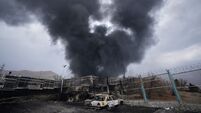
Cambodia border conflict is a disaster for the region's poorest
SeeBeyondBorders is a small education-focused NGO working in one of the world's poorest-educated countries. A conflict between Thailand and Cambodia threatens children's futures
Cambodia border conflict is a disaster for the region's poorest

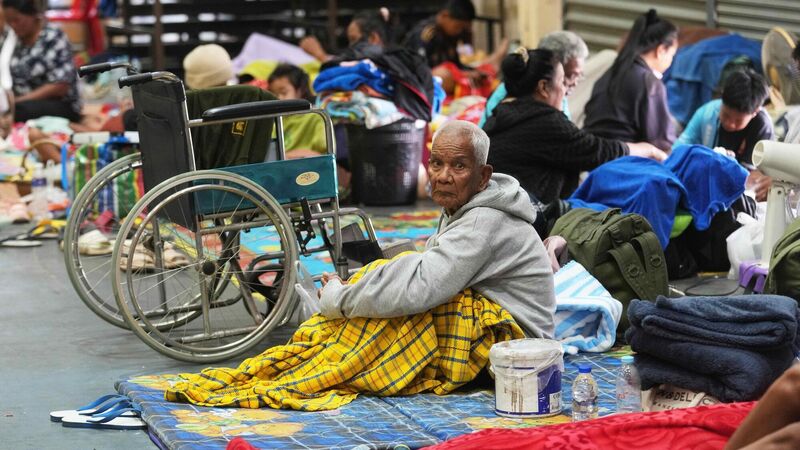
Thai residents who fled homes following the clashes between Thai and Cambodian soldiers, at an evacuation center in Surin province, Thailand, last week. Picture: AP/Sakchai Lalit

The unfolding conflict in the Cambodia-Thailand border provinces is a disaster for the region’s most disadvantaged people. It echoes a disturbing global trend of increasing nationalism, the spread of disinformation, and declining support for multilateral institutions including ASEAN, the UN and the International Court of Justice (ICJ). It has an immense human cost.

This is a conflict, at least in part, about borders and power, set against a backdrop of political turbulence within Thailand. Sovereignty along the 800km Thai-Cambodia land border has been disputed by Thailand since it was mapped by the colonial French in 1907. 

While the ICJ ruled the border legitimate in 1962 and again in 2013, Thailand does not accept this ruling. The use of heavy weapons and artillery strikes up to 80km inside Cambodia, along with the mass displacement of hundreds of thousands of people, makes this by far the most disturbing period in my time here.

This is not a conflict between equals. With a population four times larger and a GDP 14 times greater, Thailand is a bigger, more prosperous and more developed country than Cambodia. Thailand can absorb shocks that Cambodia cannot.

The Human Development Index (HDI) considers health, education, income and living conditions to provide a measure of social and economic development. At 151, Cambodia ranks lowest in the entire region and far behind neighbouring Thailand (76).

In the past week alone, 404,000 Cambodian civilians, including 96,000 children, have been displaced from their homes and schools. This year, government donors in the US, Sweden, the UK and Switzerland — but thankfully not Ireland — have drastically reduced or entirely eliminated aid. This instability therefore comes at the worst possible time for Cambodian families already on the brink. It is a crisis within a crisis.

A significant factor behind Cambodia’s low HDI relates to education.

The Cambodian education system was completely decimated by the Khmer Rouge regime, whose targeted genocide killed 90% of teachers. Since its fall, rebuilding has been from a very low base. While significant progress has been made in school infrastructure, it is people, not buildings, that make an education system.

Cambodia has one of the youngest populations globally and enormous potential, so it is Cambodian people — and Cambodian teachers — who need our support now. 

While Cambodia ranked last of 81 countries that took part in recent international education assessments, it was one of only three countries to improve its score. Its young people are proving that targeted support can be transformative.

Education can and does change lives and life outcomes. Almost every international development indicator — economic, health, equality, stability and participation — improves when access to quality education improves, especially at primary level and when teacher effectiveness improves. 

The current crisis is a huge setback, centred as it is in remote locations in northern Cambodia, already the furthest behind in educational opportunity and achievement. Children are traumatised, teachers are traumatised, and whole communities are traumatised.

Cambodian villagers sit on tractors as they flee from their home in Preah Vihear province, Cambodia, last week. Picture: AKP via AP

Some government schools where we work have closed, others have become evacuation centres, while some are taking in additional children who have been displaced.

My Cambodian colleagues, some of whom have been displaced themselves, are at the forefront of this response, working tirelessly to provide safety, stability and opportunity for children, teachers and communities in a rapidly changing situation. 

They are coordinating with displaced families, school leaders and government officials to meet the most basic educational needs of those most impacted — children.

In Cambodia, poor teaching quality remains the greatest barrier to learning, particularly in rural regions where many children do not complete their education. Teachers are committed but often lack access to training and ongoing support. 

As an Irish organisation working exclusively in Cambodian education, we focus on addressing root causes through locally-led solutions, supporting Cambodian teachers and leadership to deliver lasting improvements and help communities navigate this crisis. Our programmes are entirely led and implemented by Cambodians, for Cambodians.

We Irish have our own history of colonisation, emigration, conflict and a troubled relationship with our nearest neighbour. We also understand and value the transformative impact of investing in education.

At SeeBeyondBorders, we are committed to staying and working with Cambodian leaders to rebuild resilience, focusing first on the furthest-behind regions in this furthest-behind country.

In Cambodia, even small contributions can go far in strengthening the capacity to withstand and recover from shocks. In this polarised world, where we increasingly feel powerless and our first thought is, “But what can I do about it?”, please consider supporting our small, niche organisation here in Cambodia. You absolutely can make a difference. Now more than ever, it is needed.

  • Colm Byrne is chief executive of SeeBeyondBorders Ireland, an Irish development organisation. A former primary school teacher from Dublin, Colm has lived in Siem Reap, Cambodia, since 2013

More in this section

Revoiced

Newsletter

Sign up to the best reads of the week from irishexaminer.com selected just for you.

Cookie Policy Privacy Policy Brand Safety FAQ Help Contact Us Terms and Conditions

© Examiner Echo Group Limited