Planning reform is not a return to the Wild West
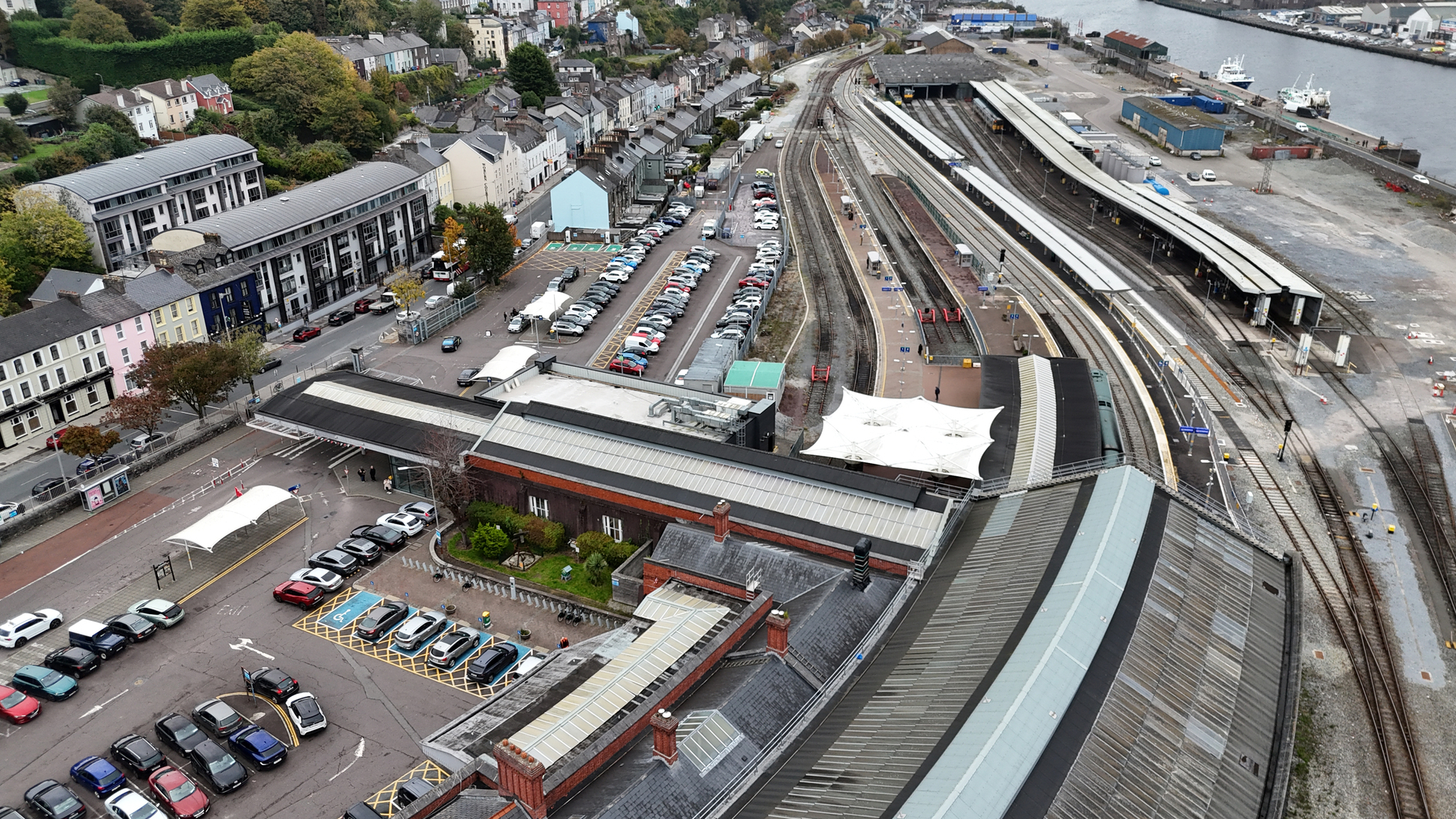
Kent Railway Station in Cork City with the docklands and River Lee. Across our infrastructure network, development timelines have doubled over 20 years. File picture: Larry Cummins
The Government’s Accelerating Infrastructure Report is a very unusual report. Compared to the number of publications that gather dust on the shelves of Government Buildings, this is a cause for optimism.
Firstly, writ large throughout is an acceptance that the delay in infrastructure and housing is self-imposed by the accumulation of regulatory, legislative and procedural systems successive Governments have introduced since 2008.
This openness is no doubt partially driven by the task force of high-level public servants from State bodies such as Uisce Éireann, Eirgrid and TII. They have been operating within the morass of overlapping regulatory and administrative bureaucracy that stymies infrastructure delivery in Ireland.
Another of the report’s rare features is a detailed action plan with timelines and responsibilities which will be hugely important as we monitor minister Chambers' attempts to co-ordinate the State’s agencies to collaborate on delivery.
A key action area that will get lots of attention will be judicial reviews (JR). JRs have become the bête noire of infrastructure delivery over the past five years and before discussing their reform, we must grasp how bad the problem around judicial reviews and infrastructure delivery has become.
If judicial reviews on planning are, as some claim, a ubiquitous cornerstone of a democratic society, we should expect to see a fairly consistent bar chart of how regularly they are taken by citizens across similar legal and cultural jurisdictions. Yet we are faced with the fact that, according to data from An Coimisiún Pleanála, Irish citizens take around eight times more judicial reviews than citizens in both Wales and England.
In part because of this, Uisce Éireann states that the development time for a small Wastewater Treatment Project in Ireland is now seven to 10 years. This is four to five years longer than similar sized projects in other EU Member States.
ESB Networks note the development cycle for a basic electricity substation has now reached six years. A basic electricity substation is usually a single-storey building made of brick with a single door and a few vents.
Across our infrastructure network, development timelines have doubled over 20 years. The impact is housing shortages, power shortages, traffic jams, isolated communities, missed climate targets, higher costs for small businesses and in extreme cases social fragmentation and the rise of populism.
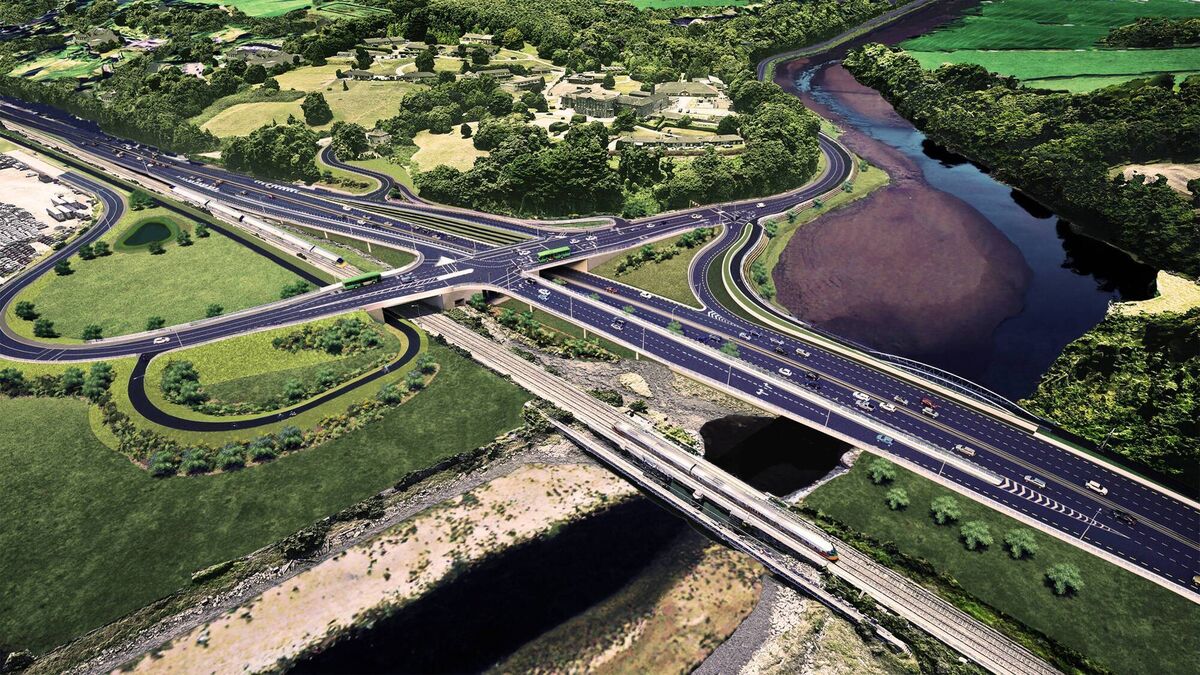
The irony is that JRs routinely stymie perfectly normal, well thought-out and environmentally consistent infrastructure projects that would help Ireland manage climate action.
Countries such as Spain and Australia, expert at delivering infrastructure at scale, have public engagement processes based on consultation rather than objection. They are time-bound, have some element of locus standi and consider individual issues against a clearly defined ‘public good’. This seems sensible and clearly works.
It feels worth noting that the need for reform in this area is not a solo-run of deregulation by minister Chambers or a return to the Wild West. We all accept Ireland is in an infrastructure crisis. Every report from every serious organisation for a decade has told us this.
The IMF, the World Bank, the European Commission, the list goes on. The 2024, European Union ‘Draghi Report’ for example, spotlighted Ireland as having the slowest approval processes for renewable electricity in the EU. For a wealthy, modern nation that fact should hurt.
How, at the same time, can we seek some of the most ambitious climate goals in Europe yet maintain the slowest approval process for renewable energy projects? Ireland is nowhere near where it needs to be on climate action and part of that is our inability to change our lived environment.
The reality is that streamlining the State’s delivery of infrastructure will see the delivery of projects that will embed sustainability into our economy and our way of life.
From an engineering perspective, the good news is our sector can provide the solutions to Ireland’s housing, infrastructure and climate crises. However, the Government must make several policy changes at speed to remove the barriers it has identified, particularly in the areas of procurement and contractual conditions.
At a time, when the State needs a healthy, engaged engineering sector, companies are being forced to abandon and avoid public sector projects due to their inherent risk, and antiquated contractual conditions. At the end of every delayed school-building, housing, road or rail project is an engineering firm, mostly SMEs, waiting for the best part of a decade for payment.
The report outlines the need for reform in procurement and the sector’s hope is that the State’s contracting authorities can adopt more enlightened and effective contracts that make public sector projects attractive for the sector again.
As things stand, in public sector contracts, engineers can be held liable for the mistakes of any other party in the project. This places incredible risk and costs on engineers who are increasingly voting with their feet. This antiquated system, arising from the 1961 Civil Liability Act, raises professional indemnity insurance and is not common practice in the rest of the EU.
So the challenges facing the system are vast and we need to recognise that the Accelerating Infrastructure Report is just that; a report. Action is now required.
Judicial reviews are not the whole picture and nobody is pretending they are. Procurement processes, labour shortages, land usage and capital spending are all in that Venn diagram but if there’s a picture of this crisis, and a jigsaw puzzle to be constructed to fix it, judicial reviews are absolutely part of it.
We need to look soberly at where the nation is. We are nowhere near our climate targets. We drive far too much compared to European averages. We burn far too much fossil fuel. We produce far too many greenhouse gases and we produce nowhere near enough houses, never mind renewable energy for our growing population.
We cannot ignore or object our way out of these challenges. We must build.
- Dónal O'Neill is senior policy advisor at the Association of Consulting Engineers

CONNECT WITH US TODAY



Be the first to know the latest news and updates