Trump’s Ukraine peace plan threatens European security
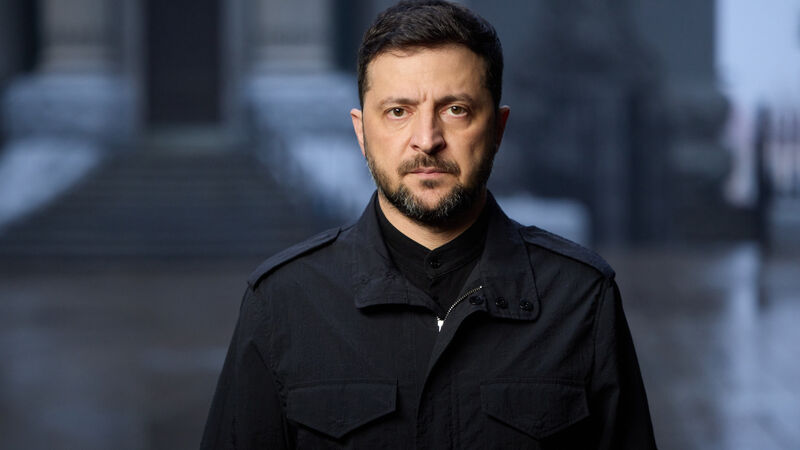
Ukrainian president Volodymyr Zelenskyy delivering a video address to the nation in Kyiv, Ukraine, last week. Picture: Press Service of the President of Ukraine/AP
No one knows whether US president Donald Trump’s 28-point peace plan for Ukraine will ultimately be implemented in anything like its initial form. The Trump administration has portrayed it as a “living document,” and its announcement has been followed by a steady stream of reported changes. But the final version will almost certainly embody a vision of international relations, shared by Trump and Russian President Vladimir Putin, that directly jeopardizes European security.
Though Russia is unequivocally the aggressor, having invaded Ukraine’s sovereign territory in violation of international law, Trump’s plan advances Russia’s interests. Nowhere is this more apparent than in its proposed partition of Ukraine, which, like the carve-up of Poland by Prussia and the Russian and Habsburg empires in the 18th century, would be carried out without regard for Ukrainians.
Trump’s plan would not only deliver de facto recognition of Russian sovereignty over Crimea — which Russia invaded and annexed in 2014 —and the territories it has occupied since February 2022; it would also force Ukraine to withdraw its troops from the part of Donetsk it currently controls. In other words, Ukraine would have to give up sovereign territory it has successfully defended militarily.
The plan even lays the groundwork for justifying Russia’s illegal land grabs. While it asserts that “Ukraine’s sovereignty will be confirmed,” it states in the very next point that Russia, Ukraine, and Europe will conclude a “comprehensive, non-aggression agreement” that settles “all ambiguities of the last 30 years.”
To what ambiguities could this possibly refer? There was nothing ambiguous about Ukraine’s 1991 declaration of independence. The 1994 Budapest Memorandum — in which Ukraine agreed to relinquish the nuclear arsenal it had inherited after the Soviet Union’s collapse in exchange for a pledge by Russia, the UK, and the US to safeguard its territorial integrity — was also perfectly clear. So is the United Nations Charter, which states that all parties should refrain from the “use of force against the territorial integrity or political independence of any state.”
Add to that several provisions in the Trump plan relating to the normalization of US-Russia relations, and the message for Europe is clear. Trump is not just some fickle, impressionable president, whom Europeans can keep on side with concessions and flattery.
While he can undoubtedly be capricious, on some issues he stands firm. Among these is the conviction that Ukraine’s wellbeing — and European security more broadly — is of limited importance to the US and should not be allowed to undermine its commercial interests or disrupt its relations with another great power.

Trump’s detachment from America’s security commitments toward Europe is particularly apparent in point four, which specifies that a dialogue “to resolve all security issues and create conditions for de-escalation” will be held “between Russia and Nato, mediated by the US.” This positions the US as separate from Nato, standing between Russia and Europe.
Of course, this is hardly the first time the Trump administration has distanced itself from Nato. It is not even the first time this month. At the Berlin Security Conference, former US Ambassador to Nato Matthew Whitaker said that the US “looks forward” to Germany eventually taking over the post — first held by US president Dwight D Eisenhower — of Supreme Allied Commander Europe (SACEUR).
Given SACEUR’s critical role in the nuclear chain of command within Nato, this may augur a nuclear decoupling between the US and Europe.
But Trump’s plan amounts to more than US distancing from Nato; it is a strategic affront, as it requires Ukraine to “enshrine in its constitution that it will not join.” For its part, Nato would have to “include in its statutes a provision” stating that Ukraine will never be admitted to the alliance and agree not to station troops there. The US would provide Ukraine with security guarantees, for which it will “receive compensation.”
Even the peace plan’s apparent concession to Ukraine — the assertion that the country will be eligible for EU membership — reflects stunning hubris. Why would the US and Russia get to decide who is and is not eligible to join the EU? In any case, the rules regarding Ukraine’s NATO membership would complicate the country’s EU accession, and there is no reason to think Trump will reconsider his endorsement of Russia’s mantra: no Ukraine in Nato, and no Nato in Ukraine.
In fact, it is a joint American-Russian “working group on security” — which includes no European or Ukrainian representatives — that will “facilitate and ensure compliance with all provisions” of the deal. Meanwhile, the US will collect 50% of the profits from Ukraine’s “US-led” reconstruction.
Whatever changes Ukrainian negotiators manage to wrest out of US officials during the ongoing talks in Geneva, there is no question that Trump’s peace plan represents a strategic defeat not only for Ukraine, but for all of Europe. But rather than engage in futile condemnations of Trump and Putin — a false ally and a true enemy, respectively — Europeans should take responsibility for their role in creating this situation.
In the decades after World War II, Europe grew so comfortable beneath the US security umbrella that it seemingly lost the ability to think for itself on security matters. So, when the US chose not to respond decisively to Russia’s 2014 invasion and occupation of Crimea, Europe unquestioningly followed. Now, the EU is paying the price for its torpor.
In 1968, then-US national security adviser Henry Kissinger worried that abandoning South Vietnam would signal “to the nations of the world that it may be dangerous to be America’s enemy, but to be America’s friend is fatal.” Six decades later, Europe, confronted by Trump’s rapprochement with Russia, should be getting the message.