'Voluntary' contributions, digital devices and other costs make education anything but free

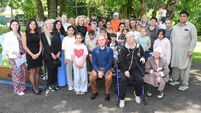
Mona Sheils (left) and Sean McGovern (right) at the launch of the Barnardos Back to School Survey 2025. Picture: Patrick Bolger Photography
With just a few weeks to go before the 2025/2026 school year begins the back-to-school advertisements are prompting those parents who have not already done so to get shopping for their children's essential school needs.
From uniforms and digital devices to so-called voluntary contributions and exam fees, the cost of sending a child to school in Ireland continues to place an enormous strain on households—particularly those already facing poverty and disadvantage.
At the Society of St Vincent de Paul (SVP), we see the effects of this every day. In 2023, we provided over €5.3 million in education assistance to families across Ireland. That support covered everything from school uniforms to digital devices and college bursaries. Yet even before the last academic year ended, we were already receiving calls for help with next year’s costs.
Education has long been viewed as the most powerful tool for breaking the cycle of poverty. But for education to fulfil this promise, it must be accessible, inclusive and truly free. Right now, that is not the case.
We commend the Government for recent initiatives such as the hot meals programme and free schoolbooks for all. These have made a measurable difference, with SVP recording a 20% drop in requests for support when free school books were introduced for primary education and a 6% drop in calls the following year when they were introduced for the junior cycle as a result.
However, these gains are being undermined by other growing costs. One common issue we encounter is the continued imposition of “voluntary” contributions. Though technically optional, these fees are, in many schools, treated as mandatory.
Families report receiving multiple requests for payment, while some schools withhold or threaten to withhold lockers, journals, or participation in activities for children whose parents have not paid. One school in Dublin barred students from joining a Transition Year trip if the contribution hadn’t been paid in previous years.
These practices, though often driven by financial necessity, place undue pressure on children and families and run counter to the principle of free education.
Another growing challenge is the increasing reliance on digital devices in the classroom. Tablets and laptops are now essential for many pupils but the cost, which can be several hundred euros, is prohibitive for low-income families. And for those families who purchase devices through instalment plans, they are forced to pay a poverty premium.
This digital divide not only undermines the spirit of the free schoolbook scheme, but risks leaving disadvantaged students further behind.
Charges for mock examinations and corrections, ranging from €25 to €300, is another area of concern. In some cases, students have been denied access to their results until fees are paid. This adds stress to students already navigating this pressurised exam period.
The pressures continue into third-level and further education. Our education bursary scheme supported over 700 students this year, providing more than €2.3 million in financial assistance.
Despite recent reforms to the SUSI grant scheme, many students still struggle to meet rising costs for accommodation, transport, equipment, and food. While requests for support with course fees have declined slightly, the growing number of families needing help with basic living expenses highlights the gap between the support offered and the reality of student life.
The Programme for Government promises to reduce third-level fees and this happened last year by €1,000. But that was a once-off and the recent controversy would suggest that it won’t happen again in the forthcoming budget. We urge the Government to honour its promise.
If we want education to be a real way out of poverty, we must remove the financial obstacles within the system.
As we expect the amount of calls for help to SVP this year to approach 250,000, our Delivering an Equal and Inclusive Budget submission is a strategic, data-driven approach that targets support where it is most needed.
Our key recommendation to improve educational equity include:
- Allocate €10 million to establish local, publicly run Early Childhood, Education and Care (ECEC) services, beginning with areas and communities that are currently not served and experiencing high concentrations of disadvantage.
- Make our state education system truly free by removing costs and charges to families. Remove mock exam and correction fees, providing funding support for electronic devices in schools where they are mandatory and increase the capitation grant by 25%, with a higher rate of 30% made available to schools that implement the Department of Education’s guidance on affordable school uniforms.
- Benchmark SUSI grants and reckonable income levels against the cost of living, include SUSI maintenance support for part-time students and enable those in receipt of SUSI to receive financial support for repeat exams.
Education remains the single most important factor in shaping a person’s life. If Ireland is to be a country where every child can achieve their right to education, we must ensure that education is not only free in name, but free in practice.
- Niamh Dalziel is research & policy officer with the Society of Saint Vincent De Paul

CONNECT WITH US TODAY



Be the first to know the latest news and updates