West Cork Film Studios rising as Hollywood faces crisis over Trump’s proposed film tariffs
From Adam Scott thrillers to Netflix hits, a West Cork studio is defying expectations as Trump threatens tariffs on Irish film
West Cork Film Studios rising as Hollywood faces crisis over Trump’s proposed film tariffs

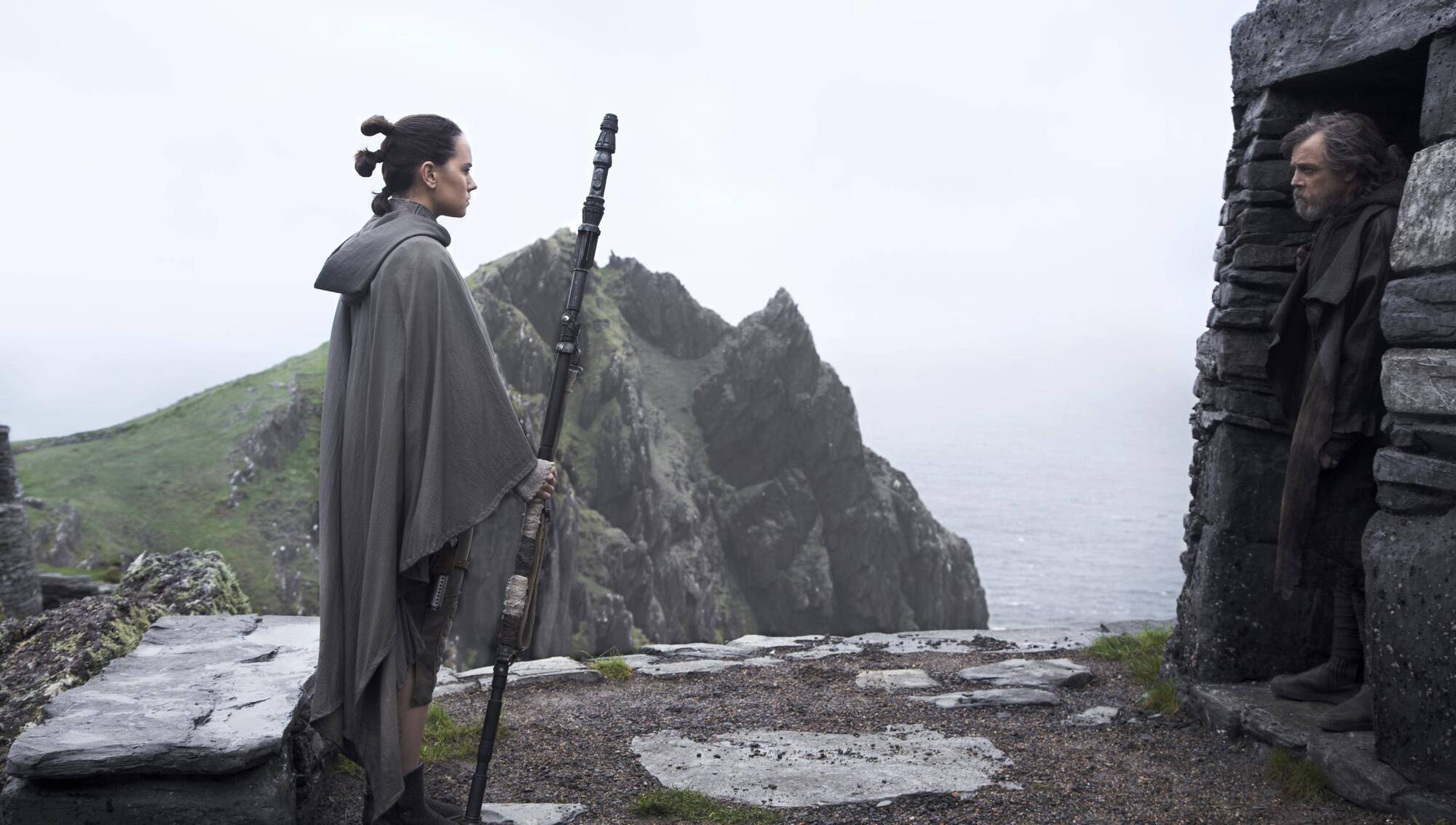
Daisy Ridley as Rey and Mark Hamill as Luke Skywalker in a scene from the movie 'Star Wars: The Last Jedi', filmed on Skellig Michael, Ireland. The production firm behind the film received €3.43m in tax credits from the Revenue. File Picture: Jonathan Olley/ Lucasfilm

If Hollywood has taught the world anything, it’s to dream big. Down in West Cork, they’ve taken the “build it and they will come” mantra to the next level.

While Tinseltown has been trying to get to grips with US president Donald Trump’s tariffs announcement — in a now familiar style, a light-on-detail plan to put 100% tariffs on films made outside the US — down on the Baltimore Rd, outside Skibbereen, it is business as usual at West Cork Film Studios.

Filming wrapped a few short weeks ago on Hokum, a supernatural thriller directed by Damian McCarthy and starring the A-list actor of Apple TV hit Severance, Adam Scott. It’s the biggest production to date to be made at West Cork Film Studios, quietly making its mark in the industry.

Setting up a film studio in West Cork had plenty of doubters. “I think people thought we were daft,” said Édaín O’Donnell, co-founder of West Cork Film Studios with Steve Park.

A lot of people in the industry and outside thought it would never work here

Édaín has worked in film production in Ireland for decades in various roles, primarily in the art and set paint production, as has Steve — Australian-born but long settled in West Cork. The idea of creating a dedicated film studio locally developed after the region was used for the production of Michael Kinirons’s thriller The Sparrowin Baltimore, along with Holding — which was adapted from Graham Norton’s novel of the same name.

Steve worked on film construction for Holding and Édaín was the head of painting.

“It was so spread out. We had a unit base in Drimoleague. We were in Dunmanway, Skibbereen, Castletownshend. We had workshops in Ballydehob and then we were trying to paint a kitchen set in a marquee,” Édaín said.

“So, at the end of Holding, we had the idea of adapting part of my family’s furniture warehouse into a film studio.”

Édaín’s father Jim has been designing and manufacturing furniture for 60 years.

“My father says he invents and reinvents himself every 20 years. So he’s embracing this as a new diversification into film at the age of 83,” Édaín said.

Édaín’s brother Aodh — an RNLI assessor, trainer, and helm in Union Hall — is also a studio director, adding a different skillset for films with sea or water-based elements.

Part of the furniture warehouse was redesigned into a 20,000sq ft film studio. In 2023, the new studio was officially opened by mentor David Puttnam in the presence of stars such as Jeremy Irons.

Edain O' Donnell with, from left, film producer David Puttnam, actor Jeremy Irons, and TD Christopher O' Sullivan at West Cork Film Studios open day. File Picture: Johannes Eisele.

Now an independent company, West Cork Film Studios has to fly solo.

“It is not just building a studio, it is building an industry from scratch,” Steve said.

“We have a different approach to what a film studio should be. It’s more holistic. It’s our job to make sure that people that come here to make movies have a really enjoyable experience. That’s part of being in West Cork. We’re not just selling the studios, we’re selling a lifestyle.”

This week, film director and screenwriter Vicky Waldron Wight has been enjoying that lifestyle as production gets underway on her international feature film The Body Is Water. Vicky’s previous feature film Happiness for Beginners, released in 2023, was a Netflix top 10 hit worldwide. Her other features include The Volunteer and The Lost Husband.

She is based in Houston, Texas, but is originally from Monkstown in Cork.

“My parents emigrated when I was 12 in 1985. My mother Helen is from Mitchelstown and was a nurse. She had lived in New York, so had become a naturalized citizen. In 1985 Ireland, times were hard and my dad’s business went under. There were four children, so my parents were adventurous and said we might as well just go.”

Before she left, her teacher Mrs Murphy showed the young Vicky some things about America.

One of those things was Steven Spielberg and his films Jaws and ET. Film became her passion and her career.

Making film, I’m compelled. It’s like religion for me 

Ireland remained close to heart. “I come back every summer now with my kids and have for many, many years. The greatest goal I had was to come back to Ireland and make a film. Now, this is a dream coming true to come back and make a film here because I’ve never felt anything but Irish. It feels like being home.”

The Body Is Water is filming at locations around West Cork until July. The film is not autobiographical, but aspects are threaded through Vicky’s own life.

“I had cancer and there’s a cancer storyline in the movie, as well as themes of grief and loss. My dad, Michael Waldron, passed away in 2002, and losing him was a seminal moment for our family because he was only 62.

“We all thought we’d be introducing him to our grandkids. Not being able to do that was just heartbreaking, because this fear of missing out that, to me, is what death is really about. When I was sick, it was very hard for me to imagine everyone else’s future without me.

“That has influenced all my writing — but this particularly.”

Director and screenwriter Vicky Waldron Wight is making her film The Body Is Water in West Cork. Picture: Sara Deane

Some of the film is set in Houston, Texas, but most will be a spectacular showcase of Ireland’s South-West. Vicky said that West Cork Film Studios offered a priceless opportunity.

“I grew up going to Schull and Barleycove, and have all these places in my mind since I was a little girl. Having production facilities here makes it so much easier to actually execute a vision in West Cork.

“Because of the infrastructure, it makes it very easy and the landscape is maybe the most beautiful in Ireland — places like Mizen Head. That’s part of our dream.”

While Ireland radiates, Hollywood is in turmoil. Adam Scott, speaking on Rob Lowe’s podcast Literally! before arriving in Ireland to shoot Hokum, said it was “so weird that nothing shoots in Los Angeles” these days. But it’s not weird.

Ireland’s generous Section 481 tax credit is worth up to 32% of expenditure to film productions up to €125m. October’s budget introduced “Scéal Uplift”, adding 8% to the 32% credit for feature films up to €20m.

Lowe, who films his US game show The Floor in Ardmore Studios, hit the nail on the head.

“It’s cheaper to bring 100 American people to Ireland than to walk across the lot at Fox, past the soundstages, and do it there,” he said.

'Green Wave'

Ireland is feeling the benefits. The production spend generated by the Irish screen industry in 2024 was valued at over €430m, representing a 33% increase on 2023, according to Screen Ireland.

Analysis by Alma Economics for Screen Ireland found the audiovisual sector supports 15,899 full-time equivalent jobs, with a value to the Irish economy of over €1bn.

Average small to medium film productions cost around €4m, and a third of that is estimated to go into the community — from accommodation to materials, food to transport.

Ireland is booming. The second season of Wednesday — season one was the most popular Netflix show of all time with 250m views — will be released in August, with filming completed in Dublin in 2024.

In 2025, Screen Ireland says more than 80 film, TV, and animation productions are planned here. Hollywood has been looking enviously at the success of Ireland, whose success has been dubbed the “Green Wave”.

Like all good movies, there has to be a plot twist. Mr Trump has seen the success of foreign film industries such as Ireland and wants a piece of the action.

“The Movie Industry in America is DYING a very fast death,” he wrote on Truth Social, bemoaning countries “offering all sorts of incentives to draw” filmmakers and studios away from the US.

His plan, like most of his other plans to wrest back jobs to the US, is tariffs. A proposed 100% tariff on foreign film production has sent a shiver through the Irish film production landscape.

“Panic is always the worst thing, but you have to plan around the potential risks,” West Cork Film Studios financial director Katherine O’Sullivan said.

It’s a constant reassessment of where one is at

In Skibbereen, filming continues on two productions through to summer with further productions lined up. This year, the studio is paying its own way and eyeing a sustainable future.

A deal to buy a former plastics factory from IDA Ireland is close to being finalised, which will transform into a studio back lot.

A link up with Kerry College’s immersive screenwriting course is in the pipeline. The studio already employs people with neurodiverse abilities to realise their talents, and Édaín says that will be developed further.

Collaboration is important, and community is even more so. More than 100 people were employed at the studio during production of Hokum.

“We get huge support locally, and people are seeing the benefit to the whole community. We see the community as co-producers,” said Édaín.

The studio continues to be mentored by David Puttnam, while Robert Sheehan of Love/Hate fame has discussed writing an independent film for the studio based in West Cork.

Ultimately, filmmakers just want to make movies. “It’s frightening to think that you couldn’t make a film in another country because of tariffs,” Vicky said.

I have two movies that I’m trying to sell in America, to shoot in America, but it’s more expensive

“I love making films in America and in Texas particularly. I would like to make more films in and around Houston and South Texas.

“The tariff conversation is complicated on a lot of levels, but — along with all the US filmmakers I know — I’m hopeful there can be measures taken to bring more work to America via federal and state tax incentives and subsidies.

“Rather than trying to load up and tariff others, actually make yourself more attractive — that is what Ireland has done.”

More in this section

Revoiced

Newsletter

Sign up to the best reads of the week from irishexaminer.com selected just for you.

Cookie Policy Privacy Policy Brand Safety FAQ Help Contact Us Terms and Conditions

© Examiner Echo Group Limited