Government's reputation will rest on handling of housing crisis
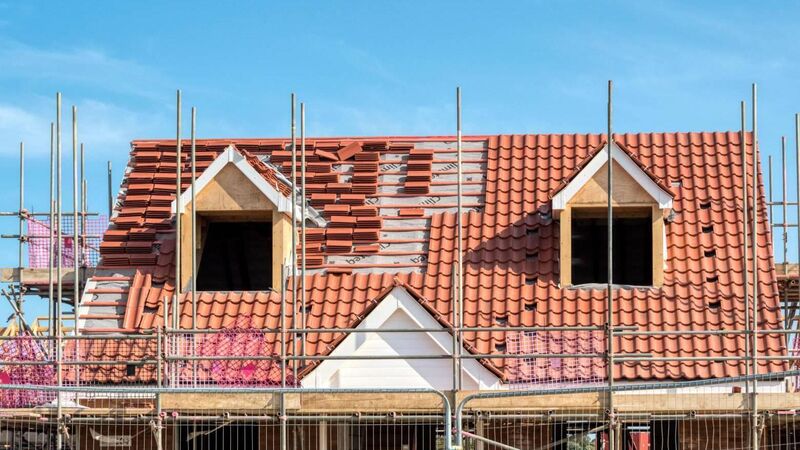
Summing up the asks of industry, the chair of CIF’s Irish Home Builders Association Michael Kelleher urged the Government to make the “necessary policy changes” so its members can deliver homes. File picture: Alamy
Addressing a crowd of hundreds in Croke Park earlier this week, the most senior civil servant in the department of housing coined a new term before immediately trying to pull back on it, as he foreshadowed soon-to-be-published fresh Government plans on housing.
“So that is what ‘Housing 2.0’ — which I hope doesn’t take off as a phrase — but that’s what I think it will need to be about,” Graham Doyle said.

The Housing secretary general had earlier spoken of how the Government had sought to build momentum in the housing sector. But he acknowledged that that momentum had stalled somewhat.
Prior to the election, ministers had persistently said that close to 40,000 homes would be built in Ireland in 2024. We now know that was way off. It was only over 30,000. The experts say we need double that to be built each year.
And, in a room full of the people who build and sell and make policy around Ireland’s homes every day, they heard even less homes could be built this year than last. In a time of acute housing crisis, this would be nothing short of a catastrophe and should set off alarm bells now.
The problem was set out in the plainest terms at the Construction Industry Federation’s (CIF) Housebuilding Summit in Dublin.
Sherry Fitzgerald Residential and Advisory managing director Marian Finnegan said that it is difficult to accurately pinpoint how many homes will be built given the unreliability of statistics such as commencement figures. But, on the whole, it does not look good.
“What I would say is what is certain is that it will disappoint,” she said.
The issues are many, according to the industry. The conference heard planning is a mess, leaving bids for permission in limbo for months on end and of fears that a judicial review could plunge a project back to square one.
Planning reforms need to take effect quickly, it was also told.
Accessing finance could be difficult too. Making sure that properties are connected for water and power in a decent timeframe can be incredibly frustrating.
Some took aim at caps on rent, which prevent landlords from hiking up the cost for tenants, and said it is harming the viability of apartments.
On apartments, they cost so much to build from start to finish that tens of thousands of them with planning permission won’t be built even with Government schemes aimed at making them more viable for developers.
The release of funding by Government for critical housing projects was a key topic too.
And the inner conflicts between the department of housing and the holders of the purse-strings in the department of public expenditure have been well flagged before in terms of releasing and providing funding for housing.
At the conference, the department of public expenditure's top civil servant David Maloney said the Government’s review of the National Development Plan set to be published in July would have between €16bn and €18bn of funding to work with.
He admitted that is a “lot of money” but stressed that “we’ll have to prioritise”.
“People are entitled to make their pitch in that context,” Mr Maloney said. “We’ll be looking at each of those demands and be recommending to Government priorities within that spend.”
But, he added, the priority is the delivery of water, energy, and the transport infrastructure to deliver housing. “That’s the number one priority,” he said.
Mr Doyle, on the other hand, said the department of housing negotiates with central Government for a “limited pool of resources” and “we negotiate that very hard". “We can only allocate what we get,” he said.
Summing up the asks of industry, the chair of CIF’s Irish Home Builders Association Michael Kelleher urged the Government to make the “necessary policy changes” so its members can deliver homes.
He said the industry is not looking for tax breaks, despite multiple reports suggesting the Government is considering such breaks to encourage construction.
Mr Kelleher, who is also the group operations director of the O’Flynn Group, said tax initiatives must benefit “end users” while international capital has to see Ireland as a comfortable place to invest.
He said there has been constant change to policy and uncertainty over future changes which has spooked international capital before.
“If we are to make inroads into housing delivery over the next number of years, then we must use all the levers we have available to us to make this happen.”
Which levers are chosen will no doubt will be outlined in the Government’s new housing plans expected this summer, with many eyes keenly watching them.
Coinciding with the conference was the Cabinet approving the revised National Planning Framework. Put simply, this framework is the plan for strategic development in this country setting out the target of building 300,000 homes by 2030.
For this to happen, each local council in the country will have to zone more land for housing. Minister for Housing James Browne has given them until the end of the year to get their act together.
Ironically, the head of housing for Fingal County Council had earlier told the conference that they are already “at or close to capacity in terms of what we can deliver” and that scaling up will be a “real challenge”.
Regardless of that, Mr Browne wants to see councils acting on this. He said:
Only fresh in the job, Mr Browne’s words on how the councils need to step up carried their own resonance. With Fianna Fáil and Fine Gael again forming a Government on a platform to fix housing, the talk is all again of new actions to “scale up” and “remove blockages” and “unlock housing”.
Before the election, the Government had said we had “turned a corner” on housing and things were moving in the right direction. And then the official figures showed the number of homes being built was decreasing rather than increasing.
Generation rent can’t afford for this to go on. The 15,000 people and counting who are homeless in Ireland can’t either.
The public purse has exploded in recent years too, so there is money there even with the US tariff risk looming over us.
If ‘Housing 2.0’ fails to turn the tide, it will have been clear that, rather than turning the corner, the Government has been leading us in circles.
And, regardless of the outcome and given how vital it is to so many, Housing 2.0 could well be the singular issue on which this new Government is judged.