Politicians must learn that normalising far-right talking points is a losing proposition
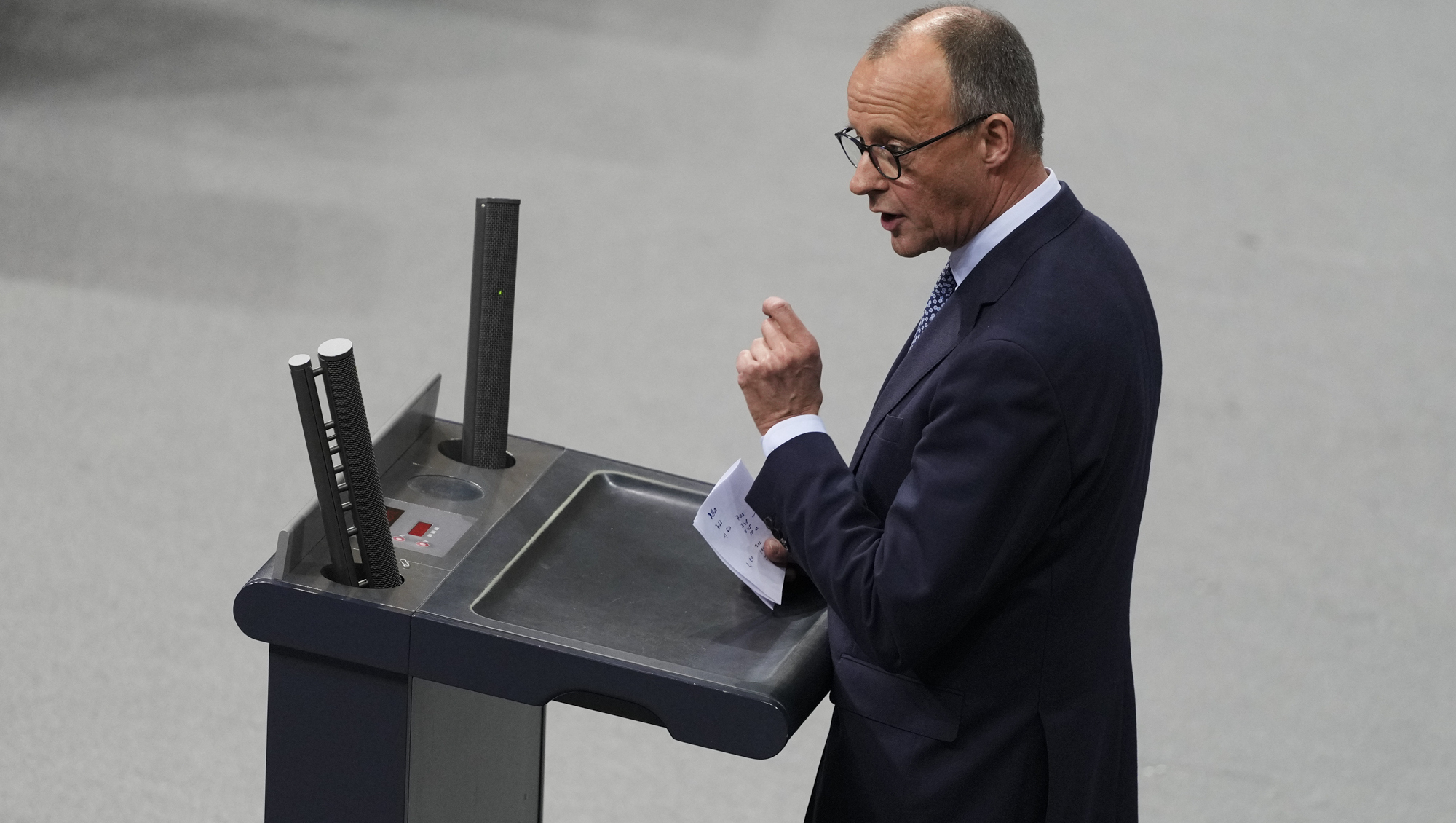
For the first time, the main opposition party, Friedrich Merz's centre-right Christian Democratic Union (CDU), relied on the support of the extreme-right Alternative for Germany (AfD) to pass a motion in the national parliament. File photo: AP/Markus Schreiber
With only a few days to go before the federal election on February 23, Germany experienced a political earthquake.
For the first time, the main opposition party, the centre-right Christian Democratic Union (CDU), relied on the support of the extreme-right Alternative for Germany (AfD) to pass a motion in the national parliament.
CDU leader Friedrich Merz, long seen as a shoo-in for the chancellorship, justified the move by blaming other parties for their unwillingness to address migration. But while the motion produced nothing concrete, the democratic political parties’ “firewall” against the far right was breached.
No longer can Germany claim to be one of the last major European democracies not to have “normalised” the far right.
But what exactly is normalisation, and on what grounds should it be criticized? For starters, it is not the same thing as mainstreaming.
Normalisation is specifically about rationalising a transgression of an existing norm — not collaborating with far-right parties that pose a threat to democracy, in this case — whereas “mainstream” is always relative. Like the notion of the political centre, it has no objective content, but simply refers to what is most common or widely subscribed.
Thus, entering a coalition with a far-right party, or relying on it to pass laws, is a form of normalisation, while copying the rhetoric of the far right is an example of mainstreaming. To mainstream an issue is to call attention to it and frame it the way the far right wants it to be framed.
Hence, social scientists have long warned that if the issues the far right favours dominate in an election campaign, the far right will do well at the polls.
Since pro-democracy politicians do not want to be perceived as cynical opportunists, they usually seek ways to justify normalisation. One option is simply to claim that the norm remains in force, and that one’s behaviour does not qualify as a violation.
Merz took this path when he stressed that his goal is to diminish AfD’s share of the vote. But this argument is unconvincing. Rival parties often end up in coalitions, and the fact that they have conflicting programs does not mean that they never co-operate.
Another option is simply to declare the norm invalid. For decades, the Italian Social Movement (MSI), which cultivated nostalgia for Mussolini and Fascism, was deemed beyond the pale. Like the Communists, it was not considered to be a part of the arco costituzionale (“the constitutional arch”): the parties that basically accepted Italy’s post-war democratic constitution.
But then came Silvio Berlusconi, a pioneer of normalisation who suggested that the anti-fascist consensus was either obsolete or a left-wing plot against the right. His party proceeded to form a coalition with the MSI in 1994.
One other option is to retain the norm, while insisting either that it does not apply to a particular party, or that it is less important than other political imperatives. Think of Italy’s current prime minister, Giorgia Meloni, who got her political start in the MSI’s youth organisations.
Plenty of politicians, both inside and outside Italy, have decided that her Brothers of Italy (Fratelli d’Italia) party — a direct descendent of the MSI — is a perfectly acceptable partner.
Even those still hesitant to work with the most right-wing Italian government since the Second World War can invoke larger issues — such as the need to present a united front in support of Ukraine — to justify co-operation.
A similar logic applies in Austria, where the centre-right People’s Party had initially ruled out working with Herbert Kickl, the chair of the far-right Freedom Party. After coalition talks with the centre-left had failed, the People’s Party proceeded to negotiate with Kickl’s party, all in the name of keeping Austria governable.
These talks, too, have now failed, but, in the process, the People’s Party signaled to Austrians that Kickl was an acceptable choice after all (a signal that no doubt will help the Freedom Party in the next elections).
It is reasonable to assume that many Austrians voted for the People’s Party in the most recent election precisely because it had vowed not to normalise the far right; it is unclear whether it will be trusted again after its glaring betrayal of that promise.
Even more nefarious are situations where the far right calls the shots even as its leaders remain out of high office, and thus largely unaccountable.
In Sweden, for example, the current minority government is supported by the far-right Sweden Democrats; in France, the government — which also lacks a majority — is ultimately at the mercy of Marine Le Pen’s National Rally; and in the Netherlands, the government includes the far right, but its leader, Geert Wilders — who completely controls his party as its only official member — remains in the background.
Normalisation is easier to detect than mainstreaming. But recognizing it as a problem requires a public that is paying attention, and prominent figures who will make norm-breaking a scandal, instead of normalising it.
Voters take their cues from elites; if a politician who is seen as mainstream treats a party as normal, public opinion will tend to follow. Moreover, research has shown that such acceptance spreads beyond partisans of the mainstream party that started the process and eventually extends to the citizenry as a whole.
Once normalisation has happened, it is virtually impossible to undo. The significance of mainstreaming is somewhat different, because it remains up to politicians which topics to emphasise and how to treat them.
It is high time they learned that uncritically adopting far-right talking points — often thinly veiled incitements to hatred — is not only immoral. It is also a losing proposition at the ballot box.
- Jan-Werner Mueller is a Professor of Politics at Princeton University


CONNECT WITH US TODAY



Be the first to know the latest news and updates