Donald Trump’s Riviera proposal has put the Middle East on edge once again
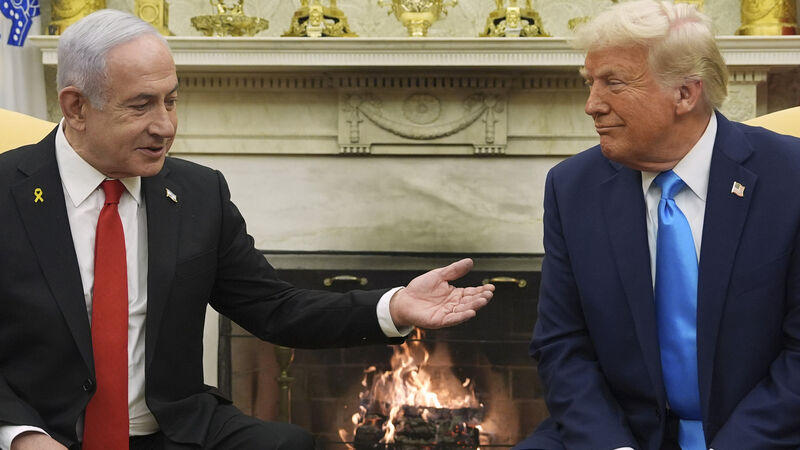
President Donald Trump (right) meeting Israel's Prime Minister Benjamin Netanyahu (left) in the Oval Office of the White House last week. Netanyahu himself has called Trump’s proposal 'revolutionary' and 'creative'. Photo: AP/Evan Vucci
After an initial 12 hours of deafening silence, the Israeli political establishment finally voiced their opinion on US president Donald Trump's proposal for the forced transfer of two million Palestinians from Gaza.
President Isaac Herzog, once the leader of the centre left Labor Party, described the potential war crime as simply a "new idea". He was later quoted in the newspaper calling for Israel’s neighbours to present their own suggestions “if you have any better idea[s].”
Many of those neighbours in the region I imagine might say — how about a two-state solution? The leader of the opposition centrist party, Yair Lapid had an equally vapid response. "We need to study the details to understand" before adding that the Netanyahu and Trump press conference was "good for Israel".
Benny Gantz, ex-minister of defence, once seen by ‘middle’ Israel as a centrist knight-in-shining-armour alternative to right-wing prime minister Benjamin Netanyahu was quoted as saying, it’s "an interesting thought" and that “Israel has nothing to lose from it — only something to gain".
Herzog, Lapid and Gantz have all been, in the recent past at least, outspoken critics of prime minister Netanyahu — from his left. Netanyahu himself has called Trump’s proposal “revolutionary” and “creative”.
The leader of Israel’s ultra-Orthodox Shas party Arye Deri, and a minister in the Netanyahu government, praised President Donald Trump as “a messenger of God for the Jewish people.” “Interesting”, “creative”, “revolutionary” “good for Israel”, “something to gain," "new idea".
Less than a year after the International Court of Justice (ICJ) found in favour of a case of “plausible genocide” against Israel on account of its military actions in Gaza, one can but wonder how the court might view the words of the Israeli political establishment on the proposed forced ethnic transfer of two million Palestinians.
There is, of course, widespread international revulsion against Trump's proposal, including an acknowledgement that his plan is both unworkable and realistically unlikely to be ever even attempted.
But that consensus largely misses a darker reality, that Israeli politics has potentially been upended by the president’s Gaza plan.
What was once a dark and implausible political fantasy of the far right in Israel politics — talk of mass transfer and ethnic cleansing — has overnight become, if not mainstream, perfectly mainstream to discuss and debate. What was once considered either morally reprehensible or logically fantastical is now openly talked of as a path forward to break the decades of political logjam between Israel and the Palestinians.
The genie is out of the bottle and is not going back in any time soon. Support amongst the wider public is apparently shockingly high. In a recent poll some 80% said they supported the Trump plan.
The sight earlier this week of visible emaciated Israeli hostages who had been held captive by Hamas for almost 500 days is likely to further fuel support for the forced removal of Palestinians from Gaza. The fact that many Palestinian prisoners released by Israel, as part of the truce deal, looked equally emaciated has apparently not registered with many in the mainstream television news in Israel.

There is a sense in Israel that the drip-drip release of the hostages is only magnifying the trauma of October 7. Israeli media commentators were not slow to make comparisons to holocaust victims. The underlying message of the mainstream media is clear, unless something dramatic is done to reshape the political future, this is the potential fate of many Israeli Jews.
As one senior Israeli diplomat speaking off the record to the acknowledged: “Gaza has been a massive thorn for decades, and so when suddenly faced with an idiotic plan to get rid of the people there, what could be better?”. With support for a two-state solution or full annexation of all the occupied territories ‘stuck’ at around 25% to 30% each and a recognition that managing the conflict has failed miserably, there is widespread appetite for something new.
The spoke to veteran columnist Ben-Dror Amini, aged 70, of the mainstream newspaper and asked what impact the proposal may have on Israeli politics. Dror Amini has travelled to Ireland to lecture on the conflict and gave a lengthy interview to the in 2013.
Whilst certain “nothing will come out of it…who remembers seven years ago Trump talk of riviera of North Korea” Amini says, he acknowledges the “damage to Israel, it’s the idea that people talking about it, a shame”.
Asked specifically on the President and leader of the opposition's words, Amini agrees they have muddied the waters. “Sometimes it’s better to shut up…unfortunately they were not clever to keep their mouth shut”.
Meanwhile, President Trump has threatened that if all remaining Israelis hostages are not released by noon this coming Saturday “Let hell break out”.
With an already fragile Hamas-Israel ceasefire seemingly unraveling, with both sides engaged in accusations and counter-accusations, the mood amongst the family of remaining Israeli hostages and presumably two million Palestinians in Gaza this week is bleak.
Meanwhile, President Trump has also threatened to withdraw all US aid and military support from both Egypt and Jordan if both nations refuse to take in forcibly removed Palestinians from Gaza. Jordan and Egypt were the third and fourth largest recipients of US aid in 2023. Israel was the second largest recipient.
The Kingdom of Jordan has apparently declared its willingness to go to war with Israel if Israel tries to expel Palestinians to its territory. Just four weeks of the Trump Presidency have passed, and the Middle East is once again on edge. Two hundred and four more weeks to go.


CONNECT WITH US TODAY



Be the first to know the latest news and updates