Storm Éowyn and the cost of muddled climate messaging
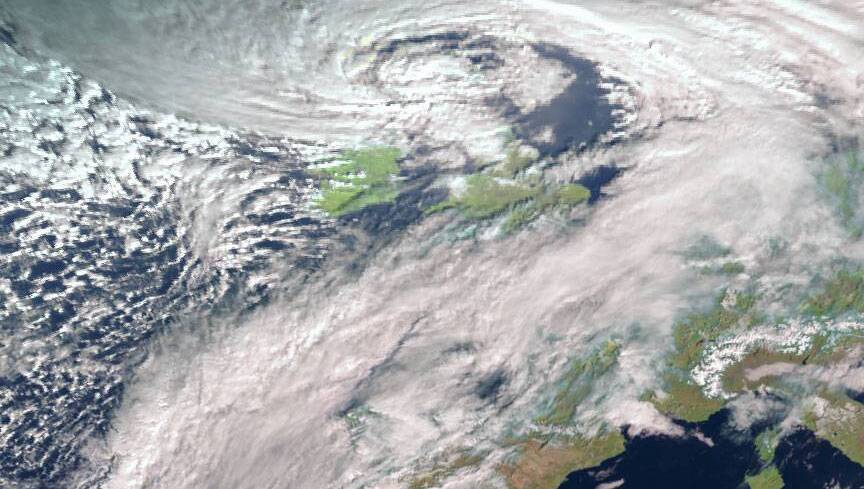
Extreme weather events provide a window to the future, giving us a sense of what we may experience and need to adapt to if we fail to reduce emissions fast enough and the motivation to take action and reduce emissions before it’s too late. Picture: Met Éireann
Record-breaking fires in California, record-breaking temperatures across the globe, and now record-breaking winds in Ireland — it’s impossible not to wonder why so many records are being broken, yet RTÉ has published not one, but two articles to tell us "there will be a great temptation to see [Storm Éowyn] as more evidence of climate change in action. But even the climate scientists themselves admit that is not the case".
I’m a scientist, and I admit that I’m disheartened by RTÉ.
Like most scientists asked about the link between specific storms and climate change, I always preface my comments by saying it takes complicated statistical analysis to determine how much climate change contributes to one particular storm. We call this “attribution science” and it was applied to the flooding in Midleton last year, where researchers at Maynooth University found the extreme rainfall “had an increased intensity of around 13% due to global warming”.
It will take a while to conduct a similar attribution study on Storm Éowyn, but in the meantime, we can discuss whether Éowyn reflects the kind of storm to expect in a rapidly changing climate. RTÉ’s first article on this topic starts by saying "we are not in any position to blame climate change for what is unfolding. It is far more complicated than that.”
It cites the esteemed Maynooth University Professor, Peter Thorne, explaining that, while there is ample evidence of the link between climate change and rainfall, there is not much research linking climate change to windstorms. However, absence of evidence is not evidence of absence.
Prof Thorne goes on to say that Storm Éowyn was born from the temperature difference between the extreme cold in south-eastern US and the warmer temperatures in the Gulf of Mexico as a key driver of wind speeds. Combined with a strong jet stream, Éowyn became “supercharged” with its record breaking winds. The penultimate sentence of the article concludes by stating quite definitively, “We cannot say Éowyn is climate change in action.”
The following day RTÉ published another article to drive home its point, arguing that some studies suggests wind speeds around Ireland will “weaken, not strengthen, because of climate change”, though admitting that “a lot more research is needed before there will be scientific agreement around that”.
While all of RTÉ’s statements are scientifically correct, they are problematic for two reasons. First, temperature differential is just one driver of wind storms. Warmer water, such as that observed in the Gulf of Mexico right now, fuels bigger storms and our oceans store over 91% of the excess heat energy in the Earth's climate system from excess greenhouse gases. Since 2019, evidence shows that 80% of Atlantic hurricanes were one category higher than they would have been with no ocean warming.
In 2024, climate change was found to have increased maximum wind speeds for every Atlantic hurricane by up to 45km/h. While this doesn’t prove that Storm Éowyn’s wind speeds specifically were influenced by warmer water due to global warming, it does show that there could be a lot more to the story than air temperature and that RTÉ’s reporting potentially oversimplifies the relationship between Storm Éowyn and climate change. A wait and see approach, until an attribution study is complete, would have been more prudent than declaring no link between Éowyn and climate change without sufficient evidence either way.
George Marshall’s book, , begins in 2013 with a trip to New Jersey just after Hurricane Sandy where he was surprised to find that none of the people he interviewed had discussed climate change after the storm, in spite of evidence demonstrating that climate change was the key factor in supercharging Sandy from a severe storm to a catastrophic one.
Marshall points out that normally, when people suffer extreme events, they are inclined to search for explanations and allocate blame, but climate change doesn’t easily fit into those blame narratives with no direct enemy, except perhaps our own high-carbon lifestyles. Five years later, Marshall expressed disappointment that there was still no movement on the Jersey shore to “connect the personal tragedies of Hurricane Sandy with wider climate policy”.
In contrast, ample evidence within psychology research shows that direct experience of extreme weather can lead to an increased awareness of climate change, including increased support for climate mitigation policies and personal adaptation measures. However, for extreme weather experiences to be translated into such positive responses, individuals must understand that the event is, in part or wholly, caused by climate change, also known as subjective attribution.
Therein lies the problem with RTÉ’s recent articles, which seem to go out of their way to disassociate climate change from storm Éowyn without sufficient evidence to do so.
It is clear we need more actions to reduce greenhouse gas emissions and address climate change, both nationally and internationally. It is also clear we need continuous public support and engagement to drive these actions. Extreme weather events provide a window to the future, giving us a sense of what we may experience and need to adapt to if we fail to reduce emissions fast enough and the motivation to take action and reduce emissions before it’s too late.
However, this must be coupled with clear messaging on how such events may be influenced by global warming in order to have a positive impact on people’s behaviour and support for climate actions. RTÉ has come a long way in their climate communications over the past decade, but last week sends us backward in our efforts to inform and engage the public in the essential battle to prevent climate chaos. We must do better.


Check out the Irish Examiner's WEATHER CENTRE for regularly updated short and long range forecasts wherever you are.
CONNECT WITH US TODAY



Be the first to know the latest news and updates