Maggie Smith: the magisterial star of Harry Potter and Downton had the talent to do everything
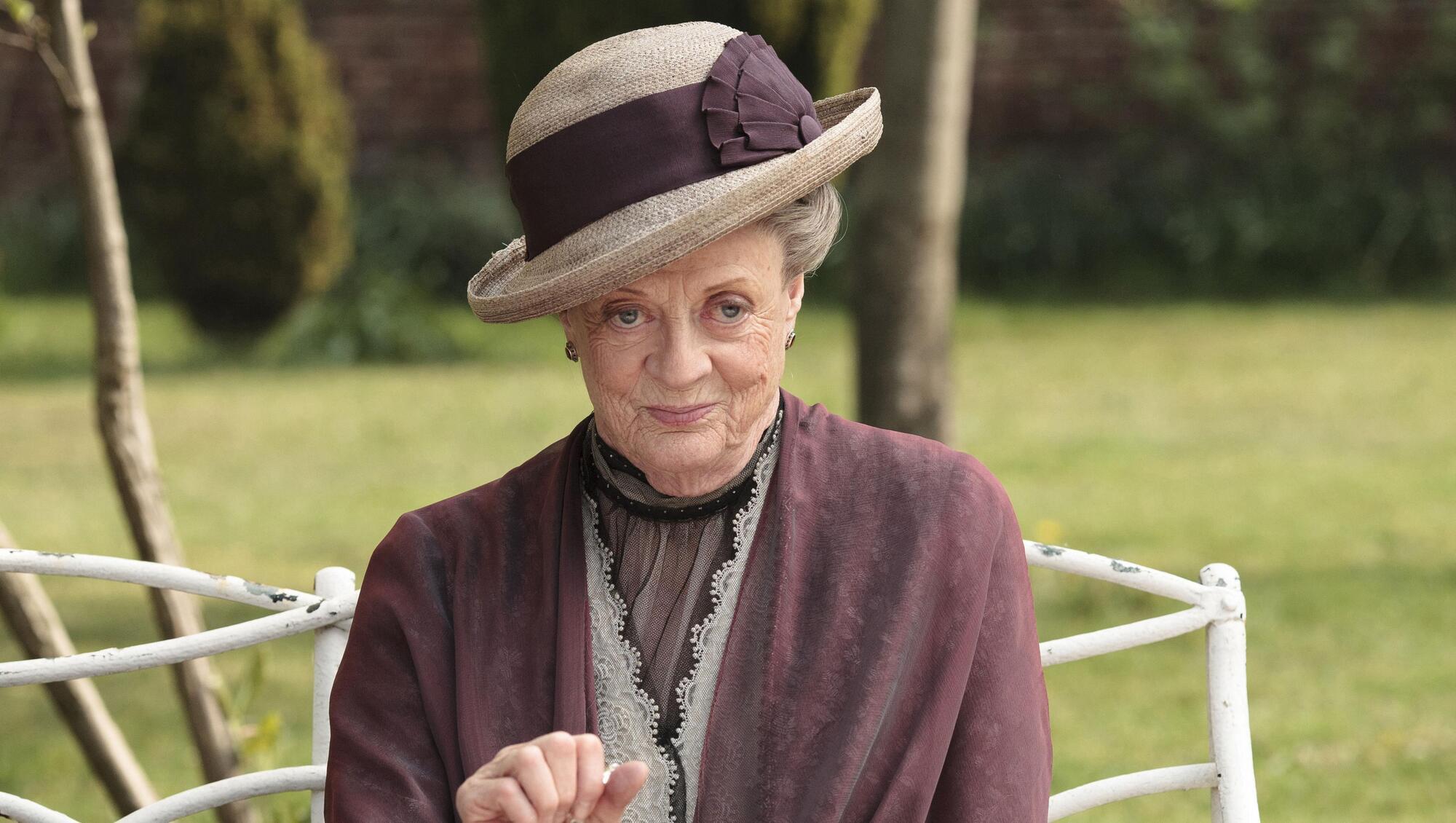
Maggie Smith as the Dowager Countess Grantham in a scene from Downton Abbey.
Maggie Smith’s trophy cabinet reflected her extraordinary achievements across theatre, film and television — from the BBC to Hollywood, the West End to Broadway. A measure of her versatility and durability is that, in the 1960s, she played nine major roles in the formative years of the National Theatre, but also, from the start of the 2000s, appeared in five series of .
Her role in that show was Violet Crawley, Dowager Countess of Grantham, who lived in such a bubble of exclusive comfort that, in trademark one-liners, she would drawl in mystification, for example: “What is a ‘weekend’?”

That acerbic superiority was a signature throughout Smith’s career, including the part that brought her first Academy award in 1970, against a shortlist also featuring Liza Minnelli and Jane Fonda, for the title role in about a maverick, arrogant schoolteacher in Edinburgh.
Smith consistently had the courage and talent to do unexpected things.
Her second Oscar, in 1979, was for , with a script by Neil Simon and a cast of high Hollywood talent including Alan Alda and Walter Matthau. Smith played exactly what she had been at the start of the decade: an English actress up for her first Academy award.
Another surprise on her CV demonstrated an ability to play it straight and dark. In 2019, after 12 years away from the stage, Smith, at the age of 84, performed a 100-minute monologue at the Bridge theatre in London.
was adapted by Christopher Hampton from a documentary movie interview given, at the age of 102 (the show was a rare case of an octogenarian ageing up for a part), by Brunhilde Pomsel, who worked for the Nazi propaganda chief Joseph Goebbels during the Holocaust, but who continued to deny complicity or guilt. With typical meticulousness, Smith refused to accept the part until she had proved to herself at home that she could memorise an extended solo. Combining enduringly impeccable technique with the guts to test it again at such an age, it was a late triumph in an astonishing career.
Despite joining the Oxford Playhouse Company at 16, rather than going to college, Smith benefited from the local varsity theatrical privileges, cast in Oxford University Dramatic Society productions, including revues, which, at the time were attended by national critics.
Such was the impact she made in comedy skits and songs that, aged 21, she was part of an ensemble recruited to appear on Broadway in a revue called New Faces of 1956. At that point, Smith seemed set to be a sketch-and-music comedian, especially when , a play about the survivors of a nuclear war in the UK, failed to transfer to London from a UK tour.
Smith’s serious dramatic career was launched when she appeared in a double bill of plays, and , by Peter Shaffer, in 1962. These won Smith her first Evening Standard best actress statuette, at the age of 27, and caught the attention of Laurence Olivier, then establishing, at Chichester, the first attempt at a National Theatre. Crucially to the development of her reputation, Olivier trusted her not only with comedy — such as , George Farquhar’s early 18th-century farce — but also tragedy: she was Desdemona to Olivier’s performance in the title role of .
Also at the National, Smith formed a relationship with the actor Robert Stephens, who became her first husband, and father of her sons, who, as Toby Stephens and Chris Larkin, followed their parents into acting.
Had Julie Andrews not turned down the Jean Brodie movie, Smith would never have played the part that redefined her career. With her American bankability increased by a US tour of Noël Coward’s , Smith used it to go into a kind of theatrical exile from Olivier and Britain. From 1976 to 1980, she played four summer seasons at the Shakespeare festival in Stratford, Ontario where she played the part of Millamant and other roles that might have been expected in London, such as .
Smith fell into a happy rhythm of filming gigs split with Canadian acting sabbaticals. While she rehearsed or acted, Beverley Cross wrote to her, having become Smith’s second husband in 1975 following her divorce from Robert Stephens.
When Smith returned to London theatre, she took over from Diana Rigg as the troubled modern colonial wife Ruth Carson, in Tom Stoppard’s . She confirmed her resurgence with two more Evening Standard awards, in 1981 and 1984, for London runs of shows she had premiered in Canada. In , by Edna O’Brien, she was the writer Virginia Woolf, for whom Smith’s gift for haughty wit made her natural casting.
Smith, in contradiction of the standard professional graphs, had, after that slight mid-career dip, a third act even more glorious than her first. Shaffer wrote for her , a comedy maximising her command of sardonic superiority, as Lettice Douffet, a tour guide who begins to embellish history. She took the play to New York, where she won a Tony award. Smith also became an Alan Bennett specialist. She co-starred with Michael Palin in the movie in 1984, as a Yorkshire woman using a black-market pig to prevent wartime rationing thwarting her upward mobility.
In the 1988 first series of Bennett’s Talking Heads monologues for television, she was a vicar’s wife, anxious about private sins, in A Bed Among the Lentils.
On stage (1999) and screen (2015), she was memorable as , a fictionalised version of Miss Shepherd , a Catholic evangelist tramp who for some years lived in a caravan on Bennett’s driveway.
Another reason for her retreat from theatre was, unusually for a septuagenarian performer, a vast demand from movie studios. Between 2001 and 2011, she appeared in seven of the eight films, as Professor Minerva McGonagall, transfiguration teacher at Hogwarts, her embodiment of the formidable Scottish academic seeming to contain affectionate nods to Brodie.
The part brought Smith considerable wealth — she joked about the “Harry Potter pension fund” — and a vast new fanbase that, she complained, made it impossible for her to shop in Waitrose any more.
Her cinematic renaissance had also included Robert Altman’s (2001). In this English country house drama, written by Julian Fellowes, Smith’s character was at least a first cousin to her countess. Appearing in a TV series with an average audience of 10 million made it even harder for her to go shopping. But this late superstardom, half a century or more after her first major theatre and movie successes, confirmed that she was an actor with the rare ability to do anything she wanted anywhere.