The rewarding role of mentor helps others unlock their full potential

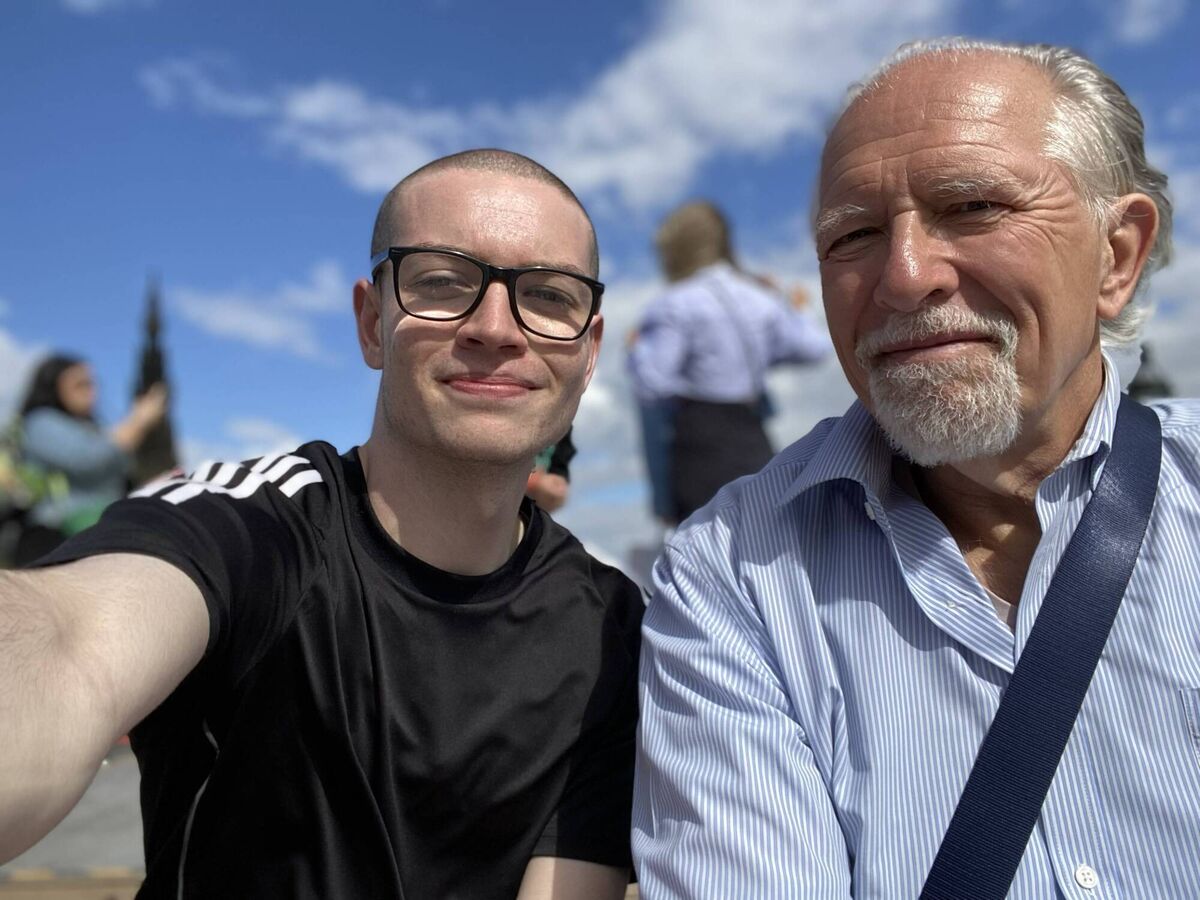
David Robinson with his mentee Aaron Easton outside the National Gallery of Scotland in Edinburgh.
If there’s one difference I’ve made to Aaron Easton’s life, it’s that when he picks up his mobile phone in the morning there are two words on its screen: Think Strategically.
I’ve made a few others. He’s starting to write the letter p with a descender, not least because it helps him read his own handwriting. In theory, he now knows what “synecdoche” means, though like me he’ll probably forget.
He promises me that one day he’ll try to understand fractions, percentages and multiplication tables, though strictly speaking maths was off the table, because the only exams he was taking before he left school were in English, Media Studies, Drama, and Religion, Morality, and Philosophy Studies.
If you stretch the point about religion and morality, the 15 years I spent as a Scottish newspaper’s books editor covered most of that. So when the charity MCR Pathways was looking for someone I could help as a volunteer mentor, Aaron seemed a good match. (They take their time to get these things right: after going through all the necessary training and background checks, I’d been on their books for a full year.)
So far, MCR Pathways hasn’t yet opened in Ireland, though it is slowly moving into England from Glasgow, where it was founded by entrepreneur Iain MacRitchie who wanted to find an answer to a very simple question: how can we help kids with fewer life chances, invariably in poor areas, to achieve their potential. What actually works?
The answer, according to MCR, is quite simple and it doesn’t cost much. Just one adult volunteer mentor chatting to their mentee — always at their school, never outside — for one hour a week.
I’m not surprised it works. Before my year with Aaron I spent several years as a volunteer with the Super Power Agency (SPA) in Edinburgh. The Irish equivalent is the superlative Fighting Words network co-founded by Roddy Doyle and Sean Love in Dublin (Behan Square, hard by Croke Park) in 2009 and now run by Colm Ó Chuanacháin.
Both Fighting Words and SPA were inspired by Doyle’s friend, leading American novelist Dave Eggers (A Heartbreaking Work of Staggering Genius, A Hologram for the King, Zeitoun etc) who set up a volunteer-led creative writing centre for children and teenagers in San Francisco in 2002. There are now nine such centres in the US, and about 25 others, following Fighting Words’ lead, in Europe.
Doyle set up Fighting Words in reaction to the complete absence of creative writing in his own education at the hands of the Christian Brothers. Each year it runs 1,200 workshops throughout Ireland with 20 partner organisations (in Cork, the Graffiti Theatre Company, for example) on a whole variety of writing subjects along with ones for primary and secondary schools as well as online and in Gaeilge (see fightingwords.ie).
Both Fighting Words and the Super Power Agency rely heavily on volunteers: Fighting Words has 528 of them on its books with a hard core of 200 regulars in its five main areas of Dublin, Cork, Limerick, Wicklow, and Kildare.
The main difference with SPA is that in Scotland the volunteers (as in Ireland, all having passed the necessary Garda/police checks) are allowed to sit alongside the pupils in creative writing classes in both primary and secondary schools to produce professionally published books of their own stories. This doesn’t happen in Ireland or the US, where all the young writers’ centres and partner organisations are attended by pupils after school rather than during the schooldays itself.
I can see the advantages of both. In Ireland, anyone attending a Fighting Words workshop is presumably already interested in creative writing and will start from a higher threshold. In Scotland, some of the children might be harder to reach and less motivated but more surprised by their own creativity. The schools SPA works with tend to be in less affluent parts of the city and each creative writing class might also have half a dozen or so adult volunteers like me alongside the project leader.
I think it matters that we are volunteers and not part of the school set-up. “You mean you do this for no money?” I’d be repeatedly asked, with expressions ranging from scorn (10%) to an impressed “I suppose we must be worth it” (90%).
For too many secondary pupils these days, an adult volunteer sitting alongside them and helping with their project might be the first grown-up they have to deal with who isn’t a relative. On my very first day as a SPA volunteer, for example, the class was working on a project about what they wanted to be in ten years’ time. I sat down alongside a boy in the corner of the class, who told me he wanted to be a boxer, run his own gym and train other boxers. So I asked him about that, and how he’d advertise his gym, and how many people he’d employ, how he’d find them and what he’d pay them.
At that moment, something clicked between us. He knew that I was taking him seriously, because I was. Our conversation, to the surprise of both of us, was genuine and engaging. As we talked, he started working out what it really would be like to be an adult boxing gym boss and began writing. At the end of the lesson, his teacher told me she’d never seen him write anything like as much. The next lesson, I helped a girl write the first poem of her life.
You can tell when a child “gets it”, when something they’ve never been sure about suddenly comes into focus. Sometimes their eyes widen a barely perceptible fraction, and right there, in the next sentence they will write, is the proof that they’ve understood. At moments like that, you can understand why anyone would want to be a teacher. You feel useful. You’ve passed on some small but useful bit of knowledge. You’ve made a tiny but real difference in someone else’s life — and quite often, as when you’re working with children from a completely different background to yours, your horizons have been widened too.
Some might worry about child safety. But the two charities I’d worked with in Scottish schools as a volunteer have been ultra-strict about both checks and references, as is the case in Ireland, and in any case there’s always another adult (and often a whole class of kids) in sight. I’ve never come across even the slightest hint of a problem in this regard in either the volunteers or teachers I’ve worked with.
And just look at the benefits.
With Super Power Agency in Scotland and Fighting Words in Ireland, just imagine what a boost it must be to the confidence of pupils — many from disadvantaged backgrounds – to see their work in professionally printed books. The volunteers, whatever they are (and I’ve worked alongside students, writers, lawyers, retired teachers and journalists) are a reminder of the wider world the pupils’ education is part of and is helping to prepare them for. Fighting Words aims to make children “more resilient, creative and successful shapers of their own lives” and if it’s anything like its Scottish equivalent, I’m sure it does just that.
How do you measure being a successful shaper of your own life? At MCR Pathways — with whom I spent my year mentoring Aaron — they have the stats back up their ambition. Some 87.7 per cent of the pupils they mentor — many of them, in the jargon of the day, “care-experienced” — get one or more Scottish Level 5 qualifications. The figure for their non-mentored peers is 66.8 per cent. Stats for mentored pupils going on to employment or higher education are similar. The difference made by that one hour a week with a mentor is unbelievable.
At the start of my year with Aaron, I was told that he was “somewhere on the spectrum”, but no more than that. My volunteer co-ordinator didn’t tell me he’d been diagnosed with autism and ADHD, which was good of her because it meant I didn’t start off with any assumptions.
I did, though, learn to recognise how his mind raced when there was no ADHD medicine to be had in Edinburgh between December and January. This is where “think strategically” came from: don’t go down all those rabbit holes; work out what you need to know and stick to it. Half of his friends have mental health problems, he told me. I’m not surprised. The UK has seen a twenty-fold increase in ADHD diagnoses among young men between 2000 and 2018, with a near-50-fold increase in prescriptions.
Aaron is a bright lad, open-hearted, honest and kind, a credit to his family. He is also religious, and was baptised into the Seventh Day Adventist church during our year. The service was put on YouTube and I was moved to tears when I watched it, not least by his wonderfully confident and eloquent address to the congregation afterwards. Even though I’m an agnostic, I could see the hope and love reflected back. He’s thinking of being a minister and I reckon he’ll be a very good one.
In that year with Aaron, I didn’t just learn about his life and experience of school. We also read Sophocles’s Antigone (did you know it’s the most performed play in the world?), worked out whether or not the Apple Vision Pro would change the future, and enjoyably chewed over Orwell’s ‘A Hanging’. And so much more.
Last month, when Higher results came out, Aaron got pretty much the grades predicted for him at the start of our year and will be starting an HNC in television multi-camera operation at Edinburgh College this month. But although I hadn’t boosted his numbers as much as I had hoped, Aaron was kind enough to say that he found the whole mentoring process “miraculous”. So, in my more agnostic way, did I.
- A version of this article first appeared in The Scotsman
CONNECT WITH US TODAY



Be the first to know the latest news and updates