Move to abolish juries in defamation cases 'retrograde and deeply disturbing'
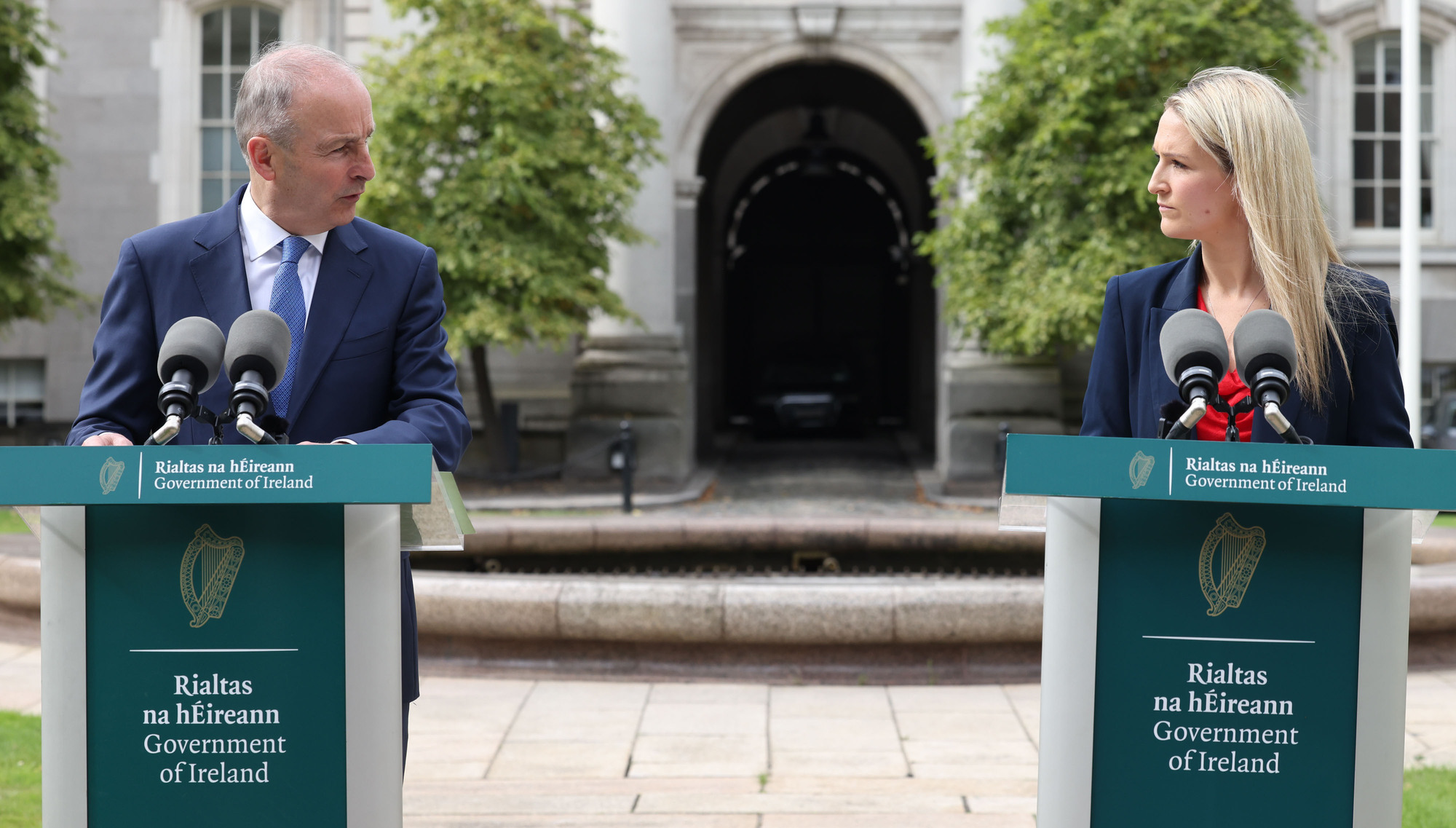
The Tánaiste Micheál Martin (left) and Minister for Justice Helen McEntee in the Courtyard of Government Buildings on Thursday announcing that the Government has approved the publication of the Defamation (Amendment) Bill 2024. Photo: Leon Farrell / © RollingNews.ie
Across society, from legal practitioners to journalists to academics, the calls for updated defamation legislation have been heard for years on end.
Now, with a general election looming, a new Defamation Bill, 15 years after the previous one was enacted, is about to be presented to the Oireachtas — though should that election be called in or around October, the chances of the Bill becoming legislation before the Government is dissolved would appear slim.
If it is not enacted, the legislation will fall with the Government. Will it be resurrected? Who can say?
The Bill hasn’t actually been published yet, but from what we do know of it, parties across the board will likely be underwhelmed by different aspects of what they see.
As pitched by the Minister for Justice Helen McEntee, the highlights of the bill include:
* the abolition of juries in order to “reduce the likelihood of disproportionate awards of damages”;
* the introduction of measures to deter the taking of SLAPP defamation proceedings (ie, unwarranted actions designed to dampen scrutiny of the powerful);
* and reform of the ‘fair and reasonable publication in the public interest’ defence dating from the 2009 Act – a defence which has never successfully been used at trial in Ireland – in order to make it ‘clearer and simpler’.
Measures to allow for damages to be awarded in SLAPP proceedings and to amend the public interest defence have not actually been included in the bill to be published, but will instead be added by amendment when the legislation is eventually debated in the Oireachtas, according to the Government.
The move to abolish juries, however, is definitely in the bill to be published — interesting in itself given the majority of advocates, including the Oireachtas Justice Committee, had recommended that juries be retained.
Neville Cox, professor of law at Trinity College Dublin describes that decision as “retrograde and deeply disturbing”.
He says:
From the point of view of Irish media, the lack of a ‘serious harm test’ in the new legislation is a point of chagrin, given it was one of the two stated priorities for the industry during the legislation’s drafting.
Such a test is one which would see each case tested to evaluate just how much damage could have been done to a reputation before a trial is convened, the idea being to eliminate frivolous suits — although using such a test, as is the case in UK law, can itself lead to heightened costs as the test is litigated at the start of any proceedings.
Perhaps most notably, the new bill has little to say on the topic of social media or artificial intelligence, areas of developing tech which have turned the media landscape upside down since the current Defamation Act was introduced in 2009.
The bill’s drafters say their hands were tied from that point of view, as the immunity of social media companies for the initial publication of defamatory content on their platforms is guaranteed under European law, while the actual regulation of those companies is now the responsibility of Coimisiun na Mean, an organisation with plenty of teeth of its own.
Prof. Cox, however, says that if the bill doesn’t seek “to deal effectively with social media defamation and how to deal with defamation generated by AI, then it is not looking to the future and seems strangely unimaginative”.
His fellow TCD law professor Eoin O’Dell disagrees, however, arguing that the department “has gone as far as it can go” as “its hands are tied by the European legislation”.
“I agree there is a gap in defamation law in terms of social media, but it is not up to the department to fill it,” he said.

CONNECT WITH US TODAY



Be the first to know the latest news and updates